Department of Geriatrics, Second Affiliated Hospital of Nanjing Medical University, Nanjing, China.
Department of Cardiology, Second Affiliated Hospital of Nanjing Medical University, Nanjing, China.
Am J Emerg Med. 2021 Dec;50:661-669. doi: 10.1016/j.ajem.2021.09.050. Epub 2021 Sep 24.
Recently, emerging evidence has suggested that atrial fibrillation (AF) has an epidemiological correlation with coronavirus disease 2019 (COVID-19). However, the clinical outcomes of AF in COVID-19 remain inconsistent and inconclusive. The aim of this study was to provide a comprehensive description of the impact of AF on the prognosis of patients with COVID-19 pneumonia.
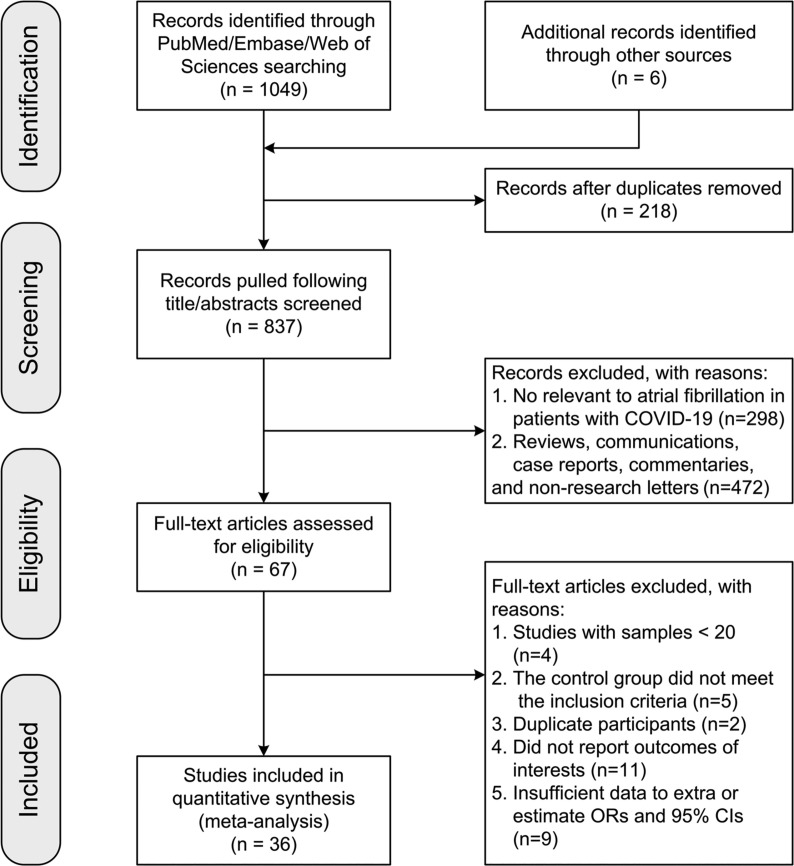
Three electronic databases (PubMed, Embase, and Web of Science) were searched for eligible studies as of March 1, 2021. Pooled odds ratios (ORs) and 95% confidence intervals (CIs) were used to evaluate the associations between AF (preexisting and new-onset) and in-hospital mortality, post-discharge mortality, and ventilator use.
A total of 36 individual studies were incorporated into our meta-analysis. The combined results revealed that preexisting AF was associated with increased in-hospital mortality (pooled OR: 2.07; 95% CI: 1.60-2.67; p < 0.001), post-discharge mortality (pooled OR: 2.69; 95% CI: 1.24-5.83; p < 0.05), and ventilator utilization (pooled OR: 4.53; 95% CI: 1.33-15.38; p < 0.05) in patients with COVID-19. In addition, our data demonstrated that new-onset AF during severe acute respiratory syndrome coronavirus 2 infection was significantly correlated with increased mortality (pooled OR: 2.38; 95% CI: 2.04-2.77; p < 0.001).
The presence of AF is correlated with adverse outcomes in patients with COVID-19 pneumonia, which deserves increased attention and should be managed appropriately to prevent adverse outcomes.
最近,有新证据表明心房颤动(AF)与 2019 年冠状病毒病(COVID-19)具有流行病学相关性。然而,COVID-19 中 AF 的临床结局仍不一致且尚无定论。本研究旨在全面描述 AF 对 COVID-19 肺炎患者预后的影响。
截至 2021 年 3 月 1 日,我们在三个电子数据库(PubMed、Embase 和 Web of Science)中检索了合格的研究。使用汇总优势比(OR)和 95%置信区间(CI)来评估 AF(预先存在和新发)与住院死亡率、出院后死亡率和呼吸机使用率之间的关联。
共有 36 项个体研究纳入了我们的荟萃分析。综合结果表明,预先存在的 AF 与住院死亡率增加相关(汇总 OR:2.07;95%CI:1.60-2.67;p<0.001)、出院后死亡率增加(汇总 OR:2.69;95%CI:1.24-5.83;p<0.05)和呼吸机使用(汇总 OR:4.53;95%CI:1.33-15.38;p<0.05)有关。此外,我们的数据表明,严重急性呼吸综合征冠状病毒 2 感染期间新发 AF 与死亡率增加显著相关(汇总 OR:2.38;95%CI:2.04-2.77;p<0.001)。
AF 的存在与 COVID-19 肺炎患者的不良结局相关,这值得引起更多关注,并应适当进行管理,以预防不良结局。