Department of Medicine, Cardiology, Angiology, Hemostasis, and Intensive Care Medicine, University Medical Center Mannheim, Faculty of Medicine Mannheim, University of Heidelberg, DE 68167 Mannheim, Germany.
Division of Experimental and Clinical Hemostasis, Hemotherapy, and Transfusion Medicine, and Hemophilia Comprehensive Care Center, Institute of Transplantation Diagnostics and Cell Therapy, Heinrich Heine University Medical Center, DE 40225 Düsseldorf, Germany.
Viruses. 2023 Jan 29;15(2):389. doi: 10.3390/v15020389.
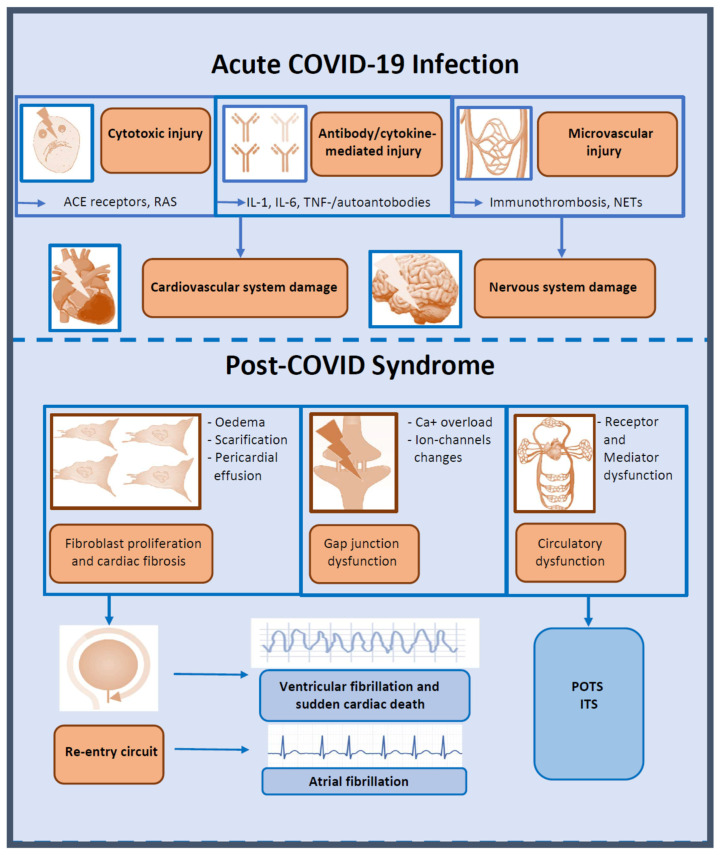
An increase in post-COVID patients with late sequelae of acute COVID-19 infection is emerging as an ongoing challenge for physicians and healthcare professionals. Since the beginning of the pandemic, it has rapidly become evident that the acute infection is not limited to the respiratory tract but that several organs, including the cardiovascular system, can be affected. Moreover, in a significant proportion of patients (ranging from about 10 to up to 50%) with former COVID-19, cardiopulmonary symptoms such as dyspnea, palpitations, restricted physical capacity, and cardiac arrhythmias can persist weeks and months after the acute SARS-CoV-2 infection. The spectrum of COVID-19-associated arrhythmias is rather wide, most likely due to various pathomechanisms. In this article, the prevalence of cardiac arrhythmias and underlying pathologies are reviewed, including direct myocardial injury and abnormal consequences with an impact on cardiac electric instability. The hyperinflammatory reaction of the host immune system is specifically considered. Moreover, several distinct rhythm disorders occurring in post-COVID patients are discussed with regard to their clinical management.
随着 COVID-19 感染后出现晚期后遗症的患者数量不断增加,这对医生和医疗保健专业人员来说是一个持续的挑战。自疫情开始以来,人们很快就发现急性感染并不仅限于呼吸道,包括心血管系统在内的多个器官都可能受到影响。此外,在相当一部分(约 10%至 50%)曾感染过 COVID-19 的患者中,呼吸急促、心悸、体力活动受限和心律失常等心肺症状在急性 SARS-CoV-2 感染后数周甚至数月仍会持续存在。COVID-19 相关心律失常的范围相当广泛,这很可能是由于各种病理机制所致。本文回顾了心律失常的发生率和潜在的病理,包括直接的心肌损伤和对心脏电不稳定性产生影响的异常后果。特别考虑了宿主免疫系统的过度炎症反应。此外,还讨论了 COVID-19 后患者中出现的几种不同的节律障碍及其临床管理。