Cao Yiyi, Xi Jing, Tang Chuanxi, Yang Ziying, Liu Weiying, You Xinyue, Feng Nannan, Zhang Xin Yu, Wu Jingui, Yu Yingxin, Luan Yang
School of Public Health, Shanghai Jiaotong University School of Medicine, Shanghai, 200025, People's Republic of China.
Center for Disease Control and Prevention of the Changning District of Shanghai, Shanghai, 200051, People's Republic of China.
Genes Environ. 2021 Dec 9;43(1):54. doi: 10.1186/s41021-021-00230-1.
The PIG-A gene mutation assay is a valuable tool for measuring in vivo gene mutations in blood cells. The human PIG-A assay, used as a potential genotoxicity biomarker, is minimally invasive, sensitive, and cost-efficient; however, the relationship between carcinogen exposure and PIG-A mutations is not well understood.
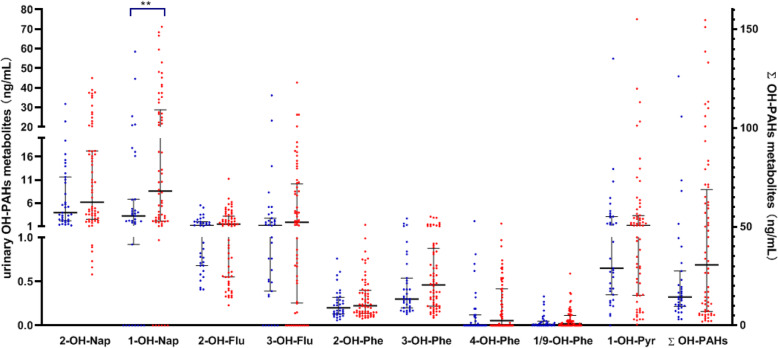
We investigated the genotoxic effect of red blood cells using PIG-A assay and lymphocyte cytokinesis-block micronucleus test in barbecue restaurant workers (N = 70) exposed to polycyclic aromatic hydrocarbons (PAHs) and self-identified healthy control subjects (N = 56). Urinary PAH metabolites were measured to evaluate internal exposure levels.
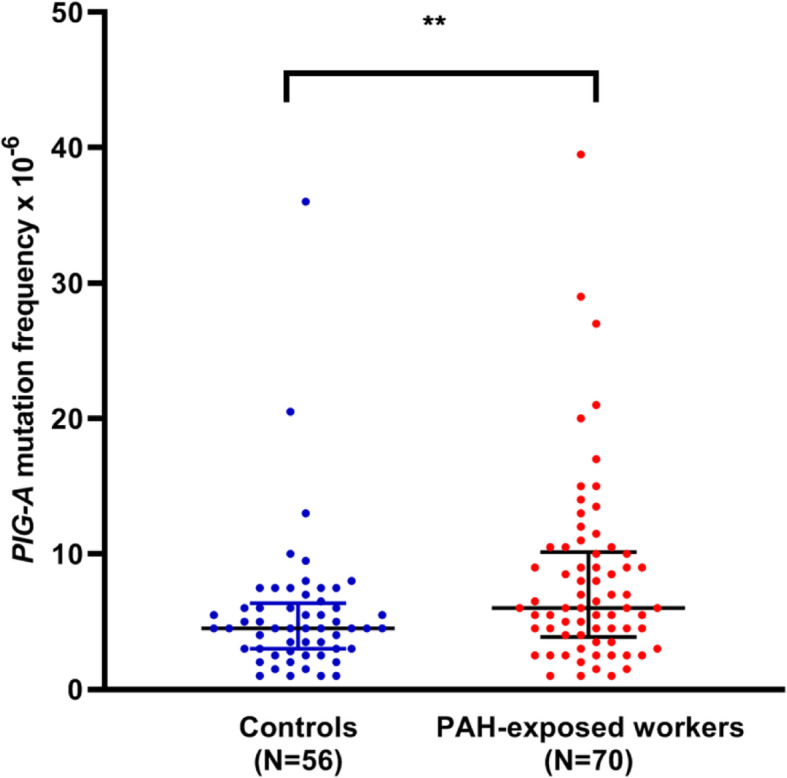
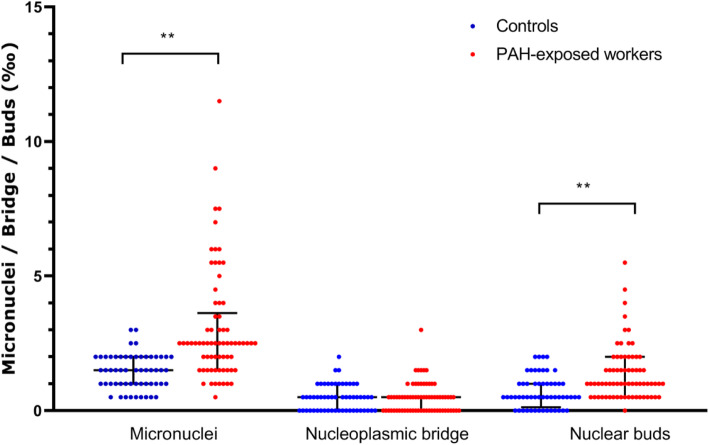
Multivariate Poisson regression showed that the PAH-exposed workers exhibited significantly higher PIG-A mutant frequency (MF) (8.04 ± 6.81 × 10) than did the controls (5.56 ± 5.26 × 10) (RR = 0.707, 95% CI: 0.615-0.812, P < 0.001). These results indicate that PAH exposure is a risk factor for elevated PIG-A MF. The frequencies of micronuclei (MN) and nuclear buds (NBUD) in the PAH-exposed workers (MN: 3.06 ± 2.07 ‰, NBUD: 1.38 ± 1.02 ‰) were also significantly higher than in the controls (MN: 1.46 ± 0.64 ‰, P < 0.001; NBUD: 0.70 ± 0.60 ‰, P < 0.001). Additionally, PIG-A MFs showed better associations with several urinary hydroxylated PAH metabolites (P = 0.032, r = 0. 268; P = 0.022, r = 0.286; P = 0.0312, r = 0.270; P = 0.018, r = 0.296), while the increase in MN, NPB, and NBUD frequencies was not associated with any OH-PAH metabolites; and high-PAH-exposed workers showed the highest PIG-A MFs. Furthermore, there was a significant association between PIG-A MF and PAH exposure levels (Chi-square test for trend, P = 0.006).
Our results indicate that an increase in PIG-A MF in barbecue workers could reflect the response to PAH exposure, providing evidence of its potential as a genotoxicity biomarker in human risk assessment.
PIG-A基因突变检测是一种用于测量血细胞体内基因突变的重要工具。作为一种潜在的遗传毒性生物标志物,人类PIG-A检测具有微创、灵敏且成本效益高的特点;然而,致癌物暴露与PIG-A突变之间的关系尚未完全明确。
我们采用PIG-A检测和淋巴细胞胞质分裂阻滞微核试验,对70名暴露于多环芳烃(PAHs)的烧烤店工人和56名自我认定为健康的对照者的红细胞遗传毒性效应进行了研究。通过测量尿中PAH代谢产物来评估体内暴露水平。
多变量泊松回归显示,PAH暴露工人的PIG-A突变频率(MF)(8.04±6.81×10)显著高于对照组(5.56±5.26×10)(RR = 0.707,95%CI:0.615 - 0.812,P < 0.001)。这些结果表明,PAH暴露是PIG-A MF升高的一个风险因素。PAH暴露工人的微核(MN)和核芽(NBUD)频率(MN:3.06±2.07‰,NBUD:1.38±1.02‰)也显著高于对照组(MN:1.46±0.64‰,P < 0.001;NBUD:0.70±0.60‰,P < 0.001)。此外,PIG-A MFs与几种尿中羟基化PAH代谢产物显示出更好的相关性(P = 0.032,r = 0.268;P = 0.022,r = 0.286;P = 0.0312,r = 0.270;P = 0.018,r = 0.296),而MN、NPB和NBUD频率的增加与任何OH-PAH代谢产物均无关联;高PAH暴露工人的PIG-A MFs最高。此外,PIG-A MF与PAH暴露水平之间存在显著关联(趋势卡方检验,P = 0.006)。
我们的结果表明,烧烤工人中PIG-A MF的增加可能反映了对PAH暴露的反应,为其作为人类风险评估中遗传毒性生物标志物的潜力提供了证据。