Motion and Exercise Science, University of Stuttgart, Allmandring 28, 70569, Stuttgart, Germany.
Computational Biophysics and Biorobotics, Institute for Modelling and Simulation of Biomechanical Systems, University of Stuttgart, Nobelstraße 15, 70569, Stuttgart, Germany.
Sci Rep. 2021 Dec 8;11(1):23638. doi: 10.1038/s41598-021-02819-6.
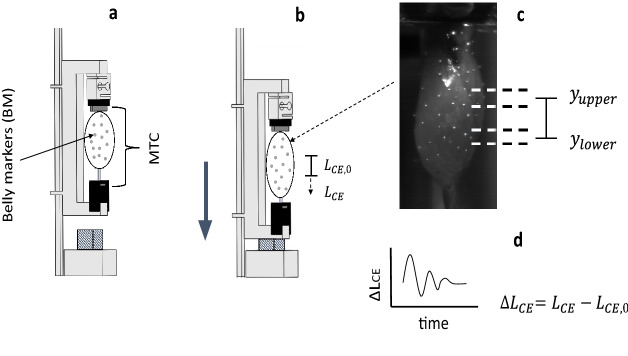
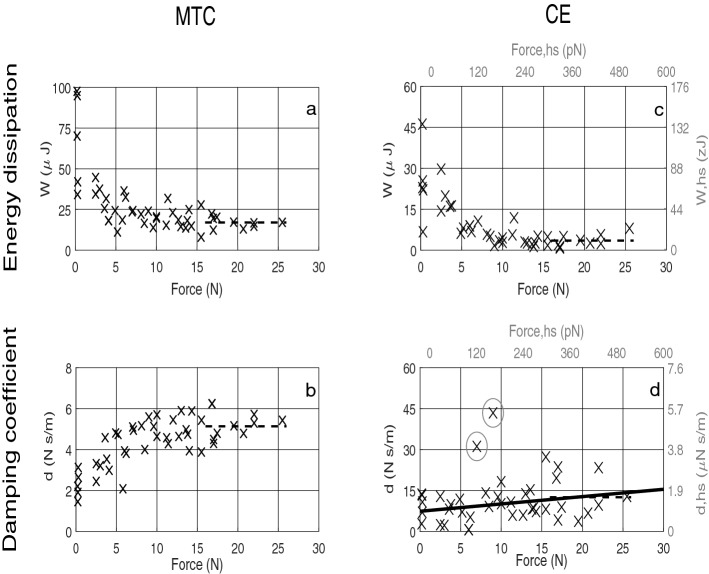
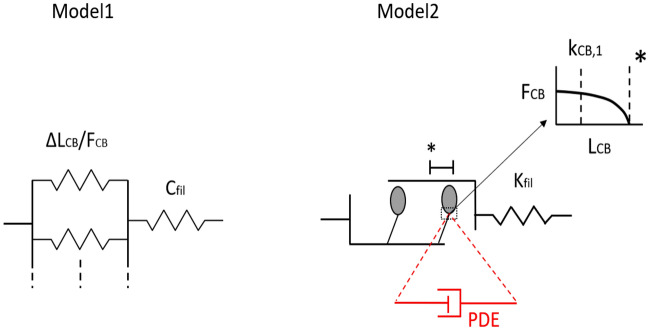
Legged locomotion has evolved as the most common form of terrestrial locomotion. When the leg makes contact with a solid surface, muscles absorb some of the shock-wave accelerations (impacts) that propagate through the body. We built a custom-made frame to which we fixated a rat (Rattus norvegicus, Wistar) muscle (m. gastrocnemius medialis and lateralis: GAS) for emulating an impact. We found that the fibre material of the muscle dissipates between 3.5 and [Formula: see text] ranging from fresh, fully active to passive muscle material, respectively. Accordingly, the corresponding dissipated energy in a half-sarcomere ranges between 10.4 and [Formula: see text], respectively. At maximum activity, a single cross-bridge would, thus, dissipate 0.6% of the mechanical work available per ATP split per impact, and up to 16% energy in common, submaximal, activities. We also found the cross-bridge stiffness as low as [Formula: see text], which can be explained by the Coulomb-actuating cross-bridge part dominating the sarcomere stiffness. Results of the study provide a deeper understanding of contractile dynamics during early ground contact in bouncy gait.
腿部运动已进化为最常见的陆地运动形式。当腿部与固体表面接触时,肌肉会吸收一些通过身体传播的冲击波加速度(冲击)。我们制造了一个定制的框架,将大鼠(Rattus norvegicus,Wistar)肌肉(m. gastrocnemius medialis 和 lateralis:GAS)固定在上面,以模拟冲击。我们发现,肌肉的纤维材料分别在 3.5 和 [Formula: see text] 之间耗散,范围从新鲜的、完全活跃的到被动的肌肉材料。因此,在半个肌节中相应耗散的能量分别在 10.4 和 [Formula: see text] 之间。在最大活动状态下,一个单交联桥每冲击一次每 ATP 分裂就会耗散可用机械功的 0.6%,在常见的亚最大活动中则会耗散高达 16%的能量。我们还发现交联桥的刚度低至 [Formula: see text],这可以用库仑驱动交联桥部分主导肌节刚度来解释。研究结果提供了对弹跳步态中早期地面接触时收缩动力学的更深入了解。