Prasannan Bipi K, Mukthar Faiz C, Unni V Narayanan, Mohan Shilpa, Vinodkumar K
Department of Nephrology, Aster Medcity, Kochi, Kerala, India.
Indian J Nephrol. 2021 Sep-Oct;31(5):449-453. doi: 10.4103/ijn.IJN_130_20. Epub 2021 Sep 21.
With the emergence of multidrug-resistant gram-negative bacterial infections, there has been a surge in the use of Colistin in recent times. The most important side effect of Colistin use is its nephrotoxicity. The study was designed to assess the effect on kidney function and the risk factors for nephrotoxicity in patients treated with Colistin.
The study is a retrospective one, which included patients who received Colistin for more than 48 hours. The estimated glomerular filtration rate (eGFR) was calculated using the Modification of Diet in Renal Disease (MDRD) four-variable equation and acute kidney injury (AKI) was diagnosed as per the Kidney Disease Improving Global Outcome (KDIGO) criteria.
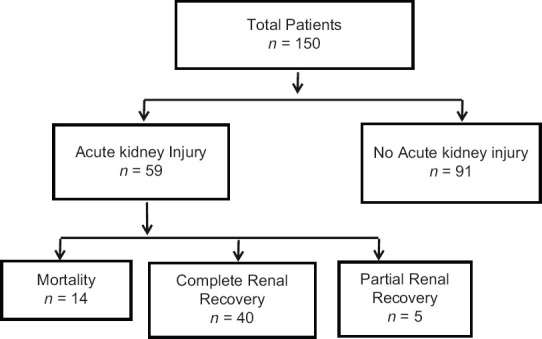
Of the 150 patients studied, 59 patients (39.2%) developed AKI within a median period of 4 days (Range 2-20 days) of initiation of Colistin. Age, eGFR at the start of therapy and requirement of vasopressor support for treatment of septic shock were the most important risk factors associated with nephrotoxicity. Among patients with AKI, nearly half had only mild worsening of renal functions to KDIGO AKI stage 1. Nearly 75% of patients with AKI had complete or partial recovery of renal functions after stopping Colistin.
Colistin has significant nephrotoxicity, the risk being higher with older age and baseline renal dysfunction. It is important to monitor renal functions early and at regular intervals after initiating therapy.
随着多重耐药革兰氏阴性菌感染的出现,近年来黏菌素的使用激增。使用黏菌素最重要的副作用是其肾毒性。本研究旨在评估黏菌素治疗患者的肾功能影响及肾毒性的危险因素。
本研究为回顾性研究,纳入接受黏菌素治疗超过48小时的患者。使用肾脏病膳食改良(MDRD)四变量方程计算估计肾小球滤过率(eGFR),并根据改善全球肾脏病预后(KDIGO)标准诊断急性肾损伤(AKI)。
在研究的150例患者中,59例(39.2%)在开始使用黏菌素的中位时间4天(范围2 - 20天)内发生AKI。年龄、治疗开始时的eGFR以及感染性休克治疗中对血管升压药支持的需求是与肾毒性相关的最重要危险因素。在AKI患者中,近一半患者肾功能仅轻度恶化至KDIGO AKI 1期。近75%的AKI患者在停用黏菌素后肾功能完全或部分恢复。
黏菌素有显著肾毒性,年龄较大和基线肾功能不全时风险更高。开始治疗后尽早并定期监测肾功能很重要。