Clinical Nutrition and Dietetics Unit, Fondazione IRCCS Policlinico San Matteo, Pavia, Italy.
Medical Oncology Unit, Fondazione IRCCS Policlinico San Matteo and Department of Internal Medicine, University of Pavia, Pavia, Italy.
Cancer Med. 2022 Jan;11(2):308-316. doi: 10.1002/cam4.4362. Epub 2021 Dec 10.
Low muscle strength has been pointed out as a key characteristic of sarcopenia, but the prognostic significance of muscle function next to reduced skeletal muscle mass (SMM) in patients with cancer has been scantily investigated.
Data on muscle strength by handgrip (HG) dynamometry and total-body SMM estimated by bioelectrical impedance analysis (BIA) of Italian and German patients with cancer observed prospectively until death or censoring were analysed (N = 1076). Patients were stratified in four risk categories based on low HG (<10th percentiles of age and gender-specific normative values) and low total-body SMM according to SMM index cutoffs (<10.75 and <6.75 kg/m in men and women, respectively).
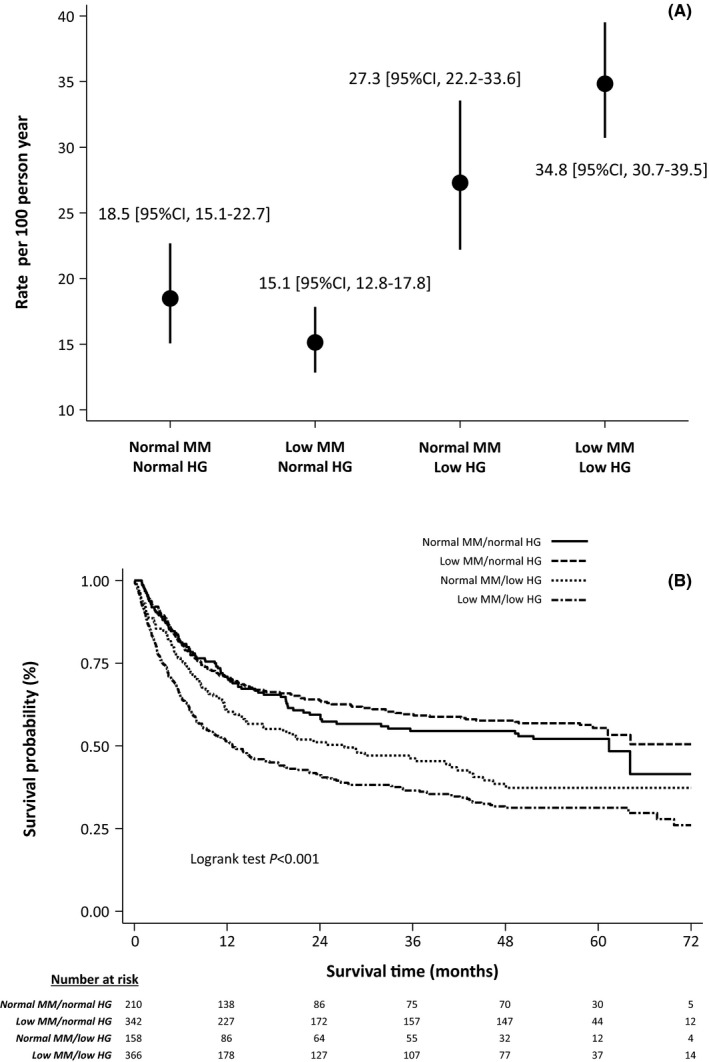
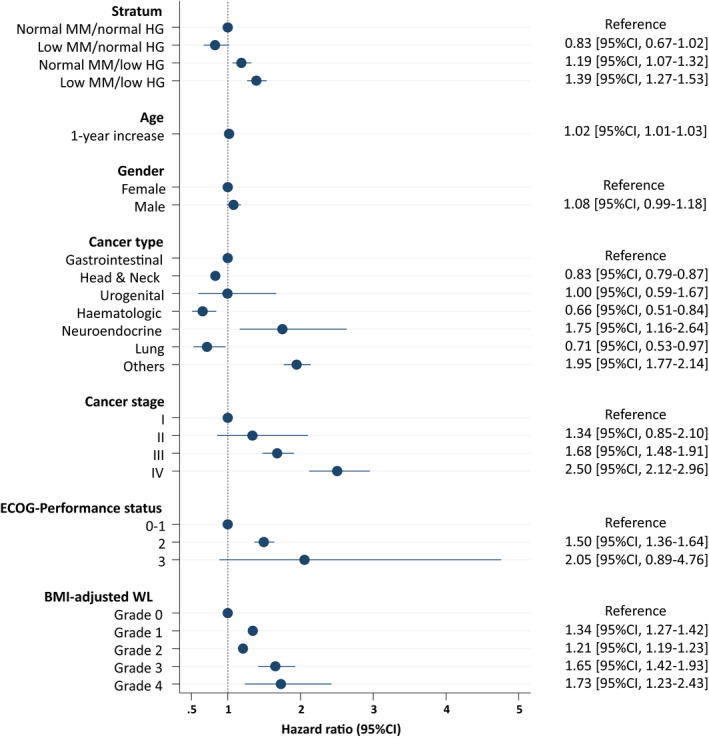
During a median follow-up of 58 months [25th-75th percentile, 37-60], 566 patients had died. Patients presenting low HG in combination or not with low SMM were characterised by shorter median survival (12.7 vs. 27.2 months, respectively; p < 0.001) compared to those with low SMM/normal HG and normal SMM/normal HG (>60 months for both). After adjusting for sex, age, body mass index and percentage of weight loss, disease's stage, performance status and type of cancer, compared to reference category (normal HG and SMM; N = 210) the hazard ratios were: low SMM/normal HG (N = 342), 0.83 [95% confidence interval, CI, 0.67-1.02] (p = 0.073); normal SMM/low HG (N = 158), 1.19 [95% CI, 1.07-1.32] (p = 0.002); low SMM/low HG (N = 366), 1.39 [95% CI, 1.27-1.53] (p < 0.001).
Muscle weakness was found to be a more powerful predictor of survival than BIA-estimated SMM and should be considered as an additional key feature of sarcopenia in patients with cancer.
低肌肉力量已被指出是肌肉减少症的一个关键特征,但在癌症患者中,除了骨骼肌质量(SMM)减少之外,肌肉功能的预后意义还鲜有研究。
分析了前瞻性观察至死亡或截尾的意大利和德国癌症患者的手部握力(HG)测力计和全身 SMM (通过生物电阻抗分析 [BIA] 估计)数据(N=1076)。根据 SMM 指数截断值(男性和女性分别为<10.75 和<6.75 kg/m),将低 HG(<年龄和性别特定正常值的第 10 百分位)和低全身 SMM 的患者分为四个风险类别。
在中位随访 58 个月(25 至 75 百分位,37 至 60)期间,566 名患者死亡。与低 SMM/HG 正常和正常 SMM/HG 正常的患者相比,同时存在低 HG 和低 SMM 或仅存在低 SMM 的患者中位生存期更短(分别为 12.7 个月和 27.2 个月;p<0.001)。在校正性别、年龄、体重指数和体重减轻百分比、疾病分期、表现状态和癌症类型后,与参考类别(正常 HG 和 SMM;N=210)相比,危险比为:低 SMM/正常 HG(N=342),0.83 [95%置信区间,CI,0.67-1.02](p=0.073);正常 SMM/低 HG(N=158),1.19 [95% CI,1.07-1.32](p=0.002);低 SMM/低 HG(N=366),1.39 [95% CI,1.27-1.53](p<0.001)。
肌肉无力被发现是生存的更有力预测因素,比 BIA 估计的 SMM 更重要,应被视为癌症患者肌肉减少症的另一个关键特征。