CNRS, Institute for Advanced Study in Toulouse, University of Toulouse 1 Capitole, France.
Philos Trans R Soc Lond B Biol Sci. 2022 Jan 31;377(1843):20200311. doi: 10.1098/rstb.2020.0311. Epub 2021 Dec 13.
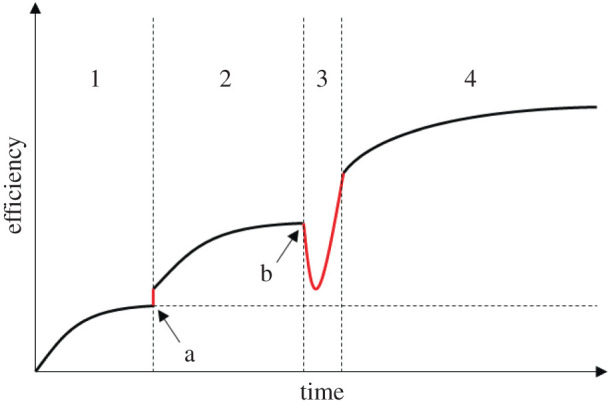
Cumulative cultural evolution (CCE)-defined as the process by which beneficial modifications are culturally transmitted and progressively accumulated over time-has long been argued to underlie the unparalleled diversity and complexity of human culture. In this paper, I argue that not just any kind of cultural accumulation will give rise to human-like culture. Rather, I suggest that human CCE depends on the gradual exploitation of natural phenomena, which are features of our environment that, through the laws of physics, chemistry or biology, generate reliable effects which can be exploited for a purpose. I argue that CCE comprises two distinct processes: optimizing cultural traits that exploit a given set of natural phenomena (Type I CCE) and expanding the set of natural phenomena we exploit (Type II CCE). I argue that the most critical features of human CCE, including its open-ended dynamic, stems from Type II CCE. Throughout the paper, I contrast the two processes and discuss their respective socio-cognitive requirements. This article is part of a discussion meeting issue 'The emergence of collective knowledge and cumulative culture in animals, humans and machines'.
累积文化进化(CCE)-定义为随着时间的推移,有益的修改通过文化传播并逐渐积累的过程-长期以来一直被认为是人类文化无与伦比的多样性和复杂性的基础。在本文中,我认为,不是任何形式的文化积累都会产生类人文化。相反,我认为人类 CCE 取决于对自然现象的逐步开发,这些自然现象是我们环境的特征,通过物理、化学或生物学定律,产生可用于特定目的的可靠效应。我认为 CCE 包括两个不同的过程:优化利用给定的自然现象的文化特征(I 型 CCE)和扩大我们所利用的自然现象的集合(II 型 CCE)。我认为,人类 CCE 的最关键特征,包括其开放性动态,源于 II 型 CCE。在整篇文章中,我对比了这两个过程,并讨论了它们各自的社会认知要求。本文是关于“动物、人类和机器中集体知识和累积文化的出现”的讨论会议的一部分。