Chevalier Yan, Matsuura Maiko, Krüger Sven, Traxler Hannes, Fleege Christoph, Rauschmann Michael, Schilling Christoph
Department of Orthopaedics and Trauma Surgery, Musculoskeletal University Center Munich (MUM), University Hospital, Ludwig Maximilian University of Munich, Munich, Germany.
Aesculap AG, Tuttlingen, Germany.
Bone Joint Res. 2021 Dec;10(12):797-806. doi: 10.1302/2046-3758.1012.BJR-2020-0533.R1.
Anchorage of pedicle screw rod instrumentation in the elderly spine with poor bone quality remains challenging. Our study aims to evaluate how the screw bone anchorage is affected by screw design, bone quality, loading conditions, and cementing techniques.
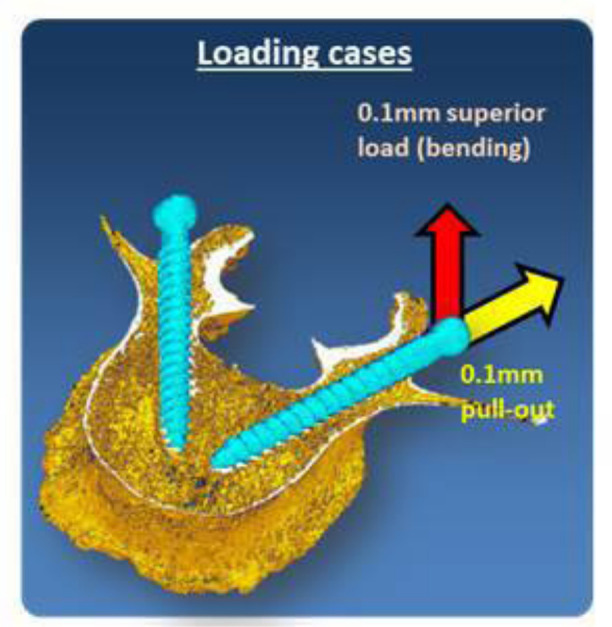
Micro-finite element (µFE) models were created from micro-CT (μCT) scans of vertebrae implanted with two types of pedicle screws (L: Ennovate and R: S). Simulations were conducted for a 10 mm radius region of interest (ROI) around each screw and for a full vertebra (FV) where different cementing scenarios were simulated around the screw tips. Stiffness was calculated in pull-out and anterior bending loads.
Experimental pull-out strengths were excellently correlated to the µFE pull-out stiffness of the ROI (R > 0.87) and FV (R > 0.84) models. No significant difference due to screw design was observed. Cement augmentation increased pull-out stiffness by up to 94% and 48% for L and R screws, respectively, but only increased bending stiffness by up to 6.9% and 1.5%, respectively. Cementing involving only one screw tip resulted in lower stiffness increases in all tested screw designs and loading cases. The stiffening effect of cement augmentation on pull-out and bending stiffness was strongly and negatively correlated to local bone density around the screw (correlation coefficient () = -0.95).
This combined experimental, µCT and µFE study showed that regional analyses may be sufficient to predict fixation strength in pull-out and that full analyses could show that cement augmentation around pedicle screws increased fixation stiffness in both pull-out and bending, especially for low-density bone. Cite this article: 2021;10(12):797-806.
在骨质较差的老年脊柱中,椎弓根螺钉内固定的锚定仍然具有挑战性。我们的研究旨在评估螺钉设计、骨质、加载条件和骨水泥注入技术如何影响螺钉与骨的锚定。
从植入两种类型椎弓根螺钉(左:Ennovate,右:S)的椎骨的微型计算机断层扫描(μCT)图像创建微观有限元(µFE)模型。围绕每个螺钉的10毫米半径感兴趣区域(ROI)以及整个椎体(FV)进行模拟,其中在螺钉尖端周围模拟不同的骨水泥注入情况。计算拔出和前屈载荷下的刚度。
实验拔出强度与ROI(R>0.87)和FV(R>0.84)模型的µFE拔出刚度高度相关。未观察到因螺钉设计导致的显著差异。骨水泥增强分别使左、右螺钉的拔出刚度提高了94%和48%,但仅使弯曲刚度分别提高了6.9%和1.5%。仅涉及一个螺钉尖端的骨水泥注入在所有测试的螺钉设计和加载情况下导致较低的刚度增加。骨水泥增强对拔出和弯曲刚度的增强作用与螺钉周围的局部骨密度呈强负相关(相关系数()=-0.95)。
这项结合实验、μCT和µFE的研究表明,区域分析可能足以预测拔出时的固定强度,而全面分析可以表明椎弓根螺钉周围的骨水泥增强在拔出和弯曲时均增加了固定刚度,特别是对于低密度骨。引用本文:2021;10(12):797-806。