RIKEN Center for Brain Science, Wako-shi, Saitama, Japan.
Department of Life Sciences, Graduate School of Arts and Sciences, The University of Tokyo, Tokyo, Japan.
Mol Brain. 2021 Dec 11;14(1):175. doi: 10.1186/s13041-021-00884-6.
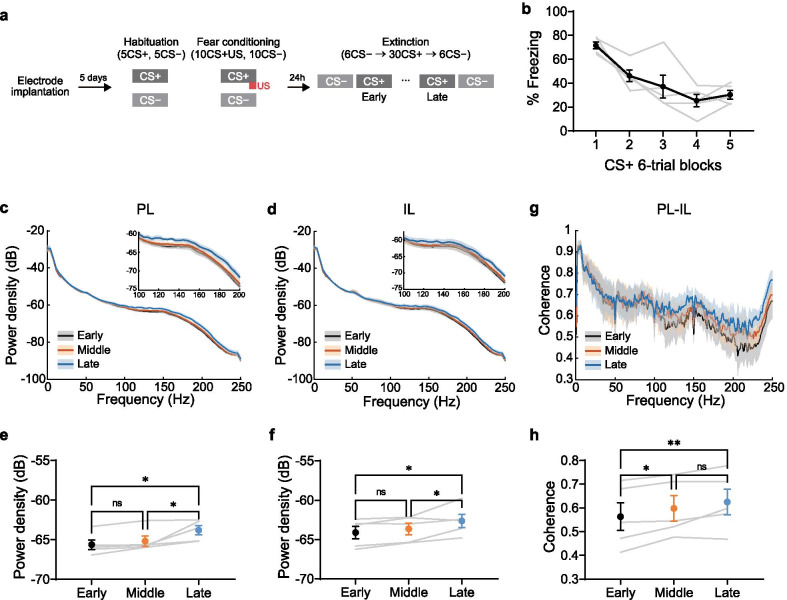
The ability to extinguish aversive memories when they are no longer associated with danger is critical for balancing survival with competing adaptive demands. Previous studies demonstrated that the infralimbic cortex (IL) is essential for extinction of learned fear, while neural activity in the prelimbic cortex (PL) facilitates fear responding and is negatively correlated with the strength of extinction memories. Though these adjacent regions in the prefrontal cortex maintain mutual synaptic connectivity, it has been unclear whether PL and IL interact functionally with each other during fear extinction learning. Here we addressed this question by recording local field potentials (LFPs) simultaneously from PL and IL of awake behaving rats during extinction of auditory fear memories. We found that LFP power in the fast gamma frequency (100-200 Hz) in both PL and IL regions increased during extinction learning. In addition, coherency analysis showed that synchronization between PL and IL in the fast gamma frequency was enhanced over the course of extinction. These findings support the hypothesis that interregional interactions between PL and IL increase as animals extinguish aversive memories.
当厌恶记忆不再与危险相关联时,消除这些记忆的能力对于平衡生存和竞争的适应需求至关重要。先前的研究表明,边缘下皮层(IL)对于习得性恐惧的消除至关重要,而前额叶皮层(PL)中的神经活动促进了恐惧反应,并与消退记忆的强度呈负相关。尽管这些前额叶皮层中的相邻区域保持着相互的突触连接,但PL 和 IL 在恐惧消退学习过程中是否具有功能上的相互作用尚不清楚。在这里,我们通过在听觉恐惧记忆消退过程中同时记录清醒行为大鼠的 PL 和 IL 的局部场电位(LFP)来解决这个问题。我们发现,PL 和 IL 区域中的快伽马频率(100-200 Hz)的 LFP 功率在消退学习过程中增加。此外,相干性分析表明,快伽马频率下 PL 和 IL 之间的同步性随着消退的进行而增强。这些发现支持了这样一种假设,即随着动物消除厌恶记忆,PL 和 IL 之间的区域间相互作用增加。