School of Mathematics and Statistical Sciences, Clemson University, Clemson, SC, USA.
Department of Epidemiology and Biostatistics, Arnold School of Public Health, University of South Carolina, Columbia, SC, USA.
Lancet Planet Health. 2021 Dec;5(12):e874-e881. doi: 10.1016/S2542-5196(21)00230-8.
Wastewater-based epidemiology provides an opportunity for near real-time, cost-effective monitoring of community-level transmission of SARS-CoV-2. Detection of SARS-CoV-2 RNA in wastewater can identify the presence of COVID-19 in the community, but methods for estimating the numbers of infected individuals on the basis of wastewater RNA concentrations are inadequate.
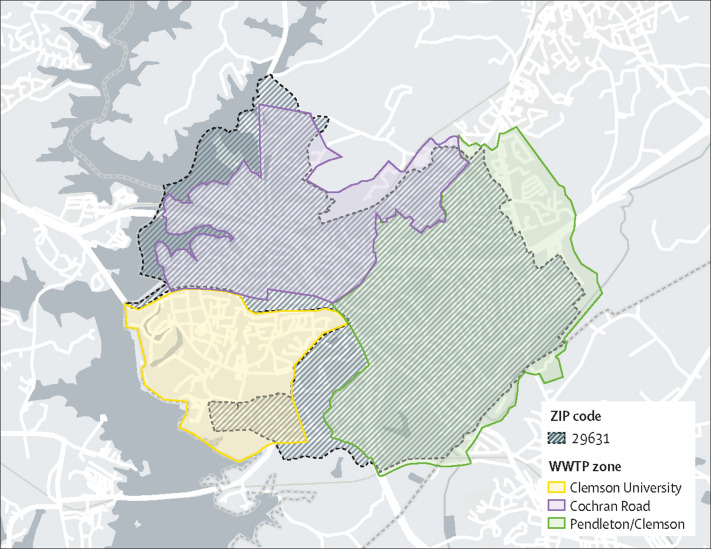
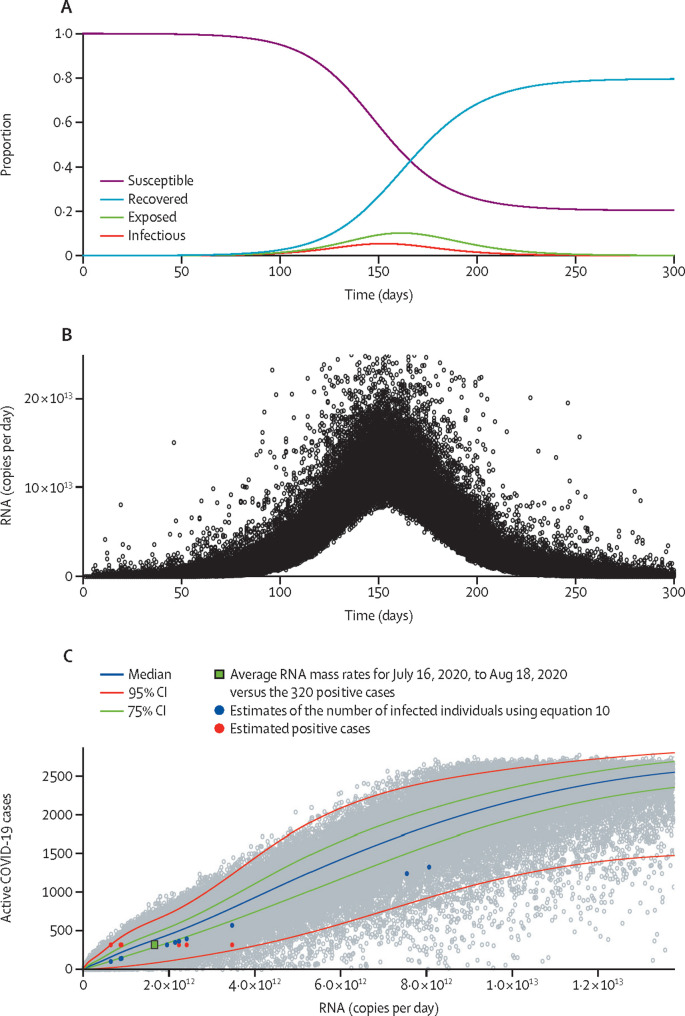
This is a wastewater-based epidemiology study using wastewater samples that were collected weekly or twice a week from three sewersheds in South Carolina, USA, between either May 27 or June 16, 2020, and Aug 25, 2020, and tested for SARS-CoV-2 RNA. We developed a susceptible-exposed-infectious-recovered (SEIR) model based on the mass rate of SARS-CoV-2 RNA in the wastewater to predict the number of infected individuals, and have also provided a simplified equation to predict this. Model predictions were compared with the number of confirmed cases identified by the Department of Health and Environmental Control, South Carolina, USA, for the same time period and geographical area.
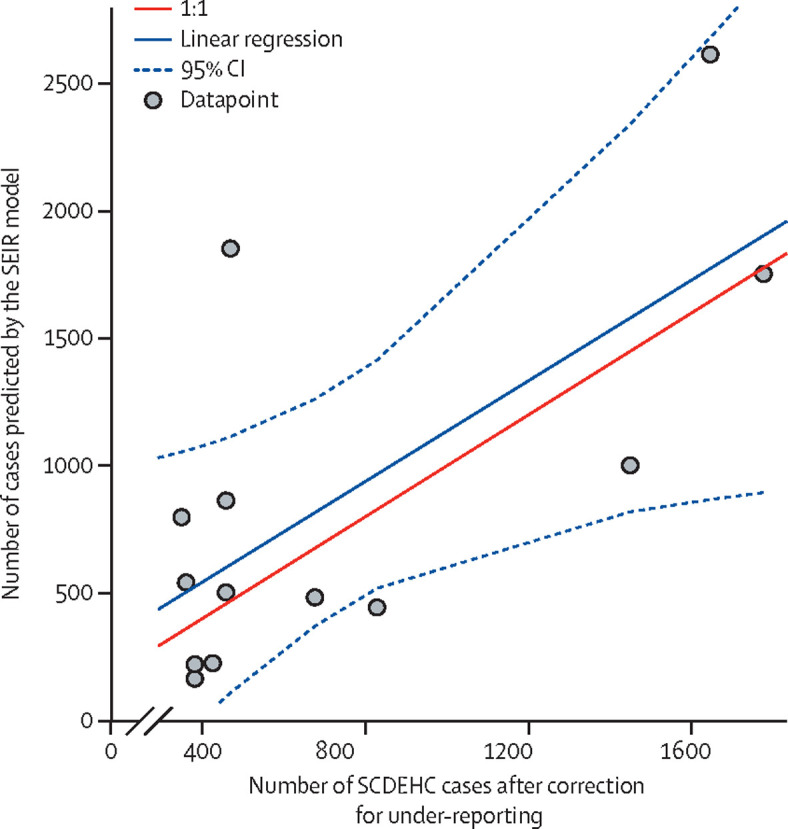
We plotted the model predictions for the relationship between mass rate of virus release and numbers of infected individuals, and we validated this prediction on the basis of estimated prevalence from individual testing. A simplified equation to estimate the number of infected individuals fell within the 95% confidence limits of the model. The rate of unreported COVID-19 cases, as estimated by the model, was approximately 11 times that of confirmed cases (ie, ratio of estimated infections for every confirmed case of 10·9, 95% CI 4·2-17·5). This rate aligned well with an independent estimate of 15 infections for every confirmed case in the US state of South Carolina.
The SEIR model provides a robust method to estimate the total number of infected individuals in a sewershed on the basis of the mass rate of RNA copies released per day. This approach overcomes some of the limitations associated with individual testing campaigns and thereby provides an additional tool that can be used to inform policy decisions.
Clemson University, USA.
基于污水的流行病学为实时、经济高效地监测 SARS-CoV-2 在社区层面的传播提供了机会。在污水中检测到 SARS-CoV-2 RNA 可以确定社区中 COVID-19 的存在,但基于污水 RNA 浓度估计感染人数的方法还不够完善。
这是一项基于污水的流行病学研究,使用每周或每两周从美国南卡罗来纳州的三个污水流域收集的污水样本,这些样本于 2020 年 5 月 27 日或 6 月 16 日至 2020 年 8 月 25 日之间采集,并检测 SARS-CoV-2 RNA。我们基于污水中 SARS-CoV-2 RNA 的质量速率开发了一个易感-暴露-感染-恢复(SEIR)模型来预测感染人数,并提供了一个简化的方程来预测这个模型。将模型预测与美国南卡罗来纳州卫生和环境控制部同期和同一地理区域确定的确诊病例数进行比较。
我们绘制了模型预测的病毒释放质量速率与感染人数之间的关系,并基于个体检测的估计患病率验证了这一预测。一个简化的方程来估计感染人数落在模型的 95%置信区间内。模型估计的未报告 COVID-19 病例率约为确诊病例的 11 倍(即,每例确诊病例的估计感染率为 10.9,95%CI 4.2-17.5)。这一比率与美国南卡罗来纳州的一项独立估计值(每例确诊病例有 15 例感染)非常吻合。
SEIR 模型提供了一种基于每天释放的 RNA 拷贝质量速率来估计污水流域内总感染人数的可靠方法。这种方法克服了与个体检测活动相关的一些限制,从而提供了一种可以用来为政策决策提供信息的额外工具。
美国克莱姆森大学。