Bourgonje Arno R, Abdulle Amaal E, Bourgonje Martin F, Binnenmars S Heleen, Gordijn Sanne J, Bulthuis Marian L C, la Bastide-van Gemert Sacha, Kieneker Lyanne M, Gansevoort Ron T, Bakker Stephan J L, Mulder Douwe J, Pasch Andreas, de Borst Martin H, van Goor Harry
Department of Gastroenterology and Hepatology, University of Groningen, University Medical Center Groningen, Groningen, the Netherlands.
Department of Internal Medicine, Division of Vascular Medicine, University of Groningen, University Medical Center Groningen, Groningen, the Netherlands.
Redox Biol. 2021 Dec 9;48:102211. doi: 10.1016/j.redox.2021.102211.
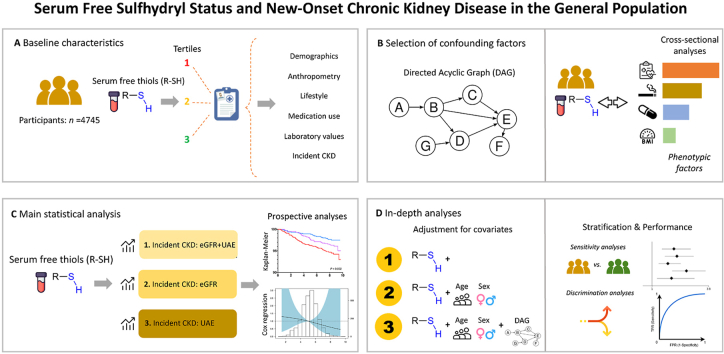
Serum sulfhydryl groups (R-SH, free thiols) reliably reflect the systemic redox status in health and disease. As oxidation of R-SH occurs rapidly by reactive oxygen species (ROS), oxidative stress is accompanied by reduced levels of free thiols. Oxidative stress has been implicated in the pathophysiology of chronic kidney disease (CKD), in which redox imbalance may precede the onset of CKD. Therefore, we aimed to investigate associations between serum free thiols and the risk of incident CKD as defined by renal function decline and albuminuria in a population-based cohort study.
Subjects without CKD (n = 4,745) who participated in the Prevention of REnal and Vascular ENd-stage Disease (PREVEND) study, a prospective, population-based cohort study in the Netherlands, were included. Baseline protein-adjusted serum free thiols were studied for their associations with the development of CKD, defined as a composite outcome of an estimated glomerular filtration rate (eGFR) < 60 mL/min/1.73m, urinary 24-h albumin excretion (UAE) > 30 mg/24-h, or both.
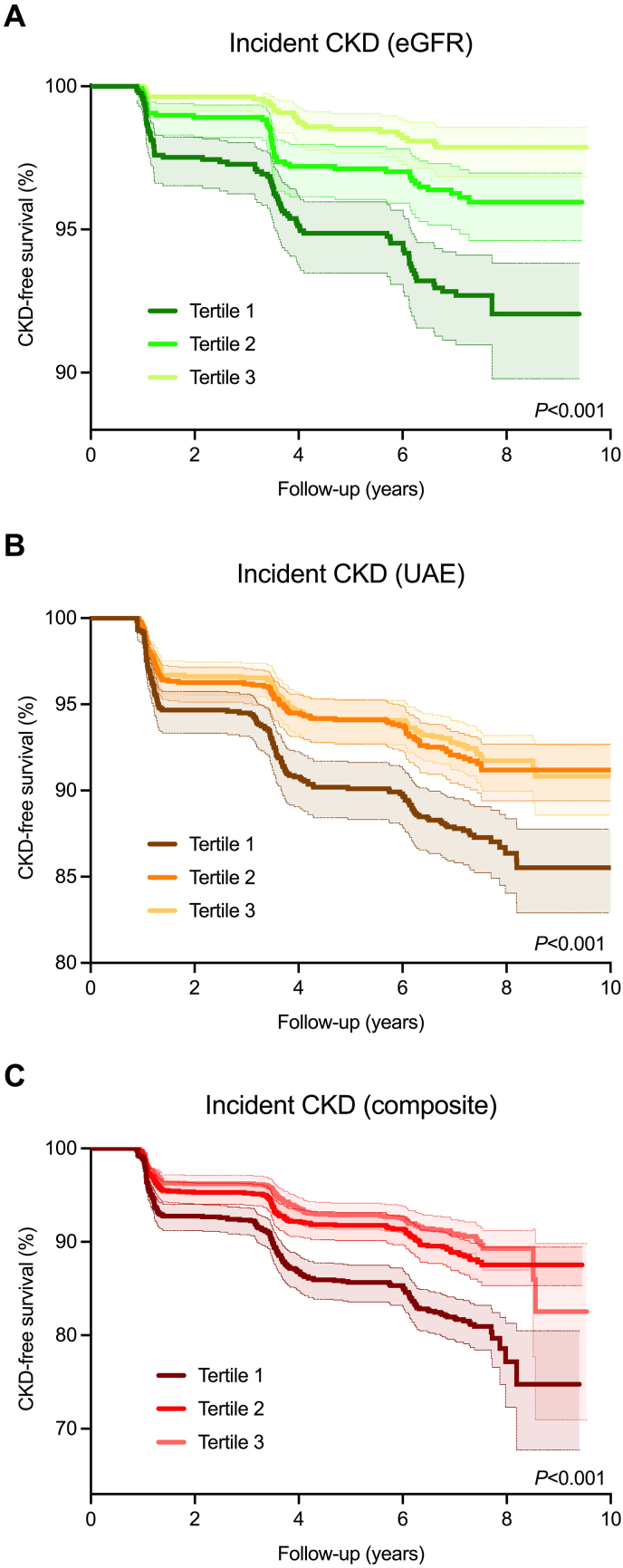
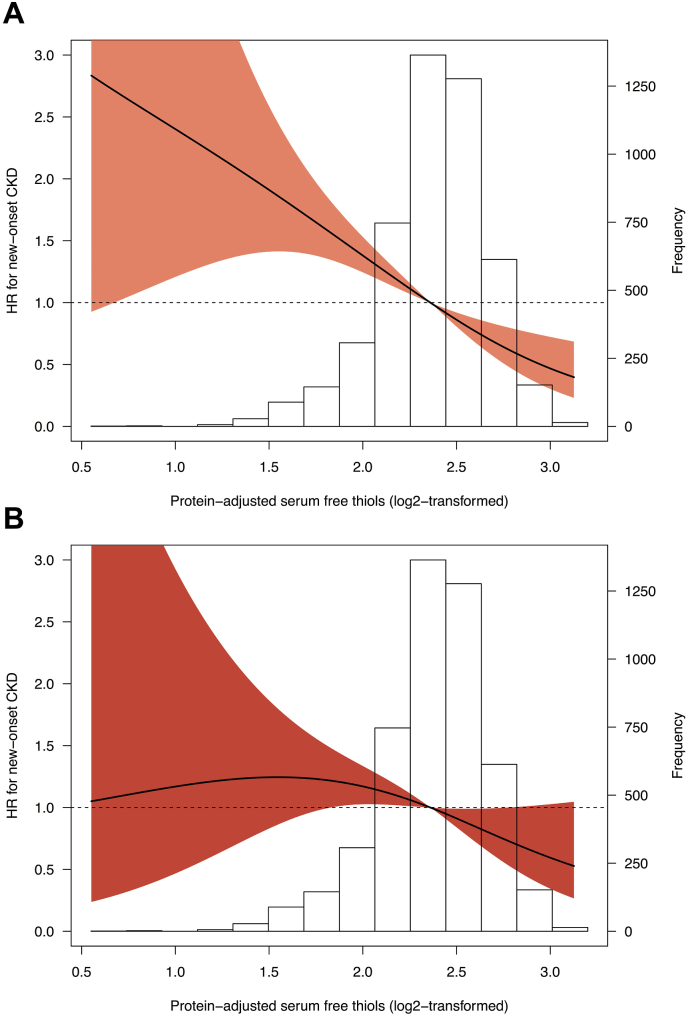
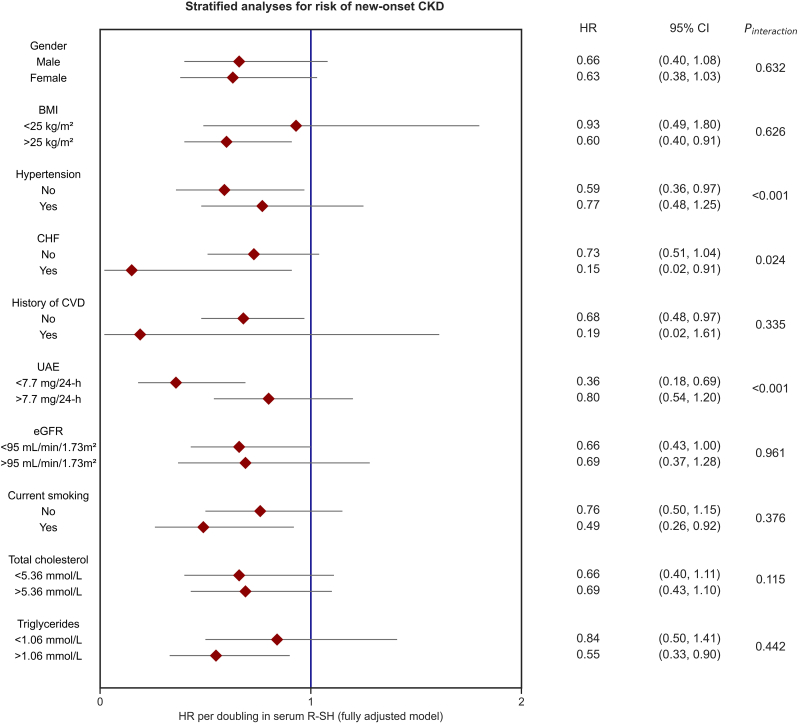
Median level of protein-adjusted serum free thiols at baseline was 5.14 μmol/g of protein (interquartile range [IQR]: 4.50-5.75 μmol/g) and median eGFR was 96 mL/min/1.73 m [IQR: 85-106]. Protein-adjusted serum free thiols were significantly associated with incident CKD (hazard ratio [HR] per doubling 0.42 [95% confidence interval [CI]: 0.36-0.52, P < 0.001), even after adjustment for traditional risk factors (HR 0.67 [95% CI: 0.47-0.94], P=0.022). In secondary analyses, the highest tertile of protein-adjusted serum free thiols was inversely associated with incident UAE >30 mg/24-h after full adjustment for confounding factors (HR per doubling 0.70 [95% CI: 0.51-0.96], P=0.028).
Higher levels of serum R-SH, reflecting less oxidative stress, are associated with a decreased risk of developing CKD in subjects from the general population. This association is primarily driven by incident CKD as defined by UAE.
血清巯基(R-SH,游离硫醇)能可靠地反映健康和疾病状态下的全身氧化还原状态。由于R-SH会被活性氧(ROS)迅速氧化,氧化应激会伴随着游离硫醇水平的降低。氧化应激与慢性肾脏病(CKD)的病理生理过程有关,其中氧化还原失衡可能在CKD发病之前就已出现。因此,在一项基于人群的队列研究中,我们旨在探讨血清游离硫醇与以肾功能下降和蛋白尿定义的新发CKD风险之间的关联。
纳入参加荷兰一项前瞻性、基于人群的队列研究——预防终末期肾病(PREVEND)研究且无CKD的受试者(n = 4745)。研究基线时经蛋白校正的血清游离硫醇与CKD发生情况的关联,CKD定义为估计肾小球滤过率(eGFR)<60 mL/min/1.73m²、24小时尿白蛋白排泄量(UAE)>30 mg/24小时或两者兼具的复合结局。
基线时经蛋白校正的血清游离硫醇中位数水平为5.14 μmol/g蛋白(四分位数间距[IQR]:4.50 - 5.75 μmol/g),eGFR中位数为96 mL/min/1.73m²[IQR:85 - 106]。经蛋白校正的血清游离硫醇与新发CKD显著相关(每增加一倍的风险比[HR]为0.42[95%置信区间[CI]:0.36 - 0.52,P < 0.001]),即使在调整传统危险因素后(HR 0.67[95%CI:0.47 - 0.94],P = 0.022)。在二次分析中,在对混杂因素进行完全调整后,经蛋白校正的血清游离硫醇最高三分位数与新发UAE>30 mg/24小时呈负相关(每增加一倍的HR为0.70[95%CI:0.51 - 0.96],P = 0.028)。
较高水平的血清R-SH反映出较低的氧化应激,与普通人群中发生CKD的风险降低相关。这种关联主要由UAE定义的新发CKD驱动。