Boekhoud Lisanne, Koeze Jacqueline, van der Slikke Elisabeth C, Bourgonje Arno R, Moser Jill, Zijlstra Jan G, Muller Kobold Anneke C, Bulthuis Marian L C, van Meurs Matijs, van Goor Harry, Bouma Hjalmar R
Department of Clinical Pharmacy and Pharmacology, University of Groningen, University Medical Center Groningen, 9713GZ Groningen, The Netherlands.
Department of Critical Care, University of Groningen, University Medical Center Groningen, 9713GZ Groningen, The Netherlands.
Antioxidants (Basel). 2020 Nov 16;9(11):1135. doi: 10.3390/antiox9111135.
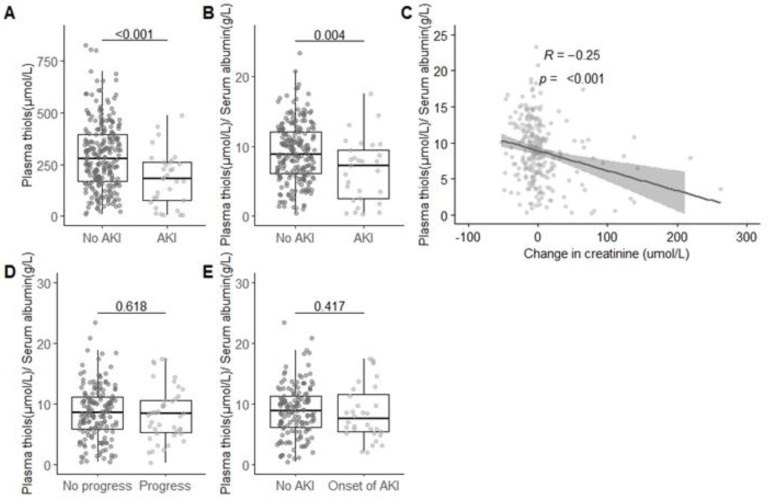
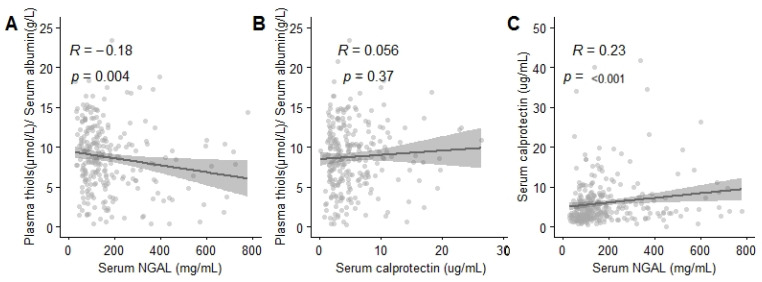
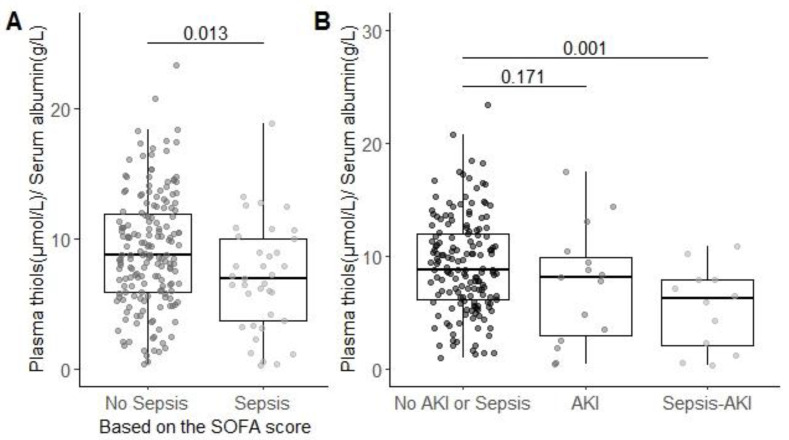
Acute kidney injury (AKI) is associated with the abrupt loss of kidney function. Oxidative stress plays an important role in the pathophysiology of AKI. Free thiols (R-SH) are crucial components of the extracellular antioxidant machinery and reliably reflect systemic oxidative stress. Lower levels of thiols represent higher levels of oxidative stress. In this preliminary study, we hypothesized that plasma-free thiols are associated with AKI upon admission to the intensive care unit (ICU). In this study, 301 critically ill patients were included. Plasma samples were taken upon admission, and albumin-adjusted plasma-free thiols were determined. Albumin-adjusted plasma-free thiols were lower in patients with AKI (n = 43, median (interquartile range) 7.28 µmol/g (3.52, 8.95)) compared to patients without AKI (8.50 μmol/g (5.82, 11.28); < 0.05) upon admission to the ICU. Higher age (B = -0.72), higher levels of neutrophil gelatinase-associated lipocalin (B = -0.002), creatinine (B = -0.01) and lower serum albumin (B = 0.47) were associated with lower free thiol levels. Further, albumin-adjusted free thiol levels were significantly reduced in patients with sepsis (8.30 (5.52-10.64) µmol/g) compared to patients without sepsis (6.95 (3.72-8.92) µmol/g; < 0.05). Together, albumin-adjusted plasma-free thiols were significantly reduced in patients with AKI and patients with sepsis compared with patients without AKI and sepsis.
急性肾损伤(AKI)与肾功能的突然丧失有关。氧化应激在AKI的病理生理学中起重要作用。游离硫醇(R-SH)是细胞外抗氧化机制的关键组成部分,能可靠地反映全身氧化应激。硫醇水平越低,氧化应激水平越高。在这项初步研究中,我们假设重症监护病房(ICU)入院时血浆游离硫醇与AKI有关。本研究纳入了301例危重症患者。入院时采集血浆样本,并测定经白蛋白校正的血浆游离硫醇。与ICU入院时无AKI的患者(8.50 μmol/g(5.82,11.28))相比,AKI患者(n = 43,中位数(四分位间距)7.28 μmol/g(3.52,8.95))经白蛋白校正的血浆游离硫醇水平更低(P<0.05)。年龄较大(B = -0.72)、中性粒细胞明胶酶相关脂质运载蛋白水平较高(B = -0.002)、肌酐水平较高(B = -0.01)以及血清白蛋白水平较低(B = 0.47)与游离硫醇水平较低有关。此外,与无脓毒症的患者(6.95(3.72 - 8.92)μmol/g)相比,脓毒症患者经白蛋白校正的游离硫醇水平显著降低(8.30(5.52 - 10.64)μmol/g;P<0.05)。总体而言,与无AKI和脓毒症的患者相比,AKI患者和脓毒症患者经白蛋白校正的血浆游离硫醇水平显著降低。