Kang In-Jeong, Kim Kyung Seok, Beattie Gwyn A, Chung Hyunjung, Heu Sunggi, Hwang Ingyu
Division of Crop Cultivation and Environment Research, National Institute of Crop Science, Suwon 16613, Korea.
Department of Agricultural Biotechnology, Seoul National University, Seoul 08826, Korea.
Plant Pathol J. 2021 Dec;37(6):652-661. doi: 10.5423/PPJ.FT.11.2021.0164. Epub 2021 Dec 1.
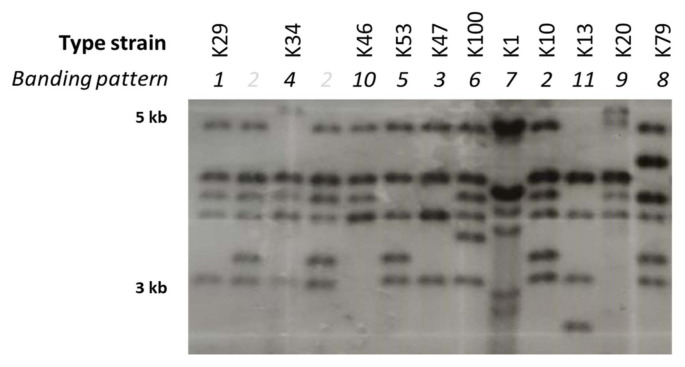
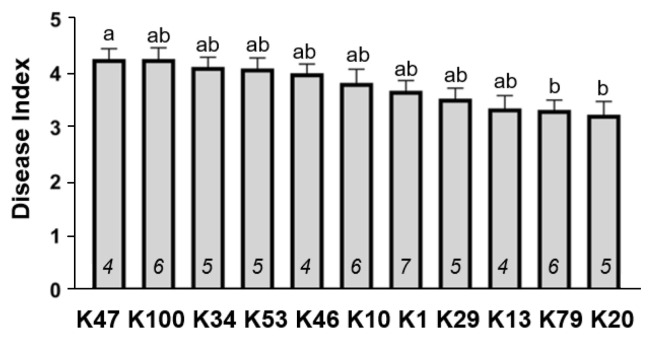
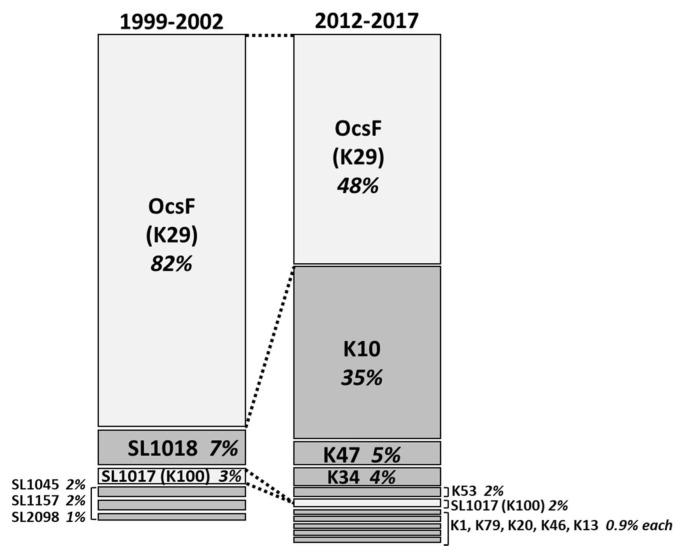
Xanthomonas citri pv. glycines (Xcg) is a major pathogen of soybean (Glycine max) in South Korea, despite the availability of soybean varieties with some resistance. We conducted a nationwide survey of the incidence and severity of bacterial pustule caused by Xcg. The percentage of infected fields was 7% to 17% between 2015 and 2017. We characterized the diversity of a nationwide collection of 106 Xcg isolates based on avrBs3 banding patterns. The isolates fell into 11 groups, each represented by a type strain; only two of these were similar to isolates collected from 1999 to 2002. The diversity of Xcg strains increased and the dominant strains changed between 1999 and 2017, with three new type strains comprising 44% of the isolates examined in 2012 to 2017. Pathogenicity tests did not show evidence for a shift in the races or aggressiveness of Xcg strains. Korean soybean cultivars, including the widely-grown Daewon cultivar, were susceptible to the 11 new type strains. The cultivar CNS, which carries the rxp resistance gene, was susceptible to most type strains, including two representing 83% of the Korean Xcg strains. In contrast, Williams 82, which also carries rxp, showed resistance to at least five type strains. Collectively, these results suggest that Williams 82 has resistance loci in addition to rxp. The widespread distribution of Xcg, the high virulence of the current endemic strains, and the low resistance of most Korean soybean cultivars collectively favor widespread disease in Korea in years that are favorable to pustule development.
柑橘黄龙病菌大豆致病变种(Xanthomonas citri pv. glycines,Xcg)是韩国大豆(Glycine max)的主要病原菌,尽管存在一些具有一定抗性的大豆品种。我们对由Xcg引起的细菌性斑点病的发病率和严重程度进行了全国范围的调查。2015年至2017年期间,受感染田地的比例为7%至17%。我们基于avrBs3条带模式对全国收集的106株Xcg分离株的多样性进行了表征。这些分离株分为11组,每组由一个模式菌株代表;其中只有两组与1999年至2002年收集的分离株相似。1999年至2017年期间,Xcg菌株的多样性增加,优势菌株发生了变化,2012年至2017年检测的分离株中有44%为三个新的模式菌株。致病性测试未显示Xcg菌株的小种或致病力发生转变的证据。包括广泛种植的大元品种在内的韩国大豆品种对11种新的模式菌株敏感。携带rxp抗性基因的CNS品种对大多数模式菌株敏感,包括代表韩国Xcg菌株83%的两个菌株。相比之下,同样携带rxp的Williams 82对至少五种模式菌株表现出抗性。总体而言,这些结果表明Williams 82除了rxp之外还有抗性位点。Xcg的广泛分布、当前流行菌株的高毒力以及大多数韩国大豆品种的低抗性共同导致在有利于斑点病发展的年份里韩国该病的广泛发生。