Cardoso-Sichieri Rafaella, Oliveira Liliane Santana, Lopes-Caitar Valéria Stefania, Silva Danielle Cristina Gregório da, Lopes Ivani de O N, Oliveira Marcelo Fernandes de, Arias Carlos Arrabal, Abdelnoor Ricardo Vilela, Marcelino-Guimarães Francismar Corrêa
Center for Biological Sciences, Londrina State University (UEL), Celso Garcia Cid Road, km 380, Londrina 86057-970, PR, Brazil.
Department of Computer Science, Federal University of Technology of Paraná (UTFPR), Alberto Carazzai Avenue, 1640, Cornélio Procópio 86300-000, PR, Brazil.
Plants (Basel). 2024 Sep 5;13(17):2484. doi: 10.3390/plants13172484.
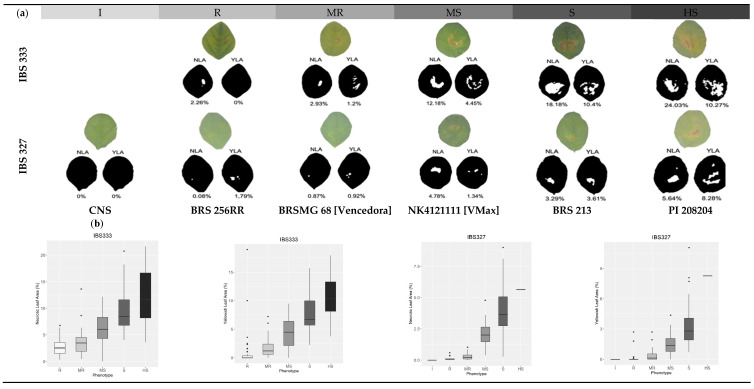
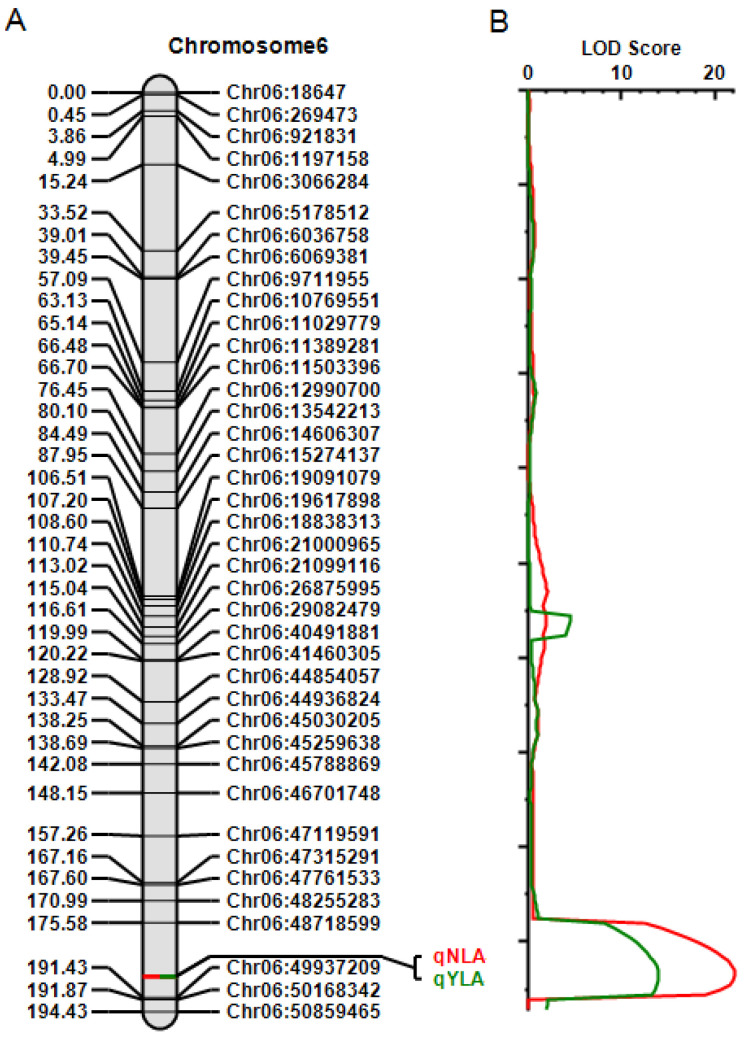
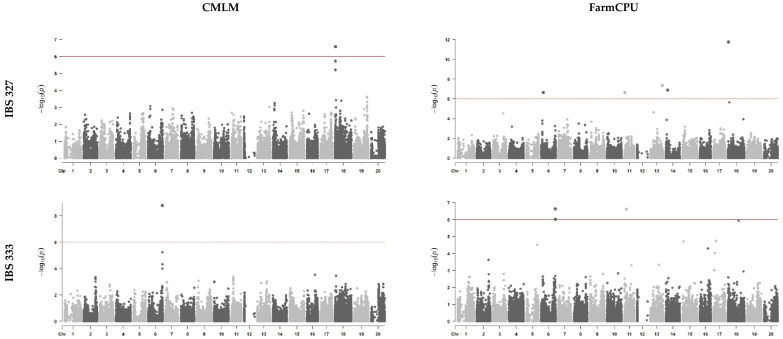
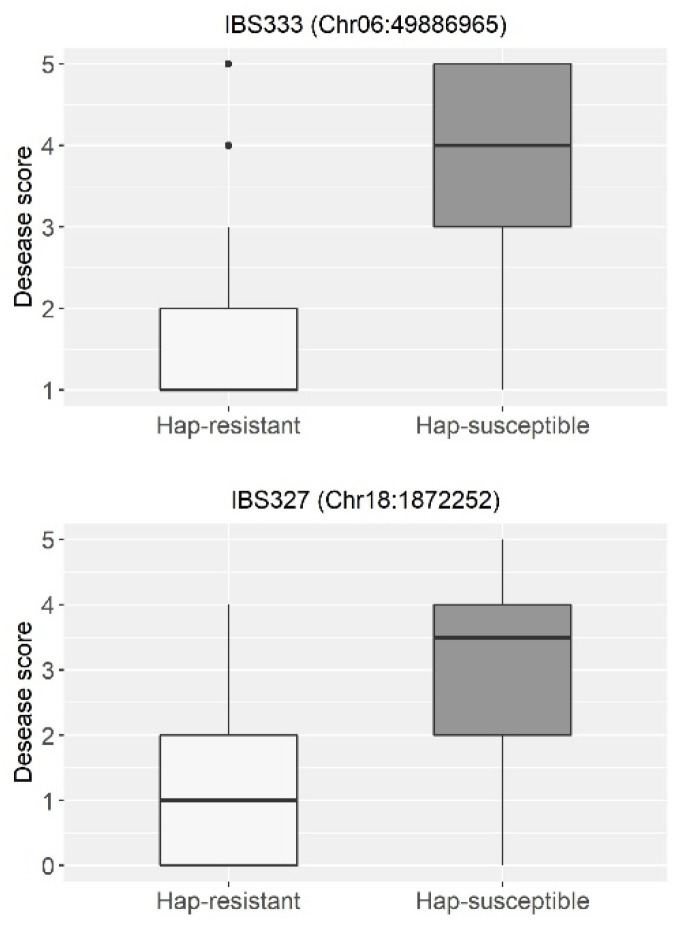
Bacterial pustule (BP), caused by pv. , is an important disease that, under favorable conditions, can drastically affect soybean production. We performed a genome-wide association study (GWAS) with a panel containing Brazilian and American cultivars, which were screened qualitatively and quantitatively against two Brazilian isolates (IBS 333 and IBS 327). The panel was genotyped using a genotyping by sequencing (GBS) approach, and we identified two main new regions in soybeans associated with resistance on chromosomes 6 (IBS 333) and 18 (IBS 327), different from the traditional gene located on chromosome 17. The region on chromosome 6 was also detected by QTL mapping using a biparental cross between Williams 82 (R) and PI 416937 (S), showing that Williams 82 has another recessive resistance gene besides , which was also detected in nine BP-resistant ancestors of the Brazilian cultivars (including CNS, S-100), based on haplotype analysis. Furthermore, we identified additional SNPs in strong LD (0.8) with peak SNPs by exploring variation available in WGS (whole genome sequencing) data among 31 soybean accessions. In these regions in strong LD, two candidate resistance genes were identified (Glyma.06g311000 and Glyma.18g025100) for chromosomes 6 and 18, respectively. Therefore, our results allowed the identification of new chromosomal regions in soybeans associated with BP disease, which could be useful for marker-assisted selection and will enable a reduction in time and cost for the development of resistant cultivars.
由 pv. 引起的细菌性脓疱病(BP)是一种重要病害,在适宜条件下会对大豆产量产生严重影响。我们对一个包含巴西和美国品种的群体进行了全基因组关联研究(GWAS),该群体针对两个巴西分离株(IBS 333 和 IBS 327)进行了定性和定量筛选。使用测序基因分型(GBS)方法对该群体进行基因分型,我们在大豆中确定了两个与抗性相关的主要新区域,分别位于6号染色体(针对IBS 333)和18号染色体(针对IBS 327),这与位于17号染色体上的传统 基因不同。通过使用Williams 82(抗病)和PI 416937(感病)之间的双亲杂交进行QTL定位,也检测到了6号染色体上的区域,表明Williams 82除了 之外还有另一个隐性抗性基因,基于单倍型分析,在巴西品种的9个抗BP祖先(包括CNS、S - 100)中也检测到了该基因。此外,通过探索31个大豆种质的全基因组测序(WGS)数据中的变异,我们在与峰值SNP处于强连锁不平衡(LD,r² = 0.8)的区域中鉴定出了其他SNP。在这些处于强LD的区域中,分别为6号和18号染色体鉴定出了两个候选抗性基因(Glyma.06g311000和Glyma.18g025100)。因此,我们的研究结果有助于确定大豆中与BP病害相关的新染色体区域,这对于标记辅助选择可能有用,并将能够减少抗性品种开发的时间和成本。