Hjorth Stephan
Department of Molecular and Clinical Medicine, Institute of Medicine, The Sahlgrenska Academy at Gothenburg University, Gothenburg, Sweden.
Pharmacilitator AB (Inc.), Vallda, Sweden.
Front Psychiatry. 2021 Nov 24;12:760181. doi: 10.3389/fpsyt.2021.760181. eCollection 2021.
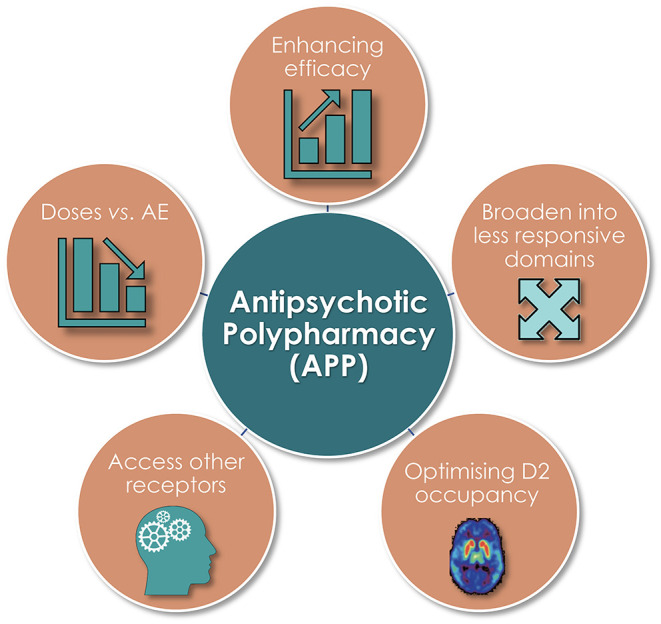
Antipsychotic polypharmacy/drug combination treatment (APP) is a remarkably common practice in the schizophrenia context, given the lack of general support in treatment Guidelines. There is also a vast literature on APP outcomes, but a paucity of high-quality evidence-based data to guide and optimize adequate use of APP. This seems particularly true regarding many pharmacology-based considerations involved in APP treatment strategies. This paper first briefly summarizes clinical literature related to the use of APP. Against this backdrop, the pharmacological target profile features are then described of frequently used antipsychotic agents, in relation to estimated free plasma exposure levels at clinically efficacious dosing. APP strategies based on the properties of these drugs are then scrutinized and gauged within the background literature framework. The anticipated usefulness of APP from the pharmacological standpoint is detailed regarding efficacy, adverse effect (AE)/tolerability, and safety perspective, including why, when, and how it may be used to its advantage. For the purpose, a number of theoretically beneficial combinations as well as instances with suboptimal-and even futile-APP approaches are exemplified and discussed from the rational pharmacodynamic and pharmacokinetic pros and cons point-of-view. In this exposé, particular attention is paid to the utility and features of 3rd Generation Antipsychotic dopamine (DA) D2-D3 agonists within an APP setting.
鉴于治疗指南缺乏普遍支持,抗精神病药物联合治疗(APP)在精神分裂症治疗中是一种非常常见的做法。关于APP治疗结果的文献也很多,但缺乏高质量的循证数据来指导和优化APP的合理使用。在APP治疗策略涉及的许多基于药理学的考虑方面,情况似乎尤其如此。本文首先简要总结了与APP使用相关的临床文献。在此背景下,接着描述常用抗精神病药物的药理学靶点特征,以及临床有效剂量下的估计游离血浆暴露水平。然后在背景文献框架内审视和评估基于这些药物特性的APP策略。从药理学角度详细阐述了APP在疗效、不良反应(AE)/耐受性和安全性方面预期的有用性,包括其为何、何时以及如何发挥优势。为此,从合理的药效学和药代动力学利弊角度,举例并讨论了一些理论上有益的联合用药以及APP方法欠佳甚至无效的情况。在本论述中,特别关注了第三代抗精神病多巴胺(DA)D2 - D3激动剂在APP治疗中的效用和特点。