Goździewska-Harłajczuk Karolina, Hamouzová Pavla, Klećkowska-Nawrot Joanna, Čížek Petr
Department of Biostructure and Animal Physiology, Faculty of Veterinary Medicine, Wrocław University of Environmental and Life Sciences, Wrocław, Poland.
Department of Physiology, Faculty of Veterinary Medicine, University of Veterinary Sciences Brno, Brno, Czech Republic.
PeerJ. 2021 Nov 25;9:e12559. doi: 10.7717/peerj.12559. eCollection 2021.
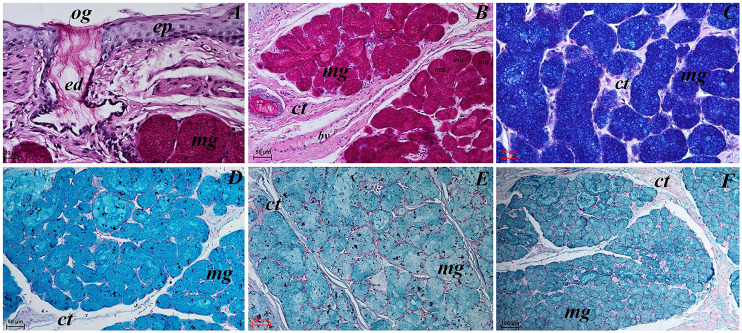
In the light of recent molecular studies, there are two phylogenetic species of the red panda (): and . The red panda belongs to the endangered species living in the wild only in Asia and is included in the CITES list. Although the biology and diet of this species has been extensively described, the histological structure of the tongue and lingual glands has not yet been characterized in detail in relation to the lifestyle of this mammal under specific conditions and as a basis for comparative anatomical studies of the biodiversity of endemic species. Study samples were collected from two adult males of . held in Wrocław Zoological Garden. Both tongues were examined macroscopically; moreover, samples with lingual papillae for light microscopy and scanning electron microscopy (SEM) were collected from the apex, body and root of the tongue. Both tongues of the . males were approximately 9 cm long. The dorsal lingual surface was covered with mechanical and gustatory lingual papillae. Filiform papillae were observed on the apex and the body of the tongue, while small conical papillae were observed on the root of the tongue. An elongated, 1-1.5 cm long cylinder-shaped lyssa was observed in the ventral part of the apex. Moreover, most numerous and largest round in shape fungiform papillae were observed on the apex and on the border of the body and root of the tongue, located directly rostrally to 12-13 round and oval in shape vallate papillae. The SEM study showed that filiform papillae on the apex had several long secondary processes, while filiform papillae on the body of the tongue were taller and their secondary papillae were shorter than the equivalent structures on the apex of the tongue. The SEM study showed numerous taste pores on the surface of the fungiform papilla, while irregular surface of the vallate papillae, however some of them had smoother surface. Mixed glands (comprised of mucous acini and serous acini) were present within the vallum (within the connective tissue core) of the vallate papilla. Beneath the papillae more serous glands were observed, while the posterior lingual glands in the caudal part of the root of the tongue were mucoserous (mucous units were prevalent). A characteristic feature of the tongue of . was the presence of lyssa, which is comparable to other representatives of Carnivora, but the number of vallate papillae was individually variable. The lack of strongly developed mechanical conical papillae probably may be related to the type of plant food that is particularly dominant in red panda. Further differences between . and . cannot be excluded. The results of these studies may be useful especially for veterinarians specializing in working with exotic animals and people dealing with wildlife conservation.
根据最近的分子研究,小熊猫有两个系统发育种( ): 和 。小熊猫属于仅在亚洲野外生存的濒危物种,被列入《濒危野生动植物种国际贸易公约》名单。尽管对该物种的生物学特性和饮食已有广泛描述,但关于这种哺乳动物在特定条件下的生活方式以及作为地方特有物种生物多样性比较解剖学研究基础的舌头和舌腺的组织学结构,尚未进行详细的特征描述。研究样本取自弗罗茨瓦夫动物园饲养的两只成年雄性 。对两条舌头进行了宏观检查;此外,从舌尖、舌体和舌根采集了带有舌乳头的样本用于光学显微镜和扫描电子显微镜(SEM)检查。这两只雄性 的舌头长度均约为9厘米。舌背表面覆盖着机械性和味觉性舌乳头。在舌尖和舌体上观察到丝状乳头,而在舌根上观察到小的锥形乳头。在舌尖腹侧观察到一个长1 - 1.5厘米的细长圆柱形润舌。此外,在舌尖以及舌体与舌根交界处观察到数量最多且最大的圆形菌状乳头,它们直接位于12 - 13个圆形和椭圆形轮廓乳头的前方。扫描电子显微镜研究表明,舌尖上的丝状乳头有几个长的二级突起,而舌体上的丝状乳头更高,其二级乳头比舌尖上的相应结构短。扫描电子显微镜研究表明,菌状乳头表面有许多味孔,轮廓乳头表面不规则,不过其中一些表面较光滑。轮廓乳头的轮缘(结缔组织核心内)有混合腺(由黏液性腺泡和浆液性腺泡组成)。在乳头下方观察到更多的浆液性腺,而舌根尾部的后舌腺是黏液浆液性的(黏液单位占主导)。 的舌头的一个特征是存在润舌,这与食肉目其他代表动物相当,但轮廓乳头的数量个体存在差异。缺乏高度发达的机械性锥形乳头可能与小熊猫特别占主导的植物性食物类型有关。 和 之间的进一步差异也不能排除。这些研究结果可能对专门从事外来动物工作的兽医以及从事野生动物保护工作的人员特别有用。