Chengyang People's Hospital, Qingdao, China.
Department of Operation room, Jinan Maternal & Children Health Care Hospital, Jinan, Shangdong, China.
Biomed Res Int. 2021 Dec 2;2021:4131917. doi: 10.1155/2021/4131917. eCollection 2021.
This study is aimed at exploring the effects of cognitive nursing combined with continuous nursing on postpartum mental state and rehabilitation.
Totally, 124 puerperas admitted to our hospital from January 2019 to January 2020 were selected and divided into a research group and a control group according to different nursing methods, with 62 cases in each group. The control group received routine care, while the research group received cognitive nursing combined with continuous nursing on this basis. The mental state, rehabilitation indicators, quality of life, incidence of complications, and nursing satisfaction were compared between the two groups after intervention.
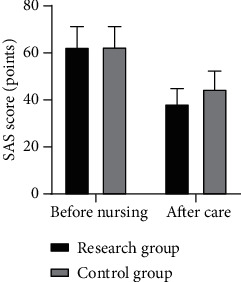
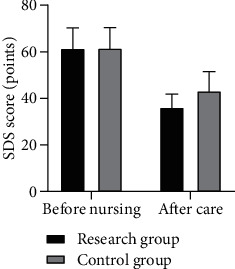
Before nursing, there was no statistically significant difference in the SAS and SDS scores between the two groups ( > 0.05); after intervention, the SAS and SDS scores of the two groups were significantly reduced, and those of the research group were lower than those of the control group ( < 0.05). After intervention, the time of the first breastfeeding, duration of lochia rubra, length of hospital stay, and score of uterine contraction pain of the research group were lower than those of the control group ( < 0.05); the psychological function, physical function, material life, and social function scores of the research group were higher than those of the control group ( < 0.05); the incidence of complications in the research group was 4.84%, lower than 20.97% in the control group ( < 0.05); the nursing satisfaction of the research group was 96.77%, which was significantly higher than 83.87% in the control group ( < 0.05).
Cognitive nursing combined with continuous nursing can effectively improve the mental state, shorten the length of hospital stay, increase the perceived well-being, and promote the physical rehabilitation in puerperas, which is worth promoting in clinical practice.
本研究旨在探讨认知护理联合延续护理对产后心理状态和康复的影响。
选取 2019 年 1 月至 2020 年 1 月我院收治的 124 例产妇,按护理方法不同分为研究组和对照组,各 62 例。对照组给予常规护理,研究组在此基础上给予认知护理联合延续护理。干预后比较两组产妇的心理状态、康复指标、生活质量、并发症发生率及护理满意度。
护理前,两组产妇 SAS、SDS 评分比较,差异无统计学意义(>0.05);护理后,两组产妇 SAS、SDS 评分均明显降低,且研究组低于对照组(<0.05)。护理后,研究组产妇首次哺乳时间、恶露持续时间、住院时间及宫缩疼痛评分均低于对照组(<0.05);研究组产妇心理功能、生理功能、物质生活及社会功能评分均高于对照组(<0.05);研究组产妇并发症发生率为 4.84%,低于对照组的 20.97%(<0.05);研究组产妇护理满意度为 96.77%,明显高于对照组的 83.87%(<0.05)。
认知护理联合延续护理可有效改善产妇心理状态,缩短住院时间,提高生活幸福感,促进产后身体康复,在临床实践中值得推广。