Department of Pulmonary and Critical Care Medicine, Taizhou First People's Hospital, Taizhou 318020, China.
Comput Math Methods Med. 2022 Apr 20;2022:4164771. doi: 10.1155/2022/4164771. eCollection 2022.
Considering the poor effect of routine nursing program on patients with lung cancer after chemotherapy, a retrospective cohort study was conducted to elucidate the effects of respiratory training based on ADOPT mode combined with continuous nursing on quality of life, mental health, and self-efficacy in patients undergoing lung cancer chemotherapy.
Sixty patients with lung cancer admitted in our hospital from January 2019 to April 2021 were selected. Patients in both groups received ADOPT breathing training. Patients who underwent routine nursing were assigned into control group ( = 30) and patients with continuous nursing were set as study group ( = 30). The differences in nursing satisfaction, self-management efficacy, quality of life score, mental health, family care index, and self-transcendence scale scores of patients with lung cancer were determined.
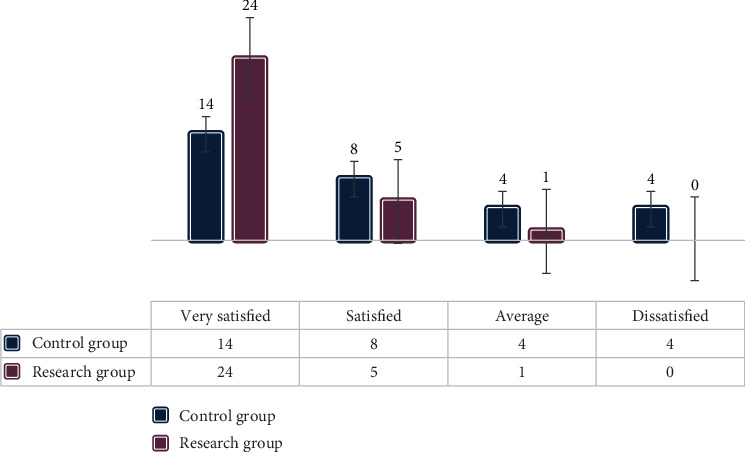
First of all, we compared the baseline data of the two groups, and there was no statistical difference. In the comparison of nursing satisfaction between the two groups, 24 cases in the study group were very satisfied, 5 cases were satisfied, 1 case was general, and the satisfaction rate was 100%, whereas in the control, 14 cases were very satisfied, 8 cases were satisfied, 4 cases were not satisfied, and the satisfaction rate was 86.67%. Compared to the control, the nursing satisfaction was higher in the study group ( < 0.05). There exhibited no significant difference in the sense of self-management efficacy between the two on the day of admission ( > 0.05). After nursing, the scores of self-management efficacy were higher in the study group, compared to the control ( < 0.05). In contrast to control, the scores of self-management efficacy at discharge and 1, 3, and 6 months after discharge were higher in the study group ( < 0.05). In terms of the scores of quality of life of patients with lung cancer, on the day of admission, no significant difference exited ( > 0.05). The scores of quality of life at discharge and 1, 3, and 6 months after discharge of the study group were higher compared to the control ( < 0.05). In the comparison of mental health, there was no significant difference between the two groups on the day of admission ( > 0.05), but the scores of anxiety and depression in the two groups decreased after nursing, and the scores of anxiety and depression in the study group at discharge and 1 month, 3 months, and 6 months after discharge were lower than those in the control group ( < 0.05). In terms of the family care index, there was no significant difference between the two groups at admission ( > 0.05), but after nursing, the family care index of the two groups increased, and the family care index at discharge and 1, 3, and 6 months after discharge was greater in the study group ( < 0.05). In terms of the score of self-transcendence scale, there exhibited no significant difference on the day of admission ( > 0.05), but the score of self-transcendence scale of the two groups increased after nursing. Furthermore, compared to the control, the score of self-transcendence scale at discharge and 1 month, 3 months, and 6 months after discharge in the study group was higher ( < 0.05).
Patients undergoing lung cancer chemotherapy using ADOPT-based breathing training combined with continuous nursing can effectively facilitate the overall quality of life of lung cancer chemotherapy patients, promote the mental health and self-efficacy of patients with lung cancer chemotherapy, and then reduce the medical burden of patients. The nursing model based on ADOPT breathing training combined with continuous nursing is worthy to be applied in the rehabilitation of patients with lung cancer.
鉴于常规护理方案对肺癌化疗患者效果不佳,本回顾性队列研究旨在阐明基于 ADOPT 模式的呼吸训练联合连续护理对肺癌化疗患者生活质量、心理健康和自我效能的影响。
选取 2019 年 1 月至 2021 年 4 月我院收治的 60 例肺癌患者。两组患者均接受 ADOPT 呼吸训练。接受常规护理的患者分为对照组(n=30),接受连续护理的患者设为研究组(n=30)。比较两组患者的护理满意度、自我管理效能、生活质量评分、心理健康、家庭护理指数和自我超越量表评分。
首先,我们比较了两组的基线数据,差异无统计学意义。在两组护理满意度比较中,研究组非常满意 24 例,满意 5 例,一般 1 例,满意度为 100%,对照组非常满意 14 例,满意 8 例,不满意 4 例,满意度为 86.67%。与对照组相比,研究组的护理满意度更高(<0.05)。入院当天两组自我管理效能感差异无统计学意义(>0.05)。护理后,研究组自我管理效能感评分高于对照组(<0.05)。与对照组相比,研究组出院时及出院后 1、3、6 个月的自我管理效能感评分更高(<0.05)。在肺癌患者生活质量评分方面,入院时两组差异无统计学意义(>0.05)。研究组出院时及出院后 1、3、6 个月的生活质量评分均高于对照组(<0.05)。在心理健康比较中,入院时两组差异无统计学意义(>0.05),但两组护理后焦虑、抑郁评分均下降,研究组出院时及出院后 1 个月、3 个月、6 个月的焦虑、抑郁评分均低于对照组(<0.05)。家庭护理指数方面,入院时两组差异无统计学意义(>0.05),但护理后两组家庭护理指数均增加,研究组出院时及出院后 1、3、6 个月的家庭护理指数均高于对照组(<0.05)。在自我超越量表评分方面,入院时两组差异无统计学意义(>0.05),但两组护理后自我超越量表评分均升高,且研究组出院时及出院后 1、3、6 个月的评分均高于对照组(<0.05)。
肺癌化疗患者采用基于 ADOPT 的呼吸训练联合连续护理,可有效提高肺癌化疗患者的整体生活质量,促进肺癌化疗患者的心理健康和自我效能,从而减轻患者的医疗负担。基于 ADOPT 呼吸训练联合连续护理的护理模式值得在肺癌患者康复中应用。
