Nureye Dejen, Kedir Muktar Sano, Muluye Rekik Ashebir, Hammeso Workineh Woldeselassie, Tekalign Eyob
Department of Pharmacology and Toxicology, School of Pharmacy, College of Medicine and Health Sciences, P. O. Box 260, Mizan-Aman, Ethiopia.
Department of Pharmacy, College of Health Sciences, Arsi University, P. O. Box 193, Asella, Ethiopia.
Heliyon. 2021 Nov 24;7(11):e08457. doi: 10.1016/j.heliyon.2021.e08457. eCollection 2021 Nov.
The incidence of resistance among currently available antimalarial drugs, as well as the high economic cost of malaria, has prompted researchers to look for novel antimalarial molecules. As a result, the current study was proposed to evaluate the antiplasmodial activity () of based on the plant's traditional claims.
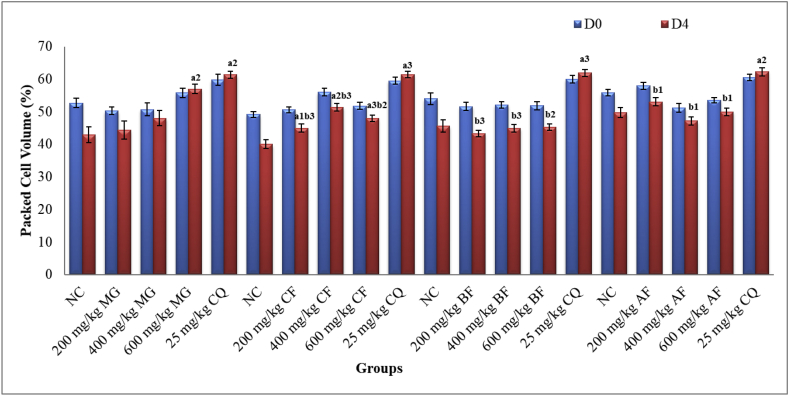
A cold maceration procedure using 80% methanol as a solvent was employed to obtain a crude extract from leaves. Chloroform, n-butanol, and pure water were used to fractionate the hydromethanolic extract. Standard procedures were followed for an acute oral toxicity test. The antimalarial effects of the plant at 200, 400, and 600 mg/kg doses were investigated using three rodent malaria models (4-day suppressive, rane's, and repository tests). Thirty mice were utilized in each experiment (3 treatment and 2 control groups, each with six mice). Parasitemia, survival time, body weight, temperature, and packed cell volume were all used to assess the extracts' antiplasmodial activity. To compare results between groups, a one-way ANOVA with Post Hoc Tukey's HSD was used.
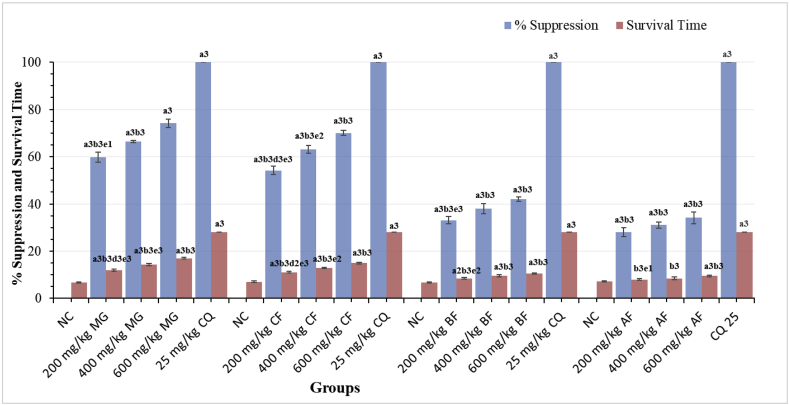
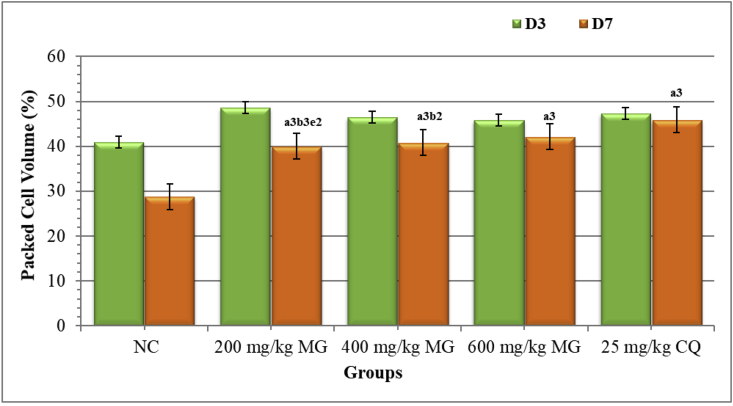
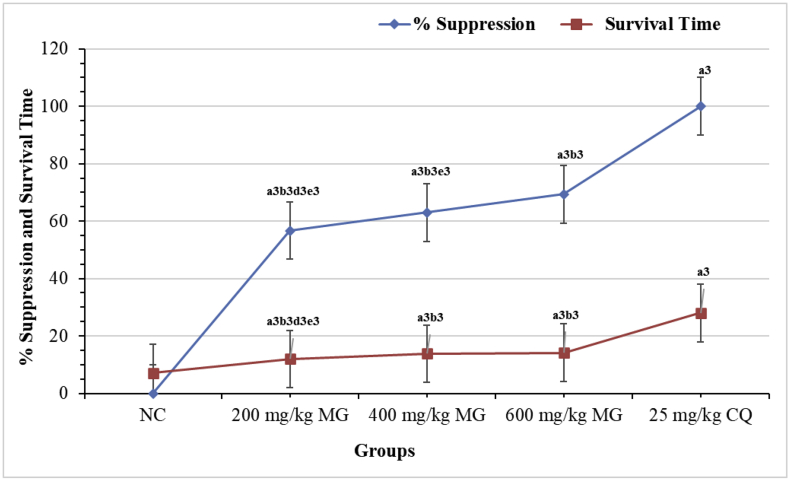
In a 4-day suppressive investigation, all doses of the crude extract and fractions suppressed parasitemia significantly (P < 0.001) as compared to the negative control. The crude extract had the greatest chemosuppressive effect (74.15%) at 600 mg/kg dose. Chloroform had the greatest parasitemia suppression among the fractions; however it was less than the crude extract. In Rane's test, all doses of the crude extract produced substantial (P < 0.001) curative effects as compared to the negative control.
According to this study, the crude extract and solvent fractions of leaves contain antimalarial activity with a substantial suppressive effect. The antiplasmodial effects were more active in the chloroform and n-butanol fractions, indicating that the plant's non-polar and medium polar constituents are responsible. Nonetheless, further analysis is required to isolate and characterize the active compounds responsible for the study plant's antimalarial activity.
当前可用抗疟药物的耐药性发生率以及疟疾的高经济成本促使研究人员寻找新型抗疟分子。因此,本研究旨在根据该植物的传统药用价值评估[植物名称]的抗疟活性。
采用以80%甲醇为溶剂的冷浸法从[植物名称]叶片中获得粗提物。用氯仿、正丁醇和纯水对水甲醇提取物进行分离。急性经口毒性试验遵循标准程序。使用三种啮齿动物疟疾模型(4天抑制试验、兰氏试验和储存试验)研究该植物在200、400和600mg/kg剂量下的抗疟效果。每个实验使用30只小鼠(3个治疗组和2个对照组,每组6只)。通过疟原虫血症、存活时间、体重、体温和红细胞压积来评估提取物的抗疟活性。为比较组间结果,采用单因素方差分析和事后Tukey's HSD检验。
在4天抑制试验中,与阴性对照相比,所有剂量的粗提物和分离物均显著抑制疟原虫血症(P < 0.001)。粗提物在600mg/kg剂量时具有最大的化学抑制作用(74.15%)。在分离物中,氯仿对疟原虫血症的抑制作用最大;然而,其作用小于粗提物。在兰氏试验中,与阴性对照相比,所有剂量的粗提物均产生显著(P < 0.001)的治愈效果。
根据本研究,[植物名称]叶片的粗提物和溶剂分离物具有抗疟活性,且抑制作用显著。氯仿和正丁醇分离物的抗疟作用更明显,表明该植物的非极性和中等极性成分起作用。尽管如此,仍需要进一步分析以分离和鉴定负责该研究植物抗疟活性的活性化合物。