Amare Gedefaw Getnet, Degu Amsalu, Njogu Peter, Kifle Zemene Demelash
Department of Pharmacy, College of Medicine and Health Sciences, Wollo University, Dessie, Ethiopia.
Department of Pharmaceutics and Pharmacy Practice, School of Pharmacy and Health Sciences, United States International University-Africa, Nairobi, Kenya.
Evid Based Complement Alternat Med. 2021 Jun 16;2021:6664711. doi: 10.1155/2021/6664711. eCollection 2021.
The lack of available vaccines and the emerging resistance to antimalarial drugs have provided the necessity to find noble antimalarial plant-based medicines. The leaf latex has been used in folk medicine against malarial and other human ailments in Ethiopia. Hence, the present study aimed to investigate the antimalarial activity of the leaf latex of against parasites.
The prophylactic and curative models were employed to determine the in vivo antimalarial activity of the leaf latex against infected mice, and the antioxidant activity of the latex was assessed using diphenyl-1-picrylhydrazine (DPPH) assay. Female mice were recruited for toxicity study, and the leaf latex was administered to fasted mice at a dose of 5000 mg/kg. The mice were kept under continuous observation for fourteen days for any signs of overt toxicity.
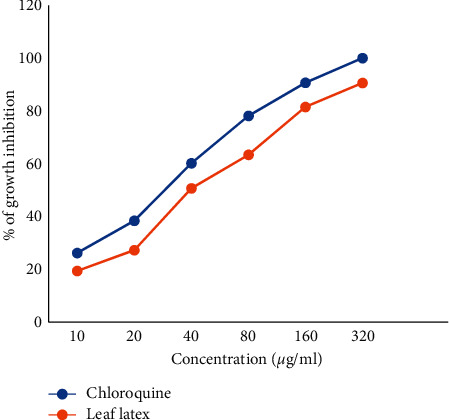
The leaf latex of was safe up to 5000 mg/kg, and the latex endowed free radical inhibition activity (IC = 10.25 g/ml). The latex of leaf demonstrated the inhibitory activity against the 3D7 strain of (IC = 9.14 g/ml). The prophylactic and curative effect of the latex was found to be dose-dependent. The mice's parasitemia level was significantly ( < 0.001) reduced at all tested doses of the leaf latex compared to negative control in the curative test. Parasitemia reduction was significant (200 mg/kg, < 0.01, and 400 and 600 mg/kg, < 0.001) in the prophylactic test compared to the control. In addition, the leaf latex significantly ( < 0.01) improved mean survival time, packed cell volume, rectal temperature, and bodyweight of infected mice.
The leaf latex of was endowed with the antimalarial activity at various doses, corroborating the plant's claimed traditional use.
可用疫苗的缺乏以及对抗疟药物不断出现的耐药性使得有必要寻找新型的基于植物的抗疟药物。在埃塞俄比亚,叶乳胶已被用于民间医学治疗疟疾和其他人类疾病。因此,本研究旨在调查叶乳胶对疟原虫的抗疟活性。
采用预防和治疗模型来确定叶乳胶对感染小鼠的体内抗疟活性,并使用二苯基-1-苦基肼(DPPH)法评估乳胶的抗氧化活性。招募雌性小鼠进行毒性研究,以5000mg/kg的剂量将叶乳胶给予禁食的小鼠。持续观察小鼠十四天,以寻找任何明显毒性的迹象。
叶乳胶在高达5000mg/kg的剂量下是安全的,并且该乳胶具有自由基抑制活性(IC = 10.25μg/ml)。叶乳胶对恶性疟原虫3D7株表现出抑制活性(IC = 9.14μg/ml)。发现乳胶的预防和治疗效果呈剂量依赖性。在治疗试验中,与阴性对照相比,在所有测试剂量的叶乳胶下,小鼠的寄生虫血症水平均显著降低(P < 0.001)。在预防试验中,与对照组相比,寄生虫血症的降低在200mg/kg时显著(P < 0.01),在400和600mg/kg时显著(P < 0.001)。此外,叶乳胶显著(P < 0.01)提高了感染疟疾小鼠的平均存活时间、红细胞压积、直肠温度和体重。
叶乳胶在不同剂量下均具有抗疟活性,证实了该植物所宣称的传统用途。