Wu Jianrong, Cai Xiaojun, Williams Gareth R, Meng Zheying, Zou Weijuan, Yao Li, Hu Bing, Chen Yu, Zheng Yuanyi
Department of Ultrasound in Medicine, Shanghai Jiao Tong University Affiliated Sixth People's Hospital, Shanghai, 200233, PR China.
UCL School of Pharmacy, University College London, London, WC1N 1AX, UK.
Bioact Mater. 2021 Aug 19;10:295-305. doi: 10.1016/j.bioactmat.2021.08.018. eCollection 2022 Apr.
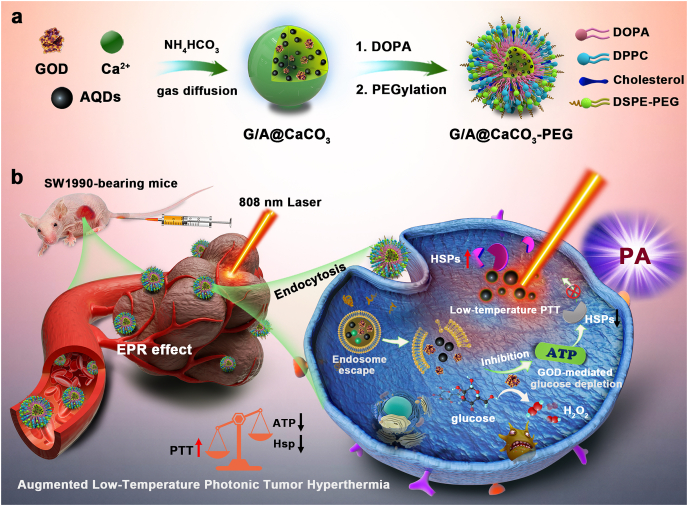
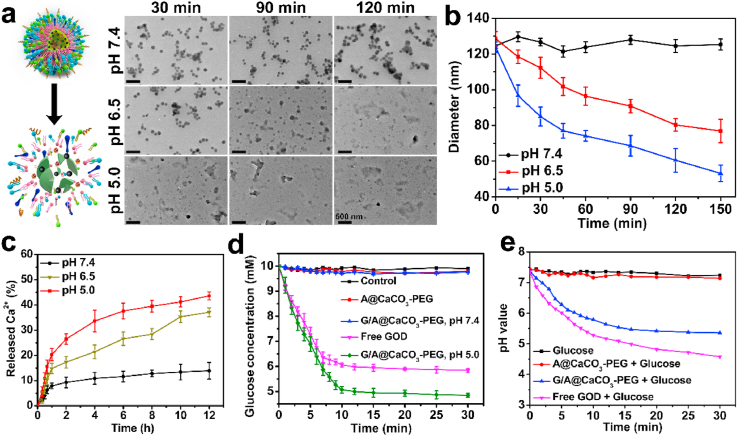
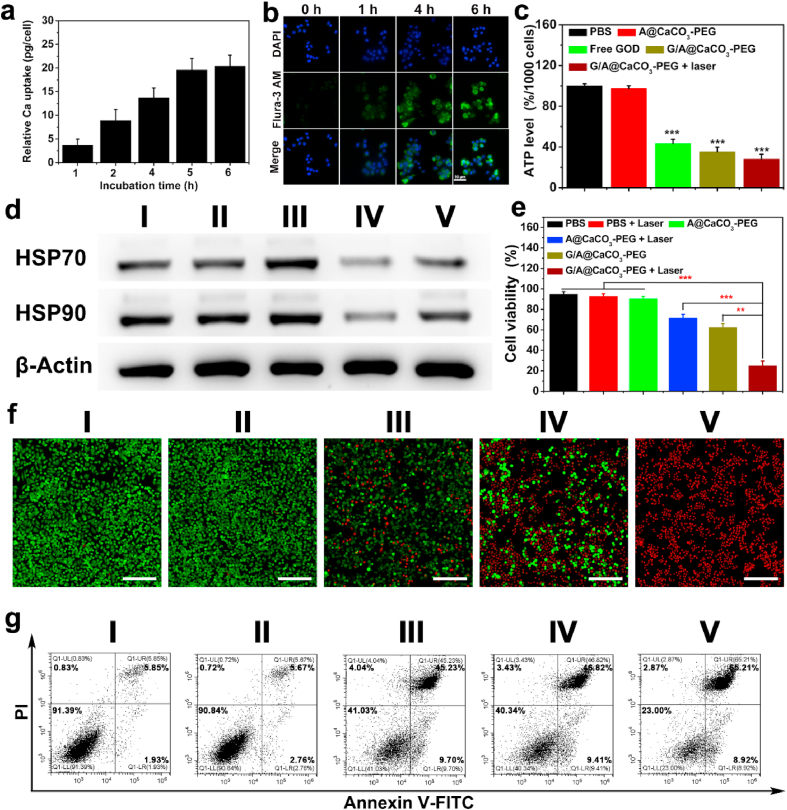
The overexpression of heat shock proteins (HSPs) in tumor cells can activate inherent defense mechanisms during hyperthermia-based treatments, inducing thermoresistance and thus diminishing the treatment efficacy. Here, we report a distinct "non-inhibitor involvement" strategy to address this issue through engineering a calcium-based nanocatalyst (G/A@CaCO-PEG). The constructed nanocatalyst consists of calcium carbonate (CaCO)-supported glucose oxidase (GOD) and 2D antimonene quantum dots (AQDs), with further surface modification by lipid bilayers and polyethylene glycol (PEG). The engineered G/A@CaCO-PEG nanocatalyst features prolonged blood circulation, which is stable at neutral pH but rapidly degrades under mildly acidic tumor microenvironment, resulting in rapid release of drug cargo in the tumor microenvironment. The integrated GOD effectively catalyzes the depletion of glucose for reducing the supplies of adenosine triphosphate (ATP) and subsequent down-regulation of HSP expression. This effect then augments the therapeutic efficacy of photothermal hyperthermia induced by 2D AQDs upon irradiation with near-infrared light as assisted by reversing the cancer cells' thermoresistance. Consequently, synergistic antineoplastic effects can be achieved via low-temperature photothermal therapy. Systematic and evaluations have demonstrated that G/A@CaCO-PEG nanocatalysts feature potent antitumor activity with a high tumor-inhibition rate (83.92%). This work thus paves an effective way for augmenting the hyperthermia-based tumor treatments via restriction of the ATP supply.
热休克蛋白(HSPs)在肿瘤细胞中的过表达可在基于热疗的治疗过程中激活固有防御机制,诱导热抗性,从而降低治疗效果。在此,我们报告了一种独特的“非抑制剂参与”策略,通过设计一种钙基纳米催化剂(G/A@CaCO-PEG)来解决这一问题。构建的纳米催化剂由碳酸钙(CaCO)负载的葡萄糖氧化酶(GOD)和二维锑烯量子点(AQDs)组成,并通过脂质双层和聚乙二醇(PEG)进行进一步的表面修饰。工程化的G/A@CaCO-PEG纳米催化剂具有延长的血液循环时间,在中性pH下稳定,但在轻度酸性肿瘤微环境中迅速降解,导致药物在肿瘤微环境中快速释放。整合的GOD有效地催化葡萄糖的消耗,以减少三磷酸腺苷(ATP)的供应并随后下调HSP的表达。这种作用随后增强了二维AQDs在近红外光照射下诱导的光热热疗的治疗效果,通过逆转癌细胞的热抗性来辅助。因此,通过低温光热疗法可以实现协同抗肿瘤作用。系统评价表明,G/A@CaCO-PEG纳米催化剂具有强大的抗肿瘤活性,肿瘤抑制率高达83.92%。因此,这项工作为通过限制ATP供应来增强基于热疗的肿瘤治疗铺平了一条有效途径。