Rozanov A S, Shekhovtsov S V, Bogacheva N V, Pershina E G, Ryapolova A V, Bytyak D S
Kurchatov Genomic Center of the Institute of Cytology and Genetics of Siberian Branch of the Russian Academy of Sciences, Novosibirsk, Russia Institute of Cytology and Genetics of Siberian Branch of the Russian Academy of Sciences, Laboratory of Molecular Biotechnologies, Novosibirsk, Russia.
Innovation Centre "Biruch-NT", Malobykovo village, Belgorod region, Russia.
Vavilovskii Zhurnal Genet Selektsii. 2021 Feb;25(1):125-134. doi: 10.18699/VJ21.015.
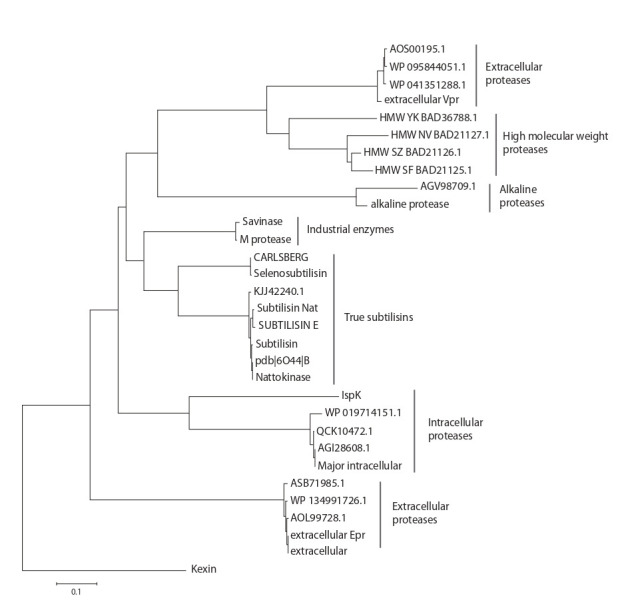
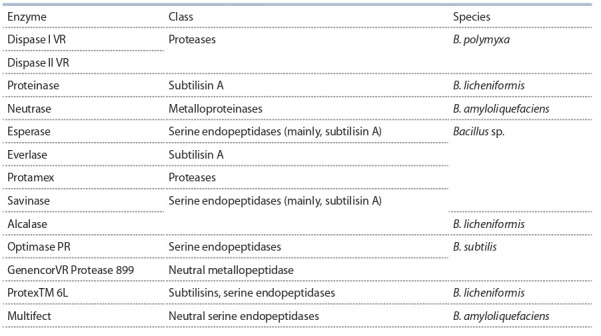
In this review, we discuss the progress in the study and modification of subtilisin proteases. Despite longstanding applications of microbial proteases and a large number of research papers, the search for new protease genes, the construction of producer strains, and the development of methods for their practical application are still relevant and important, judging by the number of citations of the research articles on proteases and their microbial producers. This enzyme class represents the largest share of the industrial production of proteins worldwide. This situation can explain the high level of interest in these enzymes and points to the high importance of designing domestic technologies for their manufacture. The review covers subtilisin classification, the history of their discovery, and subsequent research on the optimization of their properties. An overview of the classes of subtilisin proteases and related enzymes is provided too. There is a discussion about the problems with the search for (and selection of) subtilases from natural strains of various microorganisms, approaches to (and specifics of) their modification, as well as the relevant genetic engineering techniques. Details are provided on the methods for expression optimization of industrial subtilases of various strains: the details of the most important parameters of cultivation, i.e., composition of the media, culture duration, and the influence of temperature and pH. Also presented are the results of the latest studies on cultivation techniques: submerged and solid-state fermentation. From the literature data reviewed, we can conclude that native enzymes (i.e., those obtained from natural sources) currently hardly have any practical applications because of the decisive advantages of the enzymes modified by genetic engineering and having better properties: e.g., thermal stability, general resistance to detergents and specific resistance to various oxidants, high activity in various temperature ranges, independence from metal ions, and stability in the absence of calcium. The vast majority of subtilisin proteases are expressed in producer strains belonging to different species of the genus Bacillus. Meanwhile, there is an effort to adapt the expression of these enzymes to other microbes, in particular species of the yeast Pichia pastoris.
在本综述中,我们讨论了枯草杆菌蛋白酶的研究与改良进展。尽管微生物蛋白酶已有长期应用且研究论文众多,但从关于蛋白酶及其微生物生产者的研究文章被引用次数来看,寻找新的蛋白酶基因、构建生产菌株以及开发其实际应用方法仍然具有现实意义且至关重要。这类酶在全球蛋白质工业生产中占比最大。这种情况可以解释人们对这些酶的高度关注,并表明设计其国内制造技术具有高度重要性。本综述涵盖枯草杆菌蛋白酶的分类、发现历史以及随后对其性质优化的研究。还提供了枯草杆菌蛋白酶类和相关酶的概述。讨论了从各种微生物的天然菌株中寻找(和筛选)枯草杆菌蛋白酶的问题、其改良方法(及具体细节)以及相关的基因工程技术。详细介绍了各种菌株工业枯草杆菌蛋白酶表达优化的方法:培养的最重要参数细节,即培养基组成、培养持续时间以及温度和pH的影响。还介绍了培养技术的最新研究结果:深层发酵和固态发酵。从所综述的文献数据中,我们可以得出结论,由于基因工程改良的酶具有决定性优势且性能更佳,如热稳定性、对洗涤剂的一般抗性和对各种氧化剂的特异性抗性、在各种温度范围内的高活性、不依赖金属离子以及在无钙情况下的稳定性,天然酶(即从天然来源获得的酶)目前几乎没有任何实际应用。绝大多数枯草杆菌蛋白酶在属于芽孢杆菌属不同物种的生产菌株中表达。与此同时,人们正在努力使这些酶的表达适应其他微生物,特别是毕赤酵母属的物种。