Shamail Ghazala M H, Haridoss Madhumitha, Natarajan Meenakumari, Joshua Vasna, Bagepally Bhavani Shankara
ICMR-National Institute of Epidemiology, Chennai, India.
Health Technology Assessment Resource Centre, ICMR-National Institute of Epidemiology, R-127, Tamil Nadu Housing Board, Phase I and II, Ayapakkam, Chennai, 600077, India.
Rheumatol Ther. 2022 Apr;9(2):313-329. doi: 10.1007/s40744-021-00409-6. Epub 2021 Dec 13.
Rheumatoid arthritis (RA) is a chronic debilitating illness, usually associated with mental health ailments. Literature reports contradictory observations about the association between recent RA pharmacotherapies and mental health. We systematically reviewed RA randomized control trials to synthesize the association between Janus kinases (JAK) inhibitors therapy and mental health.
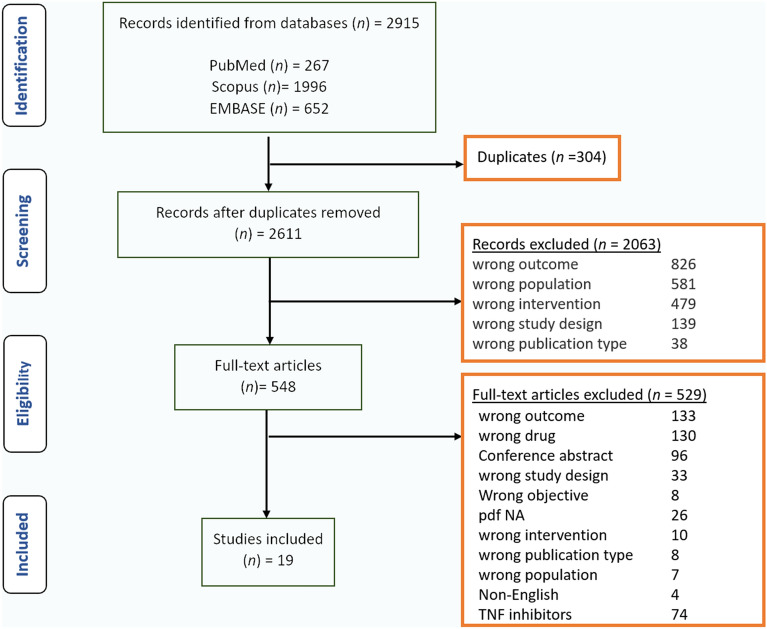
We systematically searched clinical trials of JAK inhibitor intervention reporting mental health outcomes using short form-36 (SF-36) in PubMed, Embase, and Scopus databases from inception to February 2021. We have selected the studies and extracted the data, adhering to Preferred Reporting Items of Systematic reviews and Meta-Analysis (PRISMA) guidelines. We have pooled the mean change of SF-36 mental component score (MCS) between JAK inhibitors and comparator therapy with a 95% confidence interval.
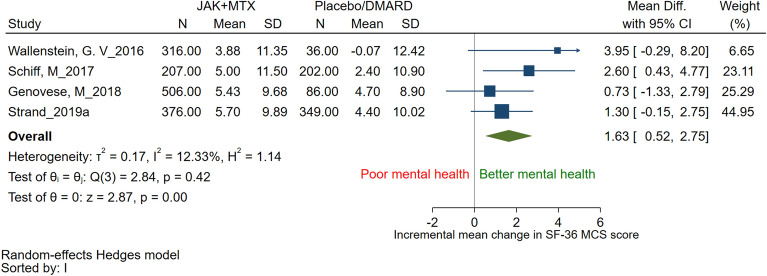
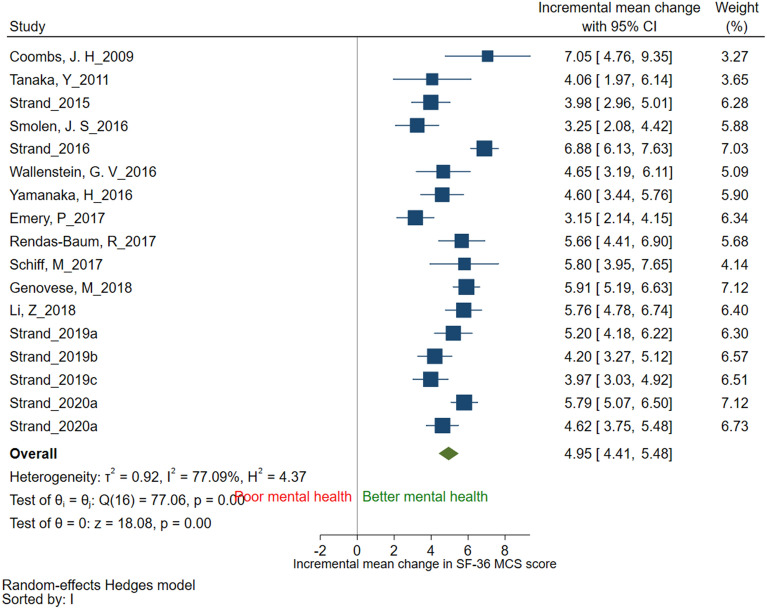
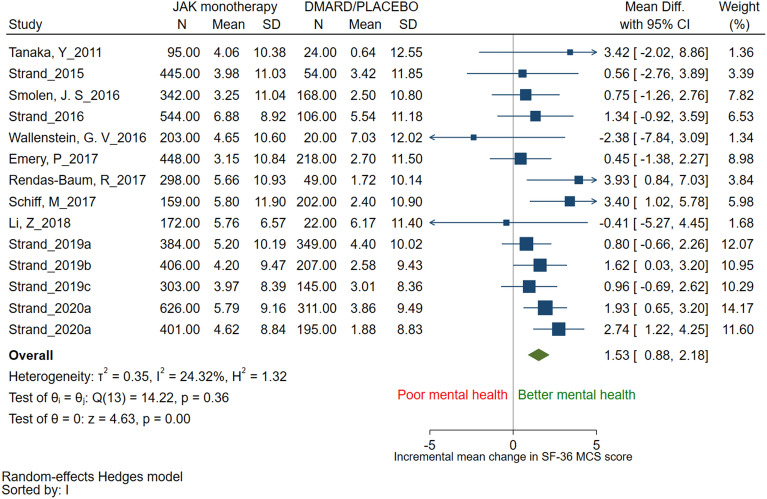
Of the 2915 searched studies for systematic review, 19 studies involving 14,323 individuals were included for the meta-analysis. The pooled mean reduction in SF-36 MCS scores (after minus before) with JAK inhibitors was 4.95 (4.41-5.48). The pooled mean difference of incremental mean change in SF-36 MCS score between JAK monotherapy and comparator was 1.53 (0.88-2.18). The improvement in SF-36 MCS scores with JAK inhibitor therapy is greater than the minimum clinically important difference (MCID) value of 2.5. However, on separate analysis with comparator drugs like methotrexate and standard treatment, the MCS scores did not exceeded the MCID value and were also not statistically significant.
JAK inhibitors results in clinically meaningful improvement in the mental health scores of the RA patients.
2021 CRD42021234466.
类风湿性关节炎(RA)是一种慢性致残性疾病,通常与心理健康问题相关。文献报道了关于近期类风湿性关节炎药物治疗与心理健康之间关联的相互矛盾的观察结果。我们系统回顾了类风湿性关节炎随机对照试验,以综合分析 Janus 激酶(JAK)抑制剂治疗与心理健康之间的关联。
我们从创刊至 2021 年 2 月在 PubMed、Embase 和 Scopus 数据库中系统检索了使用简短健康调查问卷(SF-36)报告心理健康结果的 JAK 抑制剂干预临床试验。我们按照系统评价和 Meta 分析的首选报告项目(PRISMA)指南选择研究并提取数据。我们汇总了 JAK 抑制剂与对照治疗之间 SF-36 心理成分得分(MCS)的平均变化及 95%置信区间。
在检索的 2915 项用于系统评价的研究中,纳入了 19 项涉及 14323 名个体的研究进行荟萃分析。使用 JAK 抑制剂后,SF-36 MCS 得分(治疗后减去治疗前)的汇总平均降低值为 4.95(4.41 - 5.48)。JAK 单药治疗与对照治疗之间 SF-36 MCS 得分增量平均变化的汇总平均差值为 1.53(0.88 - 2.18)。JAK 抑制剂治疗使 SF-36 MCS 得分的改善大于最小临床重要差异(MCID)值 2.5。然而,在与甲氨蝶呤等对照药物和标准治疗进行单独分析时,MCS 得分未超过 MCID 值,且无统计学意义。
JAK 抑制剂可使类风湿性关节炎患者的心理健康得分在临床上得到有意义的改善。
PROSPERO 注册号:2021 CRD42021234466。