Ikeda Yuka, Nagase Nozomi, Tsuji Ai, Kitagishi Yasuko, Matsuda Satoru
Food Science and Nutrition, Nara Women's University, Nara 630-8506, Japan.
World J Biol Chem. 2021 Nov 27;12(6):104-113. doi: 10.4331/wjbc.v12.i6.104.
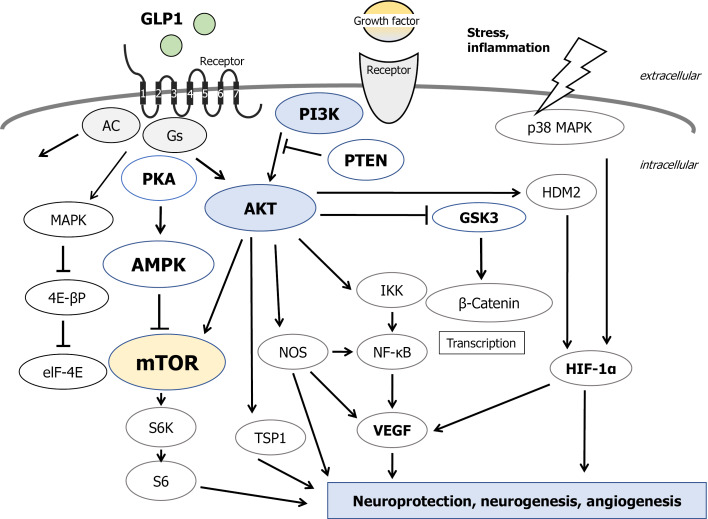
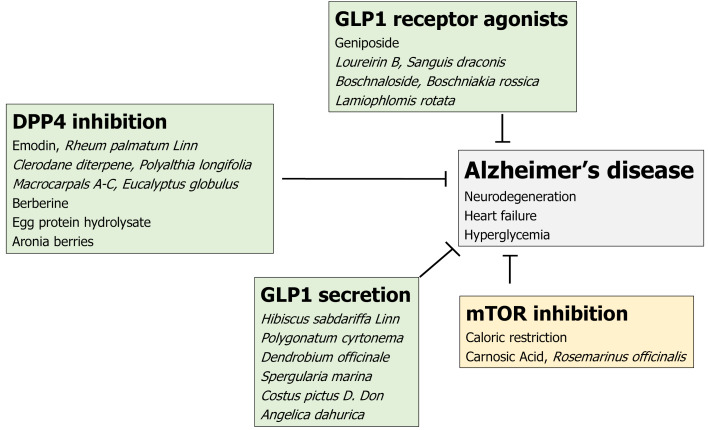
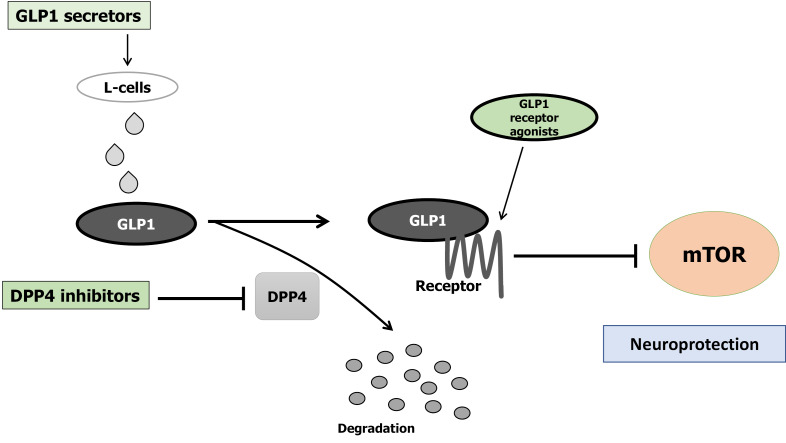
Alzheimer's disease (AD) is the most common reason for progressive dementia in the elderly. It has been shown that disorders of the mammalian/mechanistic target of rapamycin (mTOR) signaling pathways are related to the AD. On the other hand, diabetes mellitus (DM) is a risk factor for the cognitive dysfunction. The pathogenesis of the neuronal impairment caused by diabetic hyperglycemia is intricate, which contains neuro-inflammation and/or neurodegeneration and dementia. Glucagon-like peptide-1 (GLP1) is interesting as a possible link between metabolism and brain impairment. Modulation of GLP1 activity can influence amyloid-beta peptide aggregation the phosphoinositide-3 kinase/AKT/mTOR signaling pathway in AD. The GLP1 receptor agonists have been shown to have favorable actions on the brain such as the improvement of neurological deficit. They might also exert a beneficial effect with refining learning and memory on the cognitive impairment induced by diabetes. Recent experimental and clinical evidence indicates that dipeptidyl-peptidase-4 (DPP4) inhibitors, being currently used for DM therapy, may also be effective for AD treatment. The DPP-4 inhibitors have demonstrated neuroprotection and cognitive improvements in animal models. Although further studies for mTOR, GLP1, and DPP4 signaling pathways in humans would be intensively required, they seem to be a promising approach for innovative AD-treatments. We would like to review the characteristics of AD pathogenesis, the key roles of mTOR in AD and the preventive and/ or therapeutic suggestions of directing the mTOR signaling pathway.
阿尔茨海默病(AD)是老年人进行性痴呆最常见的原因。研究表明,哺乳动物雷帕霉素靶蛋白(mTOR)信号通路紊乱与AD相关。另一方面,糖尿病(DM)是认知功能障碍的一个危险因素。糖尿病高血糖导致的神经元损伤发病机制复杂,包括神经炎症和/或神经退行性变及痴呆。胰高血糖素样肽-1(GLP1)作为代谢与脑损伤之间可能的联系备受关注。调节GLP1活性可影响AD中淀粉样β肽聚集及磷酸肌醇-3激酶/蛋白激酶B/mTOR信号通路。GLP1受体激动剂已被证明对大脑有有益作用,如改善神经功能缺损。它们可能对糖尿病所致认知障碍的学习和记忆改善也有有益影响。最近的实验和临床证据表明,目前用于DM治疗的二肽基肽酶-4(DPP4)抑制剂可能对AD治疗也有效。DPP-4抑制剂在动物模型中已显示出神经保护作用和认知改善。尽管还需要对人体中的mTOR、GLP1和DPP4信号通路进行深入研究,但它们似乎是创新AD治疗的一种有前景的方法。我们将综述AD发病机制的特点、mTOR在AD中的关键作用以及针对mTOR信号通路的预防和/或治疗建议。