Institute for Biomagnetism and Biosignal Analysis, University of Münster, Münster, Germany.
Otto Creutzfeldt Center for Cognitive and Behavioral Neuroscience, University of Münster, Münster, Germany.
Elife. 2021 Dec 14;10:e70907. doi: 10.7554/eLife.70907.
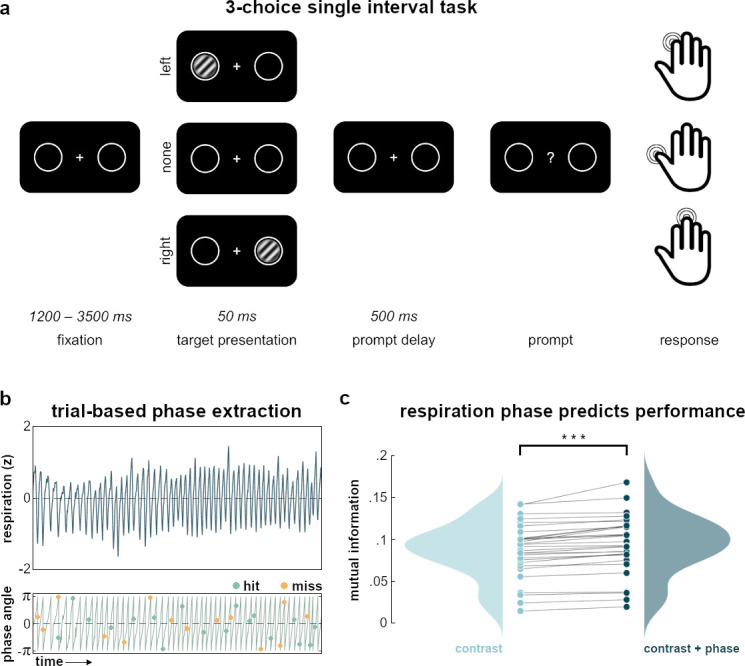
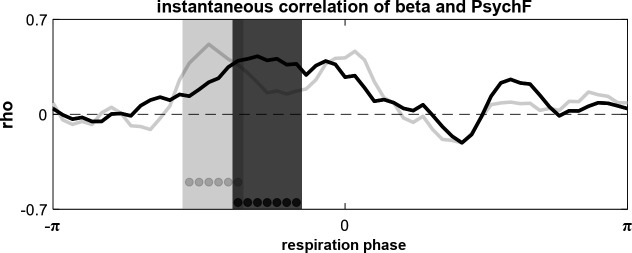
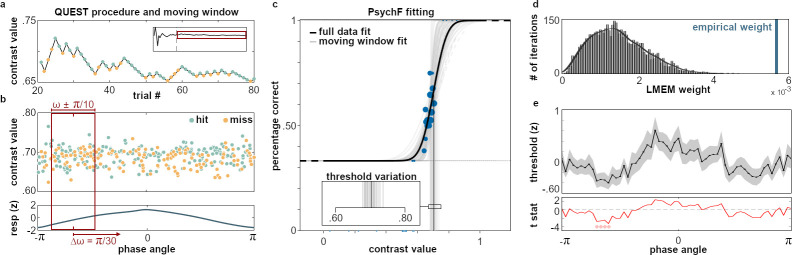
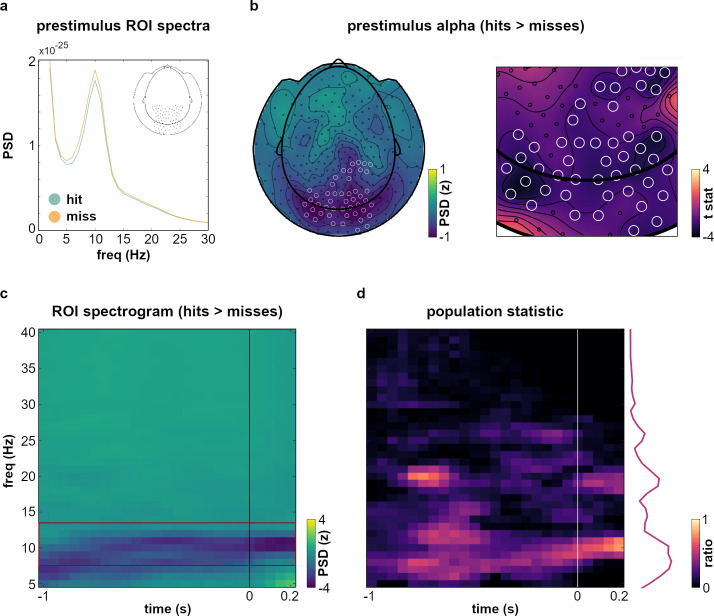
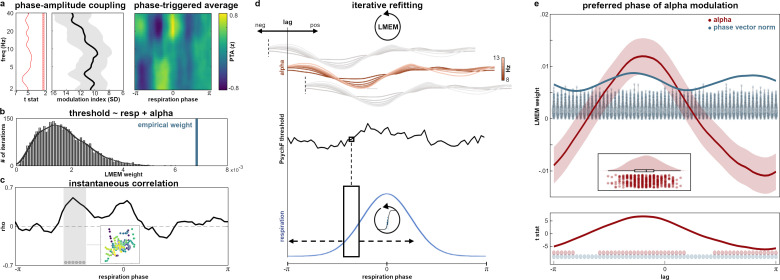
Recent studies from the field of interoception have highlighted the link between bodily and neural rhythms during action, perception, and cognition. The mechanisms underlying functional body-brain coupling, however, are poorly understood, as are the ways in which they modulate behavior. We acquired respiration and human magnetoencephalography data from a near-threshold spatial detection task to investigate the trivariate relationship between respiration, neural excitability, and performance. Respiration was found to significantly modulate perceptual sensitivity as well as posterior alpha power (8-13 Hz), a well-established proxy of cortical excitability. In turn, alpha suppression prior to detected versus undetected targets underscored the behavioral benefits of heightened excitability. Notably, respiration-locked excitability changes were maximized at a respiration phase lag of around -30° and thus temporally preceded performance changes. In line with interoceptive inference accounts, these results suggest that respiration actively aligns sampling of sensory information with transient cycles of heightened excitability to facilitate performance.
最近来自内脏感觉领域的研究强调了在行动、感知和认知过程中身体和神经节律之间的联系。然而,功能身体-大脑耦合的机制以及它们调节行为的方式还知之甚少。我们从一个接近阈值的空间检测任务中获得了呼吸和人类脑磁图数据,以研究呼吸、神经兴奋性和表现之间的三元关系。研究发现,呼吸显著调节了感知灵敏度以及被广泛认可的皮质兴奋性指标——后alpha 功率(8-13Hz)。反过来,在检测到与未检测到目标之前的 alpha 抑制强调了提高兴奋性的行为益处。值得注意的是,在呼吸相位滞后约 -30°时,兴奋性的呼吸锁定变化达到最大值,因此在性能变化之前发生。与内脏感觉推断理论一致,这些结果表明呼吸主动将感觉信息的采样与短暂的兴奋性增强周期对齐,以促进表现。