Massachusetts Veterans Epidemiology Research and Information Center (MAVERIC), VA Boston Healthcare System, 150 South Huntington Ave, Boston, MA 02130, USA.
Division of Aging, Department of Medicine, Brigham & Women's Hospital, Harvard Medical School, 1620 Tremont St Boston, MA 02120, USA.
Eur Heart J. 2022 Feb 22;43(8):818-826. doi: 10.1093/eurheartj/ehab850.
Frailty is associated with an increased risk of all-cause mortality and cardiovascular (CV) events. Limited data exist from the modern era of CV prevention on the relationship between frailty and CV mortality. We hypothesized that frailty is associated with an increased risk of CV mortality.
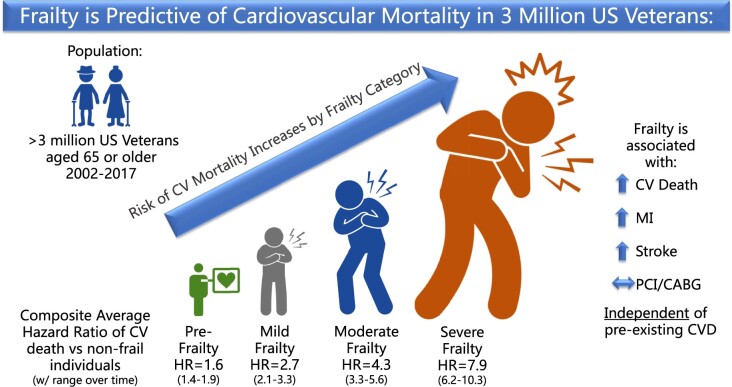
All US Veterans aged ≥65 years who were regular users of Veteran Affairs care from 2002 to 2017 were included. Frailty was defined using a 31-item previously validated frailty index, ranging from 0 to 1. The primary outcome was CV mortality with secondary analyses examining the relationship between frailty and CV events (myocardial infarction, stroke, revascularization). Survival analysis models were adjusted for age, sex, ethnicity, geographic region, smoking, hyperlipidaemia, statin use, and blood pressure medication use. There were 3 068 439 US Veterans included in the analysis. Mean age was 74.1 ± 5.8 years in 2002, 76.0 ± 8.3 years in 2014, 98% male, and 87.5% White. In 2002, the median (interquartile range) frailty score was 0.16 (0.10-0.23). This increased and stabilized to 0.19 (0.10-0.32) for 2006-14. The presence of frailty was associated with an increased risk of CV mortality at every stage of frailty. Frailty was associated with an increased risk of myocardial infarction and stroke, but not revascularization.
In this population, both the presence and severity of frailty are tightly correlated with CV death, independent of underlying CV disease. This study is the largest and most contemporary evaluation of the relationship between frailty and CV mortality to date. Further work is needed to understand how this risk can be diminished.
Can an electronic frailty index identify adults aged 65 and older who are at risk of CV mortality and major CV events?
Among 3 068 439 US Veterans aged 65 and older, frailty was associated with an increased risk of CV mortality at every level of frailty. Frailty was also associated with an increased risk of myocardial infarction and stroke, but not revascularization.
Both the presence and severity of frailty are associated with CV mortality and major CV events, independent of underlying CV disease.
虚弱与全因死亡率和心血管(CV)事件的风险增加有关。在 CV 预防的现代时代,关于虚弱与 CV 死亡率之间的关系,数据有限。我们假设虚弱与 CV 死亡率的风险增加有关。
所有年龄≥65 岁的美国退伍军人,只要在 2002 年至 2017 年期间是退伍军人事务护理的常规使用者,均被纳入研究。使用先前验证的 31 项虚弱指数来定义虚弱,范围从 0 到 1。主要结局是 CV 死亡率,次要分析检查虚弱与 CV 事件(心肌梗死、中风、血运重建)之间的关系。生存分析模型根据年龄、性别、种族、地理位置、吸烟、血脂异常、他汀类药物使用和血压药物使用进行了调整。共纳入了 3068439 名美国退伍军人进行分析。2002 年平均年龄为 74.1±5.8 岁,2014 年为 76.0±8.3 岁,98%为男性,87.5%为白人。2002 年,中位数(四分位距)虚弱评分 0.16(0.10-0.23)。2006-14 年期间,该评分增加并稳定在 0.19(0.10-0.32)。虚弱的存在与每个虚弱阶段的 CV 死亡率风险增加相关。虚弱与心肌梗死和中风的风险增加相关,但与血运重建无关。
在该人群中,虚弱的存在和严重程度均与 CV 死亡密切相关,且与潜在的 CV 疾病无关。这是迄今为止对虚弱与 CV 死亡率之间关系进行的最大和最现代的评估。需要进一步的工作来了解如何降低这种风险。
电子虚弱指数能否识别出 65 岁及以上患 CV 死亡率和主要 CV 事件风险的成年人?
在 3068439 名年龄在 65 岁及以上的美国退伍军人中,虚弱与每个虚弱水平的 CV 死亡率风险增加相关。虚弱也与心肌梗死和中风的风险增加相关,但与血运重建无关。
虚弱的存在和严重程度均与 CV 死亡率和主要 CV 事件相关,且与潜在的 CV 疾病无关。