Magíster en Salud Pública. Pontificia Universidad Católica de Chile. Santiago, Chile.
Pontificia Universidad Católica de Chile. Instituto de Sociología & Departamento de Salud Pública. Santiago, Chile.
Rev Saude Publica. 2021 Dec 8;55:101. doi: 10.11606/s1518-8787.20210550033253. eCollection 2021.
Reconstruct types of simultaneous stress trajectories in the family and employment domain at different stages of life and estimate their association with cerebrovascular accident (CVA) in old age.
We used a retrospective, face-to-face, representative survey of people aged 65 to 75 years in the city of Santiago, Chile, (n = 802). We performed a multichannel sequence analysis to reconstruct family and employment stress trajectory types at various life stages and then used logistic regression models to estimate the association of these trajectory types with CVA in old age, controlled for traditional cardiovascular risk factors.
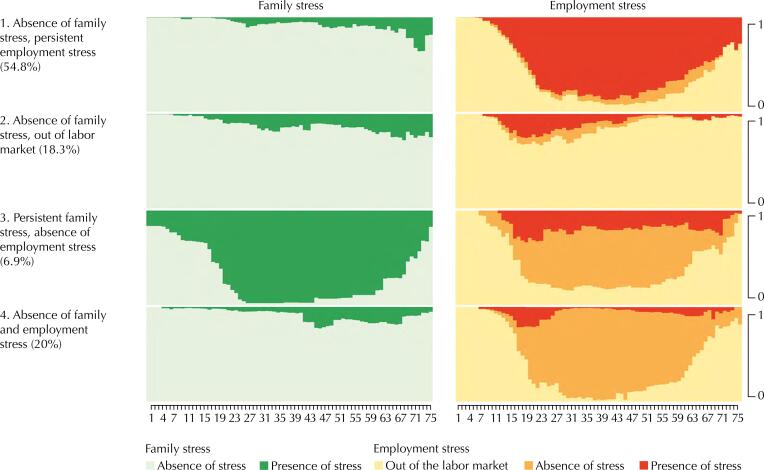
Four representative types of family and employment stress trajectories were identified: (1) Absence of family and employment stress, (2) Absence of family stress, persistent employment stress, (3) Absence of family stress, out of the labor market, and (4) Persistent family stress, absence of employment stress. The 61.7% of the sample followed trajectories marked by the permanent presence of family and/or employment stress. Likewise, 18.3% had a trajectory characterized by prolonged absence from the labor market. Individuals with persistent family or employment stress trajectories, as well as those with extended periods of inactivity, are more at risk of developing CVA.
Stress is a risk factor for cardiovascular disease experienced by many people at different stages and domains of life on a prolonged basis. Consequently, prevention systems for this type of chronic diseases should emphasize the highly harmful effects of daily and cumulatively stressful life experiences. This could mitigate the multiple health and financial consequences associated with CVA.
重建人生不同阶段家庭和就业领域同时存在的压力轨迹类型,并估计其与老年脑血管意外(CVA)的关系。
我们使用了智利圣地亚哥市 65 至 75 岁人群的回顾性、面对面、代表性调查(n=802)。我们进行了多通道序列分析,以重建不同生命阶段的家庭和就业压力轨迹类型,然后使用逻辑回归模型,在控制传统心血管危险因素的情况下,估计这些轨迹类型与老年 CVA 的关联。
确定了四种具有代表性的家庭和就业压力轨迹类型:(1)家庭和就业压力均不存在,(2)家庭压力不存在,持续就业压力,(3)家庭压力不存在,失业,(4)持续家庭压力,就业压力不存在。61.7%的样本遵循家庭和/或就业压力永久存在的轨迹。同样,18.3%的人有长期失业的轨迹。持续存在家庭或就业压力轨迹的个体,以及长期不活动的个体,患 CVA 的风险更高。
压力是许多人在不同阶段和生活领域长期经历的心血管疾病的危险因素。因此,这种慢性疾病的预防系统应强调日常生活和累积压力经历的高度有害影响。这可以减轻与 CVA 相关的多种健康和经济后果。