Division of Exercise Physiology, West Virginia University School of Medicine, Morgantown, WV, USA.
Mitochondria, Metabolism and Bioenergetics Working Group, West Virginia University School of Medicine, Morgantown, WV, USA.
Part Fibre Toxicol. 2021 Dec 15;18(1):44. doi: 10.1186/s12989-021-00437-8.
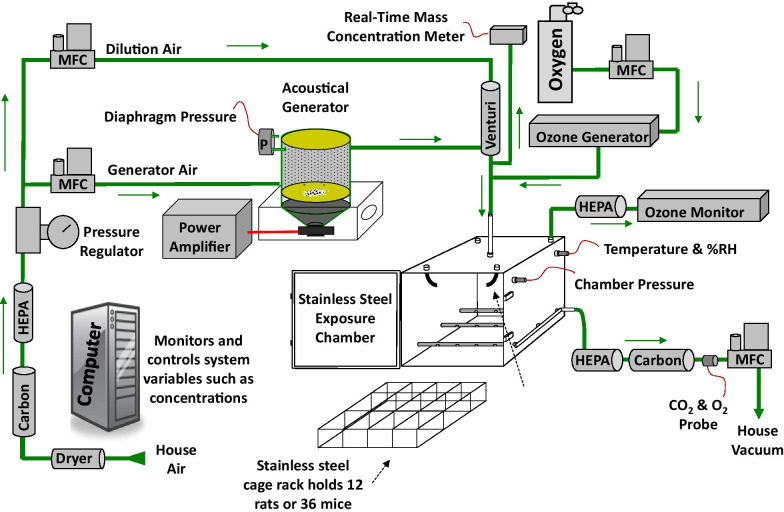
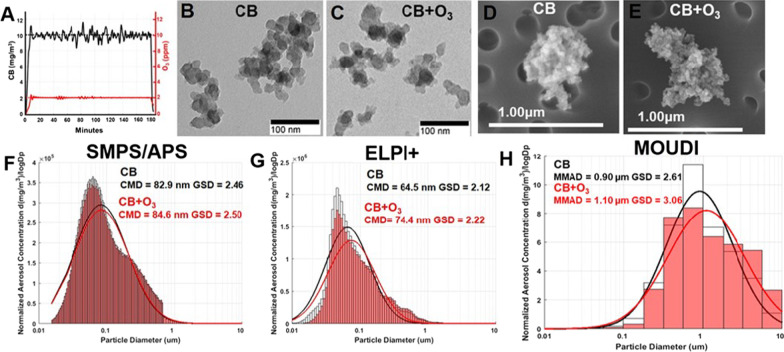
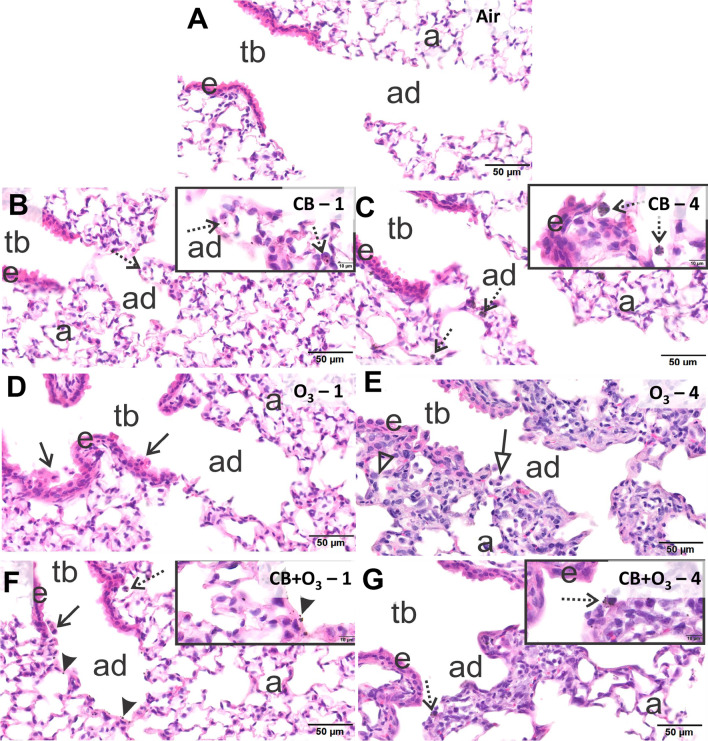
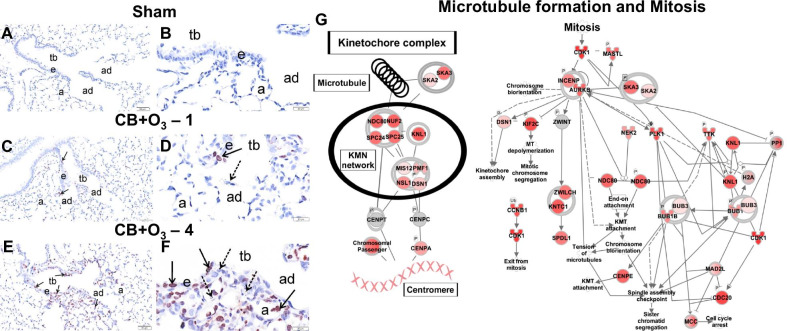
Air pollution is a complex mixture of particles and gases, yet current regulations are based on single toxicant levels failing to consider potential interactive outcomes of co-exposures. We examined transcriptomic changes after inhalation co-exposure to a particulate and a gaseous component of air pollution and hypothesized that co-exposure would induce significantly greater impairments to mitochondrial bioenergetics. A whole-body inhalation exposure to ultrafine carbon black (CB), and ozone (O) was performed, and the impact of single and multiple exposures was studied at relevant deposition levels. C57BL/6 mice were exposed to CB (10 mg/m) and/or O (2 ppm) for 3 h (either a single exposure or four independent exposures). RNA was isolated from lungs and mRNA sequencing performed using the Illumina HiSeq. Lung pathology was evaluated by histology and immunohistochemistry. Electron transport chain (ETC) activities, electron flow, hydrogen peroxide production, and ATP content were assessed.
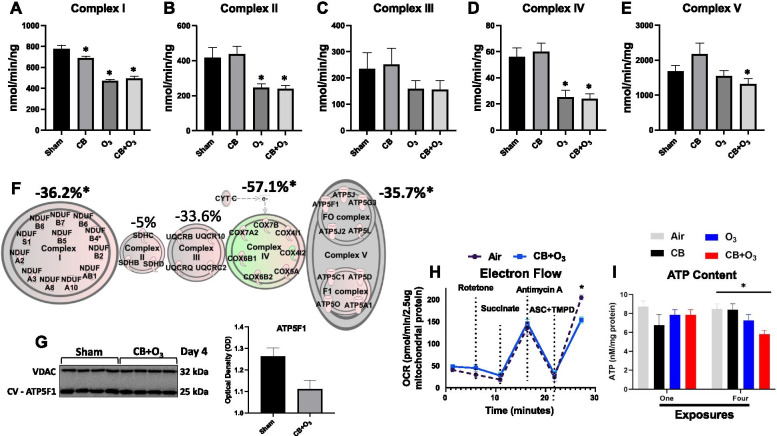
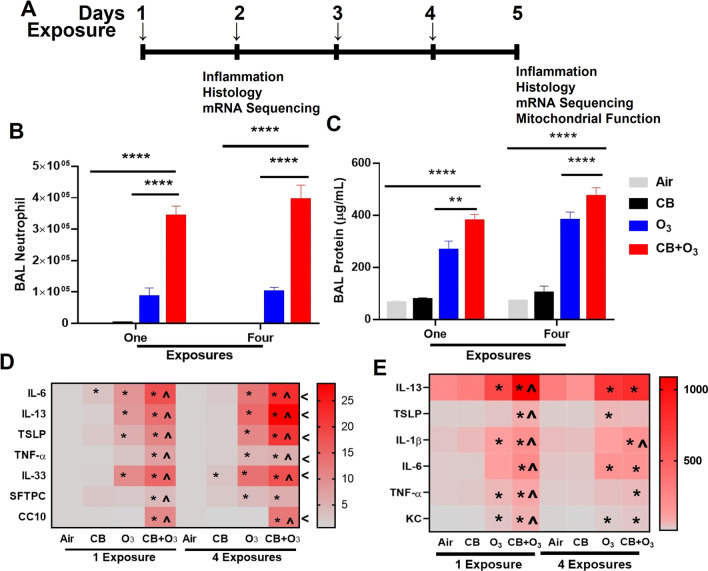
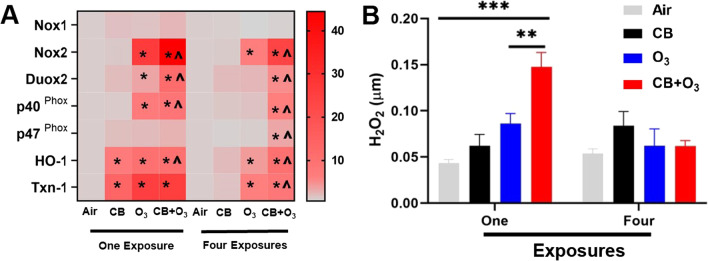
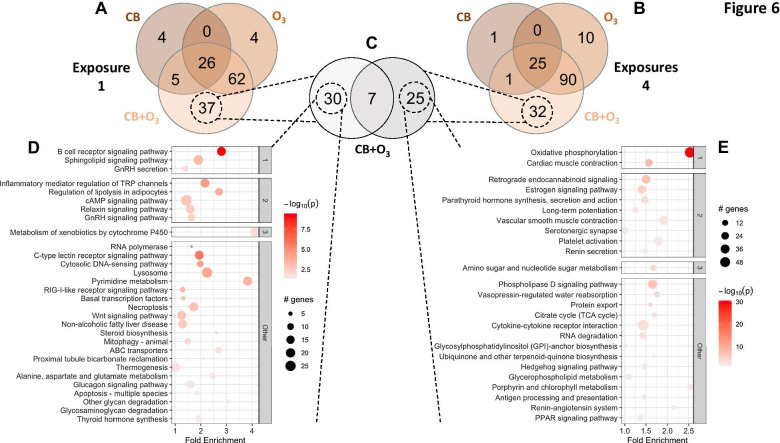
Compared to individual exposure groups, co-exposure induced significantly greater neutrophils and protein levels in broncho-alveolar lavage fluid as well as a significant increase in mRNA expression of oxidative stress and inflammation related genes. Similarly, a significant increase in hydrogen peroxide production was observed after co-exposure. After single and four exposures, co-exposure revealed a greater number of differentially expressed genes (2251 and 4072, respectively). Of these genes, 1188 (single exposure) and 2061 (four exposures) were uniquely differentially expressed, with 35 mitochondrial ETC mRNA transcripts significantly impacted after four exposures. Both O and co-exposure treatment significantly reduced ETC maximal activity for complexes I (- 39.3% and - 36.2%, respectively) and IV (- 55.1% and - 57.1%, respectively). Only co-exposure reduced ATP Synthase activity (- 35.7%) and total ATP content (30%). Further, the ability for ATP Synthase to function is limited by reduced electron flow (- 25%) and translation of subunits, such as ATP5F1, following co-exposure.
CB and O co-exposure cause unique transcriptomic changes in the lungs that are characterized by functional deficits to mitochondrial bioenergetics. Alterations to ATP Synthase function and mitochondrial electron flow underly a pathological adaptation to lung injury induced by co-exposure.
空气污染是一种复杂的颗粒和气态混合物,但目前的法规是基于单一有毒物质水平制定的,未能考虑共同暴露的潜在交互结果。我们研究了吸入空气污染的颗粒和气态成分共同暴露后转录组的变化,并假设共同暴露会对线粒体生物能产生显著更大的损害。进行了全身吸入超细碳黑 (CB) 和臭氧 (O) 的暴露,研究了在相关沉积水平下单次和多次暴露的影响。将 C57BL/6 小鼠暴露于 CB(10mg/m)和/或 O(2ppm)3 小时(单次暴露或四次独立暴露)。从肺部分离 RNA 并使用 Illumina HiSeq 进行 mRNA 测序。通过组织学和免疫组织化学评估肺病理学。评估电子传递链 (ETC) 活性、电子流、过氧化氢产生和 ATP 含量。
与单独暴露组相比,共同暴露诱导了支气管肺泡灌洗液中明显更多的中性粒细胞和蛋白质水平,以及氧化应激和炎症相关基因的 mRNA 表达显著增加。同样,共同暴露后过氧化氢的产生也显著增加。在单次和四次暴露后,共同暴露显示出更多差异表达的基因(分别为 2251 和 4072)。在这些基因中,1188 个(单次暴露)和 2061 个(四次暴露)是唯一差异表达的基因,在四次暴露后,有 35 个线粒体 ETC mRNA 转录本受到显著影响。O 和共同暴露处理均显著降低复合物 I(分别为-39.3%和-36.2%)和 IV(分别为-55.1%和-57.1%)的 ETC 最大活性。只有共同暴露降低了 ATP 合酶活性(-35.7%)和总 ATP 含量(30%)。此外,共同暴露后,ATP 合酶的功能受到电子流减少(-25%)和翻译亚基(如 ATP5F1)的限制。
CB 和 O 共同暴露会导致肺部产生独特的转录组变化,其特征是线粒体生物能出现功能缺陷。ATP 合酶功能和线粒体电子流的改变是共同暴露引起的肺损伤病理适应的基础。