Department of Endocrinology and Metabolism, Peking University People's Hospital, Beijing, China.
Front Endocrinol (Lausanne). 2021 Nov 30;12:780557. doi: 10.3389/fendo.2021.780557. eCollection 2021.
The difference in the relationship between β-cell function and insulin resistance among Africans, Caucasians and East Asians with normal glucose tolerance (NGT) was not well investigated.
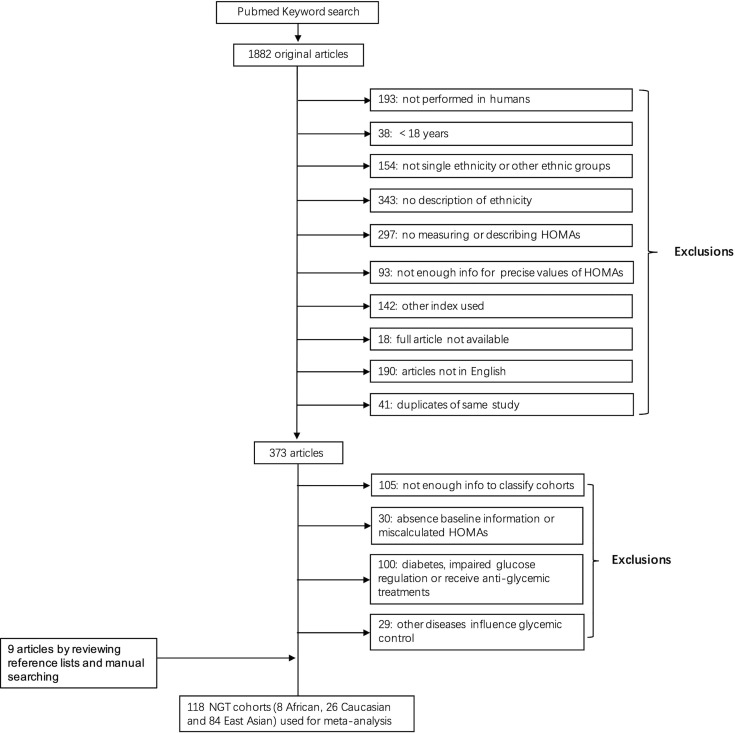
We searched PubMed and Web of Science with keywords and identified studies that used the homeostasis model assessment (HOMA) model to evaluate β-cell function (HOMA-B) and insulin sensitivity/resistance (HOMA-S/HOMA-IR) in certain ethnic groups. We used random-effect model to pool data of HOMAs and compared the combined data among the three ethnic groups using subgroup analysis. Linear regression analysis was used to estimate the coefficient of HOMA-S on HOMA-B in these ethnic groups.
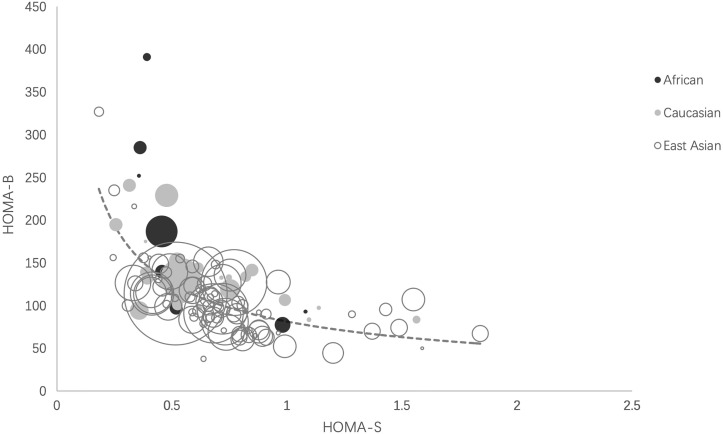
We evaluated pooled data of HOMAs in eight African, 26 Caucasian, and 84 East Asian cohorts with NGT, and also 2,392, 6,645 and 67,317 individuals, respectively. The three ethnic groups had distinct HOMA-B but similar HOMA-IR. The regression coefficient of lnHOMA-B on lnHOMA-S was different between Africans and Caucasians (-1.126 -0.401, P = 0.0006) or East Asian (-1.126 -0.586, P = 0.0087), but similar between Caucasians and East Asians (-0.401 -0.586, P = 0.1282). The coefficient in all ethnic groups was similar when age, BMI, and gender were adjusted (African Caucasian P = 0.0885, African East Asian P = 0.1092, and Caucasian East Asian P = 0.6298).
In subjects with NGT, East Asians had lower HOMA-B but similar β-cell response relative to insulin resistance with Caucasians and Africans when age, BMI, and gender were controlled. This result may challenge the allegation that there was an Asian-specific diabetes phenotype with worse β-cell function.
在血糖正常的个体(NGT)中,非洲人、白种人和东亚人之间β细胞功能与胰岛素抵抗之间的关系存在差异,但这一差异并未得到充分研究。
我们使用关键词在 PubMed 和 Web of Science 上进行了检索,并确定了使用稳态模型评估(HOMA)模型评估特定种族人群的β细胞功能(HOMA-B)和胰岛素敏感性/抵抗性(HOMA-S/HOMA-IR)的研究。我们使用随机效应模型对 HOMA 数据进行了汇总,并使用亚组分析比较了这三个种族群体的综合数据。线性回归分析用于估计这些种族群体中 HOMA-S 对 HOMA-B 的系数。
我们评估了 8 个非洲、26 个白种人和 84 个东亚 NGT 队列的 HOMA 汇总数据,以及分别包含 2292、6645 和 67317 个人的 HOMA 数据。这三个种族群体的 HOMA-B 明显不同,但 HOMA-IR 相似。非洲人和白种人(-1.126 -0.401,P = 0.0006)或东亚人(-1.126 -0.586,P = 0.0087)之间 lnHOMA-B 对 lnHOMA-S 的回归系数不同,但白种人和东亚人之间相似(-0.401 -0.586,P = 0.1282)。当调整年龄、BMI 和性别时,所有种族群体的系数相似(非洲 白种人 P = 0.0885,非洲 东亚人 P = 0.1092,白种人 东亚人 P = 0.6298)。
在 NGT 个体中,当控制年龄、BMI 和性别时,东亚人的 HOMA-B 较低,但与白种人和非洲人相比,β细胞对胰岛素抵抗的反应相似。这一结果可能对亚洲存在特定的糖尿病表型、β细胞功能更差的说法提出挑战。