Department of Surgery II, Faculty of Medicine, Yamagata University, Yamagata, Japan.
Department of Dentistry, Oral and Maxillofacial Plastic and Reconstructive Surgery, Faculty of Medicine, Yamagata University, Yamagata, Japan.
Thorac Cancer. 2022 Feb;13(3):460-465. doi: 10.1111/1759-7714.14282. Epub 2021 Dec 16.
Saliva is often used as a biomarker for the diagnosis of some oral and systematic diseases, owing to the non-invasive attribute of the fluid. In this study, we aimed to identify salivary biomarkers for distinguishing lung cancer (LC) from benign lung lesion (BLL).
Unstimulated saliva samples were collected from 41 patients with LC and 21 with BLL. Salivary metabolites were comprehensively analyzed using capillary electrophoresis mass spectrometry. To differentiate between patients with LCs and BLLs, the discriminatory ability of each biomarker was assessed. Furthermore, a multiple logistic regression (MLR) model was developed for evaluating discriminatory ability of each salivary metabolite.
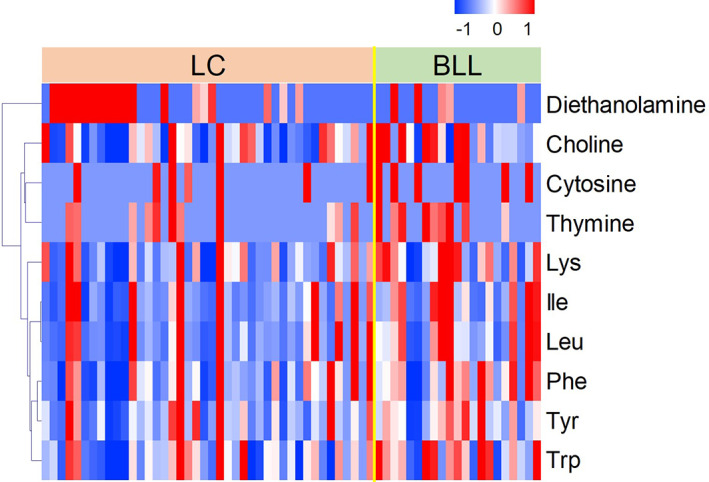
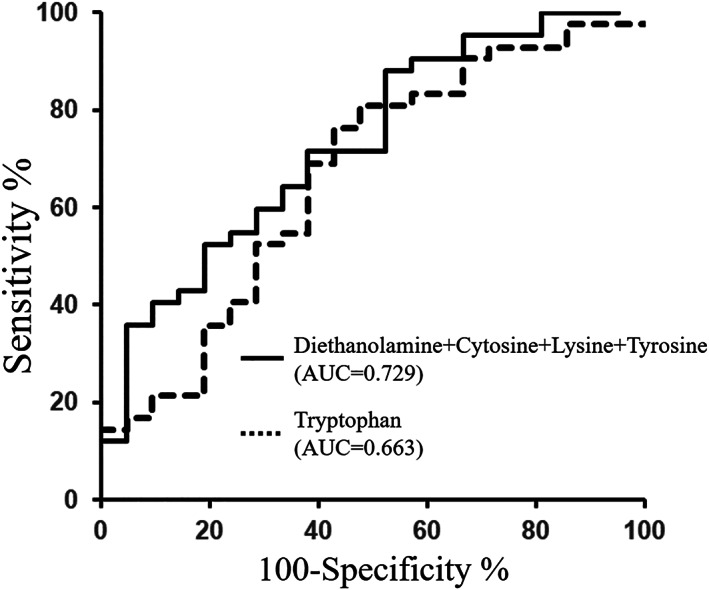
The profiles of 10 salivary metabolites were remarkably different between the LC and BLL samples. Among them, the concentration of salivary tryptophan was significantly lower in the samples from patients with LC than in those from patients with BLL, and the area under the curve (AUC) for discriminating patients with LC from those with BLL was 0.663 (95% confidence interval [CI] = 0.516-0.810, p = 0.036). Furthermore, from the MLR model developed using these metabolites, diethanolamine, cytosine, lysine, and tyrosine, were selected using the back-selection regression method. The MLR model based on these four metabolites had a high discriminatory ability for patients with LC and those with BLL (AUC = 0.729, 95% CI = 0.598-0.861, p = 0.003).
The four salivary metabolites can serve as potential non-invasive biomarkers for distinguishing LC from BLL.
由于唾液具有非侵入性,因此常被用作某些口腔和系统性疾病的诊断生物标志物。在本研究中,我们旨在确定用于区分肺癌(LC)和良性肺病变(BLL)的唾液生物标志物。
收集了 41 例 LC 患者和 21 例 BLL 患者的非刺激性唾液样本。使用毛细管电泳质谱法对唾液代谢物进行了全面分析。为了区分 LC 患者和 BLL 患者,评估了每个生物标志物的区分能力。此外,还建立了多元逻辑回归(MLR)模型来评估每个唾液代谢物的判别能力。
LC 和 BLL 样本之间的 10 种唾液代谢物图谱明显不同。其中,LC 患者的唾液色氨酸浓度明显低于 BLL 患者,区分 LC 患者和 BLL 患者的曲线下面积(AUC)为 0.663(95%置信区间 [CI] = 0.516-0.810,p = 0.036)。此外,使用这些代谢物建立的 MLR 模型中,使用后向选择回归方法选择了二乙醇胺、胞嘧啶、赖氨酸和酪氨酸。基于这四个代谢物的 MLR 模型对 LC 患者和 BLL 患者具有很高的判别能力(AUC = 0.729,95%CI = 0.598-0.861,p = 0.003)。
这四种唾液代谢物可以作为区分 LC 和 BLL 的潜在非侵入性生物标志物。