Department of Microbiology, Perelman School of Medicine, University of Pennsylvania, Philadelphia, PA, 19104-6076, USA.
Department of Microbiology, Perelman School of Medicine, University of Pennsylvania, Philadelphia, PA, 19104-6076, USA.
Tumour Virus Res. 2022 Jun;13:200232. doi: 10.1016/j.tvr.2021.200232. Epub 2021 Dec 15.
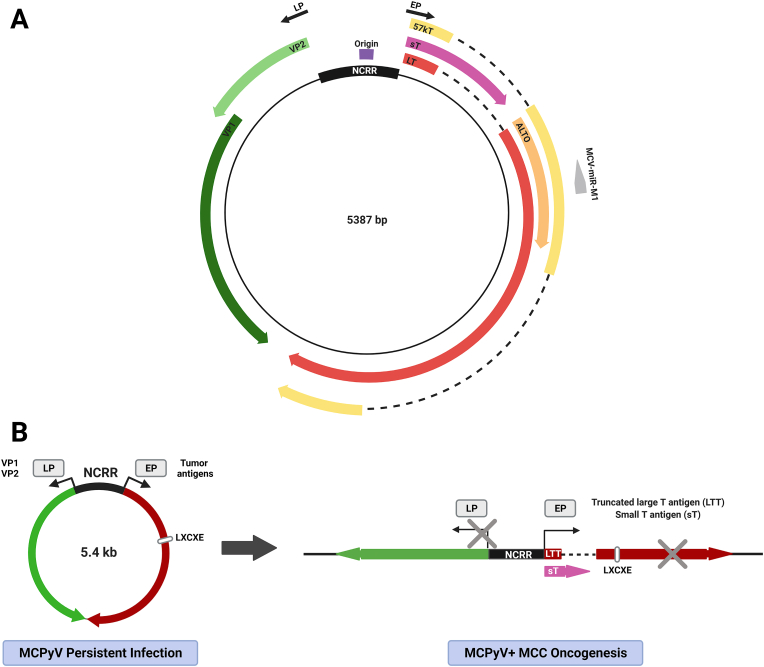
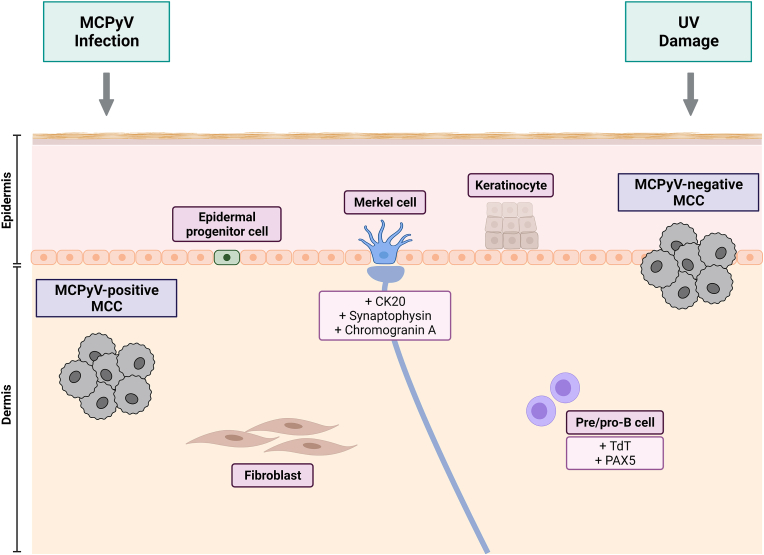
Merkel cell polyomavirus (MCPyV) is a ubiquitous skin infection that can cause Merkel cell carcinoma (MCC), a highly lethal form of skin cancer with a nearly 50% mortality rate. Since the discovery of MCPyV in 2008, great advances have been made to improve our understanding of how the viral encoded oncoproteins contribute to MCC oncogenesis. However, our knowledge of the MCPyV infectious life cycle and its oncogenic mechanisms are still incomplete. The incidence of MCC has tripled over the past two decades, but effective treatments are lacking. Only recently have there been major victories in combatting metastatic MCC with the application of PD-1 immune checkpoint blockade. Still, these immune-based therapies are not ideal for patients with a medical need to maintain systemic immune suppression. As such, a better understanding of MCPyV's oncogenic mechanisms is needed in order to develop more effective and targeted therapies against virus-associated MCC. In this review, we discuss current areas of interest for MCPyV and MCC research and the progress made in elucidating both the natural host of MCPyV infection and the cell of origin for MCC. We also highlight the remaining gaps in our knowledge on the transcriptional regulation of MCPyV, which may be key to understanding and targeting viral oncogenesis for developing future therapies.
默克尔细胞多瘤病毒(Merkel cell polyomavirus,MCPyV)是一种普遍存在于皮肤的感染病毒,可导致默克尔细胞癌(Merkel cell carcinoma,MCC),这是一种具有近 50%死亡率的高度致命性皮肤癌。自 2008 年发现 MCPyV 以来,人们在提高对病毒编码的致癌蛋白如何促进 MCC 致癌作用的理解方面取得了重大进展。然而,我们对 MCPyV 的感染生命周期及其致癌机制的了解仍不完整。过去二十年来,MCC 的发病率增加了两倍,但缺乏有效的治疗方法。直到最近,应用 PD-1 免疫检查点阻断剂才在治疗转移性 MCC 方面取得了重大胜利。尽管如此,这些免疫疗法对于需要维持全身免疫抑制的患者并不理想。因此,为了开发针对与病毒相关的 MCC 的更有效和有针对性的治疗方法,需要更好地了解 MCPyV 的致癌机制。在这篇综述中,我们讨论了当前 MCPyV 和 MCC 研究的关注领域,以及在阐明 MCPyV 感染的天然宿主和 MCC 的起源细胞方面取得的进展。我们还强调了我们对 MCPyV 转录调控的了解仍然存在差距,这可能是理解和靶向病毒致癌作用以开发未来疗法的关键。