Abu Rached Nessr, Becker Jürgen C, Lonsdorf Anke S, Keller Aric, Zeglis Ioannis A, Gambichler Thilo
Skin Cancer Center, Department of Dermatology, Venereology and Allergology, Ruhr-University Bochum, Bochum, Germany.
International Centre for Hidradenitis Suppurativa/Acne Inversa (ICH), Department of Dermatology, Venereology and Allergology, Ruhr-University, Bochum, Germany.
Front Oncol. 2024 Jul 22;14:1427740. doi: 10.3389/fonc.2024.1427740. eCollection 2024.
Merkel cell carcinoma (MCC) is an aggressive skin cancer with a poor prognosis, which only improved with the introduction of immunotherapies. An MCC prediction model with high diagnostic accuracy is lacking. The aim was to develop an MCC prognostic score (MCC-PS) based on combinations of previously proposed risk factors.
A multicentric, retrospective study was conducted to develop MCC-PS, which included age, neuron-specific enolase (NSE), C-reactive protein (CRP), creatinine, bilirubin, and international normalized ratio (INR). Creatinine, bilirubin, and INR were used to calculate the model of end-stage liver disease (MELD) score. A total of 98 patients were included in the study, including 36.7% with stage I according to American Joint Committee on Cancer 2018 ( = 36), 30.6% with stage II ( = 30), 25.5% with stage III ( = 25), and 7.1% with stage IV ( = 7). Survival data of MCC patients were correlated with selected laboratory parameters and risk factors. Primary endpoint was MCC-specific survival (MSS) and the secondary endpoint was progression-free survival. Several statistical methods were used to develop the prognostic score, including correlation analysis, Kaplan-Meier curves, Cox regression, and time-dependent receiver operating characteristic analysis.
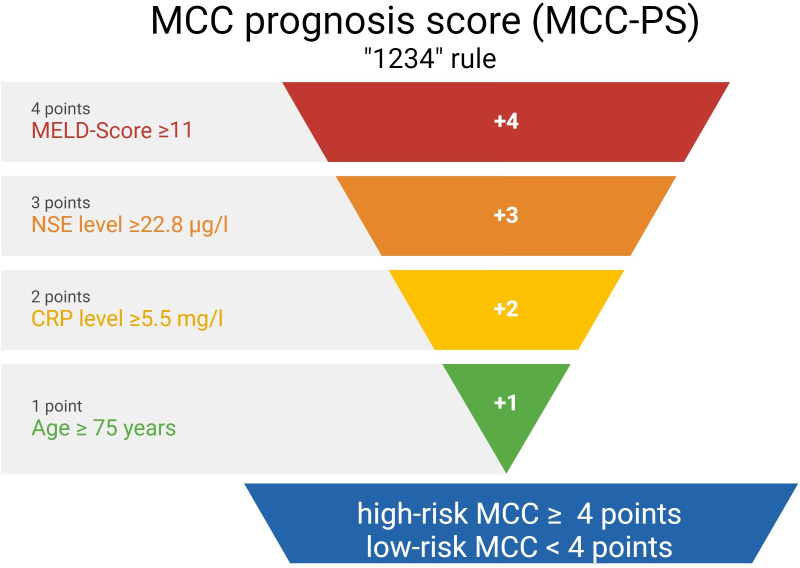
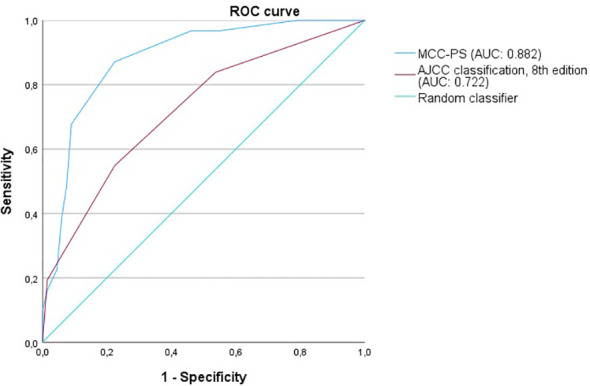
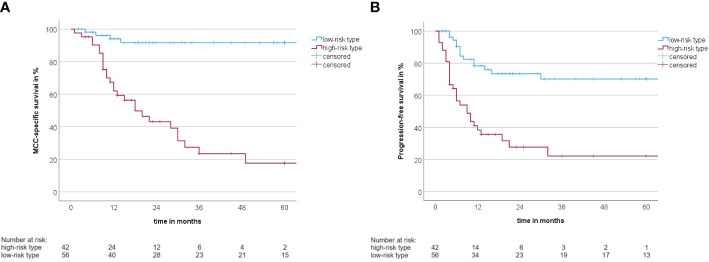
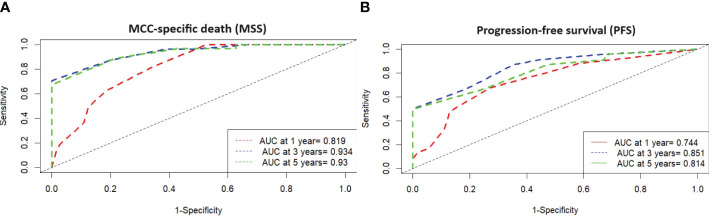
The MCC-PS is based on the sum of the following baseline variables: elevated CRP (≥5.5 mg/l), elevated NSE (≥22.8 µg/l), MELD score ≥ 11, and age ≥ 75 years. An MELD score ≥ 11 was scored as 4 points, elevated NSE level as 3 points, elevated CRP level as 2 points, and age ≥ 75 years as 1 point. A high-risk group according to the MCC-PS was characterized by a score of 4 or more points. The high-risk group was associated with a worse prognosis than the low-risk group (1-year MSS 62%, 2-year 43.1%, 5-year 17.6% as compared to 1-year MSS 79.5%, 3-year 75%, 5-year 72%). Notably, the developed MCC-PS predicts MCC outcome measures with high accuracy (3-year MSS: area under the curve (AUC) 0.934, sensitivity 87.5% and specificity 82.2%; 5-year MSS: AUC 0.93, sensitivity 89% and specificity 82%).
MCC-PS is the first prognostic score predicting MCC outcome with a high accuracy based on five easily available laboratory parameters and patient's age. An MCC-PS of 4 or more indicates a high-risk patient associated with a poor prognosis.
默克尔细胞癌(MCC)是一种侵袭性皮肤癌,预后较差,免疫疗法的引入才使其有所改善。目前缺乏具有高诊断准确性的MCC预测模型。本研究旨在基于先前提出的风险因素组合开发一种MCC预后评分(MCC - PS)。
进行了一项多中心回顾性研究以开发MCC - PS,该研究纳入了年龄、神经元特异性烯醇化酶(NSE)、C反应蛋白(CRP)、肌酐、胆红素和国际标准化比值(INR)。肌酐、胆红素和INR用于计算终末期肝病模型(MELD)评分。共有98例患者纳入研究,根据美国癌症联合委员会2018年标准,I期患者占36.7%(n = 36),II期患者占30.6%(n = 30),III期患者占25.5%(n = 25),IV期患者占7.1%(n = 7)。MCC患者的生存数据与选定的实验室参数和风险因素相关。主要终点是MCC特异性生存(MSS),次要终点是无进展生存。使用了多种统计方法来开发预后评分,包括相关性分析、Kaplan - Meier曲线、Cox回归和时间依赖性受试者工作特征分析。
MCC - PS基于以下基线变量之和:CRP升高(≥5.5 mg/l)、NSE升高(≥22.8 μg/l)、MELD评分≥11以及年龄≥75岁。MELD评分≥11计4分,NSE水平升高计3分,CRP水平升高计2分,年龄≥75岁计1分。根据MCC - PS,评分4分及以上为高危组。高危组的预后比低危组差(1年MSS:62%,2年43.1%,5年17.6%,而低危组1年MSS为79.5%,3年75%,5年72%)。值得注意的是,所开发的MCC - PS能高度准确地预测MCC的预后指标(3年MSS:曲线下面积(AUC)为0.934,敏感性87.5%,特异性82.2%;5年MSS:AUC为0.93,敏感性89%,特异性82%)。
MCC - PS是首个基于五个易于获取的实验室参数和患者年龄,能高度准确预测MCC预后的评分系统。MCC - PS为4分及以上表明患者为高危,预后较差。