Health Economics and Outcomes Research, Bristol Myers Squibb, Rueil-Malmaison, France.
Biostatistic Team, Bordeaux Population Health Center, ISPED, Centre INSERM U1219, INSERM, Bordeaux, France.
ESMO Open. 2022 Feb;7(1):100340. doi: 10.1016/j.esmoop.2021.100340. Epub 2021 Dec 17.
Time to next treatment or death (TNT-D) may be a patient-relevant endpoint in patients treated with immune checkpoint inhibitors. This study investigated TNT-D as a surrogate endpoint (SE) for overall survival (OS) in previously untreated advanced melanoma patients.
Patient-level data from the 60-month results of the CheckMate 067 randomised, controlled trial were used. Analyses were carried out for nivolumab monotherapy or nivolumab with ipilimumab versus ipilimumab monotherapy. The SE 1-step validation method based on a joint frailty-copula model was used where the country of enrolment was applied to define clusters. Kendall's τ and the coefficient of determination (R) were estimated for respective measurements of association at the individual and cluster levels. The surrogate threshold effect, the maximum threshold hazard ratio for TNT-D that would translate into OS benefit, was estimated. A leave-one-out cross-validation analysis was carried out to evaluate model robustness.
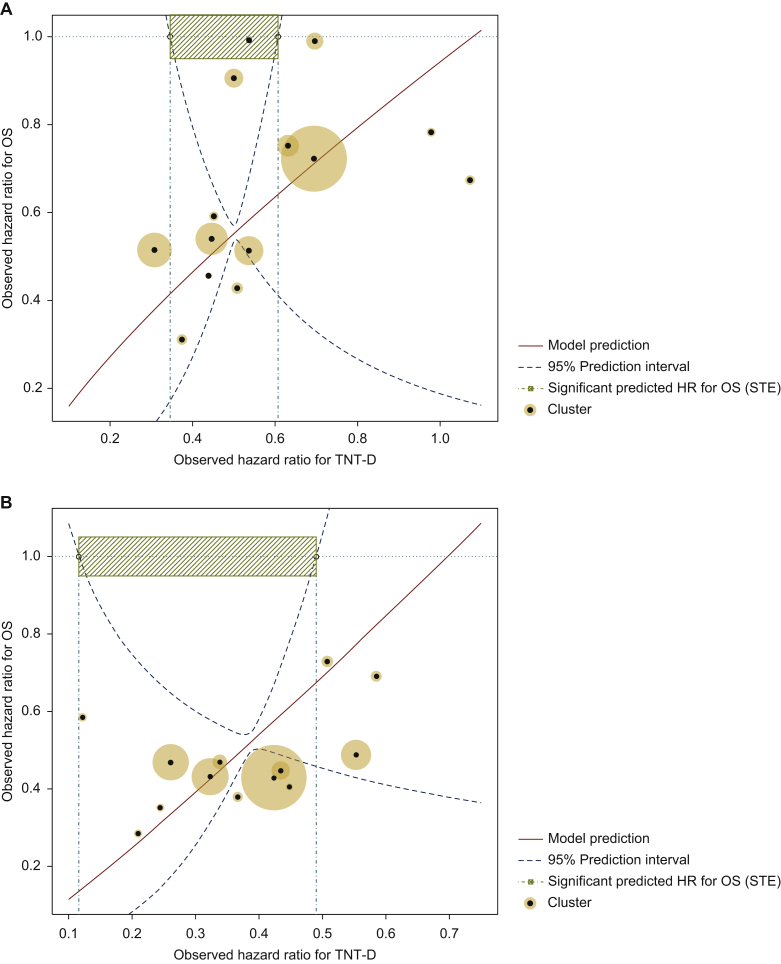
Fifteen clusters of data were generated from 945 patients. For both nivolumab-containing arms, the association between TNT-D and OS was deemed acceptable at the individual level (Kendall's τ > 0.60) and strong at the cluster level, with R fairly close to 1, with narrow confidence intervals. The estimated surrogate threshold effects were 0.61 for nivolumab versus ipilimumab and 0.49 for nivolimub + ipilimumab versus ipilimumab. Cross-validation results showed minimum variation of the correlation measures and satisfactory predictive accuracy for the model.
Results suggest that TNT-D may be a valuable SE in previously untreated advanced melanoma patients treated with immune checkpoint inhibitors. Surrogacy analyses considering multiple randomised controlled trials are warranted for confirming these findings.
在接受免疫检查点抑制剂治疗的患者中,下一次治疗或死亡时间(TNT-D)可能是一个与患者相关的终点。本研究调查了 TNT-D 作为未经治疗的晚期黑色素瘤患者总生存(OS)的替代终点(SE)。
使用 CheckMate 067 随机对照试验 60 个月结果的患者水平数据进行分析。分析包括纳武单抗单药治疗或纳武单抗联合伊匹单抗与伊匹单抗单药治疗。使用基于联合脆弱性- Copula 模型的 SE 1 步验证方法,其中入组国家用于定义聚类。在个体和聚类水平上,分别估计了各自关联的 Kendall's τ 和决定系数(R)。估计了 TNT-D 的替代阈值效应,即 TNT-D 的最大阈值风险比,可转化为 OS 获益。进行了留一交叉验证分析以评估模型的稳健性。
从 945 名患者中生成了 15 个数据聚类。对于包含纳武单抗的两个臂,TNT-D 与 OS 的关联在个体水平上被认为是可以接受的(Kendall's τ>0.60),在聚类水平上很强,R 相当接近 1,置信区间较窄。估计的替代阈值效应分别为纳武单抗联合伊匹单抗对比伊匹单抗为 0.61,纳武单抗单药治疗对比伊匹单抗为 0.49。交叉验证结果表明,相关度量的变化最小,模型具有令人满意的预测准确性。
结果表明,在接受免疫检查点抑制剂治疗的未经治疗的晚期黑色素瘤患者中,TNT-D 可能是一个有价值的 SE。需要进行考虑多个随机对照试验的替代分析,以确认这些发现。