Jang Kyeongmin, Jo Eunmi, Song Kyoung Jun
Department of Nursing, Bucheon University, 56, Sosa-ro, Bucheon-si, Gyeonggi-do, Republic of Korea.
Department of Nursing, Seoul Metropolitan Government-Seoul National University Boramae Medical Center, 20 Boramae-ro 5-gil, Dongjak-gu, 07061, Seoul, Korea.
BMC Nurs. 2021 Dec 20;20(1):256. doi: 10.1186/s12912-021-00781-2.
Differences in the classification results among triage nurses in the emergency room can be improved by training or applying an algorithm. This study aimed to confirm whether the agreement among triage nurses could be improved through learner-led problem-based learning.
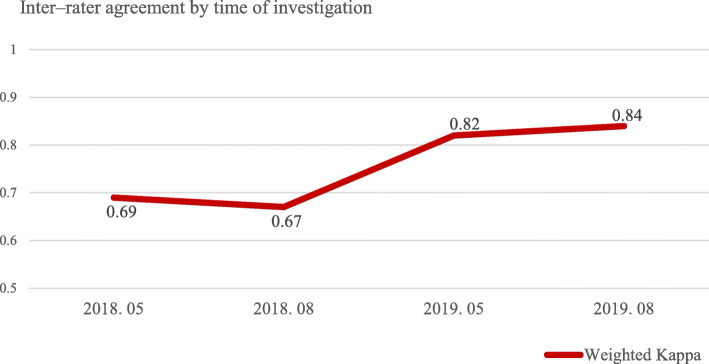
This study had a single-group time series design to investigate the effect of problem-based learning led by triage nurses on the agreement of Korean Triage and Acuity Scale classification results for patients who visited the emergency department. We extracted 300 patients each in May and August 2018 before learning began and 300 patients each in May and August 2019 after learning.
After problem-based learning was applied, the self-efficacy of triage nurses for emergency patient classification increased statistically significantly compared to before learning (7.88 ± 0.96, p < .001), and the weighted kappa coefficient was also found to be almost perfectly agreement (0.835, p < .001).
In this study, problem-based learning improved the inter-rater agreement of Korean Triage and Acuity Scale classification results and self-efficacy of triage nurses. Therefore, problem-based learning can contribute to patient safety in the emergency department by enhancing the expertise of triage nurses and increasing the accuracy of triage classification.
通过培训或应用算法可以改善急诊室分诊护士分类结果的差异。本研究旨在确认是否可以通过以学习者为导向的基于问题的学习来提高分诊护士之间的一致性。
本研究采用单组时间序列设计,以调查分诊护士主导的基于问题的学习对急诊科就诊患者韩国分诊及 acuity 量表分类结果一致性的影响。我们在学习开始前的 2018 年 5 月和 8 月各抽取 300 例患者,在学习后的 2019 年 5 月和 8 月各抽取 300 例患者。
应用基于问题的学习后,分诊护士对急诊患者分类的自我效能感与学习前相比有统计学显著提高(7.88±0.96,p<0.001),加权 kappa 系数也显示几乎完全一致(0.835,p<0.001)。
在本研究中,基于问题的学习提高了韩国分诊及 acuity 量表分类结果的评分者间一致性和分诊护士的自我效能感。因此,基于问题的学习可以通过提高分诊护士的专业水平和增加分诊分类的准确性,为急诊科的患者安全做出贡献。