Chu Joanna Ting Wai, Wadham Angela, Jiang Yannan, Stasiak Karolina, Shepherd Matthew, Bullen Christopher
The National Institute for Health Innovation, School of Population Health, University of Auckland, Auckland, New Zealand.
Department of Psychological Medicine, Faculty of Medical and Health Sciences, University of Auckland, Auckland, New Zealand.
JMIR Pediatr Parent. 2021 Dec 20;4(4):e17723. doi: 10.2196/17723.
Parenting programs are well established as an effective strategy for enhancing both parenting skills and the well-being of the child. However, recruitment for family programs in clinical and nonclinical settings remains low.
This study aims to describe the recruitment and retention methods used in a text messaging program (MyTeen) trial for parents of adolescents (10-15 years) and identify key lessons learned. We aim to provide insights and direction for researchers who seek to recruit parents and build on the limited literature on recruitment and retention strategies for parenting program trials.
A recruitment plan was developed, monitored, and modified as needed throughout the course of the project. Strategies to facilitate recruitment were identified (eg, program content and recruitment material, staff characteristics, and study procedures). Traditional and web-based recruitment strategies were used.
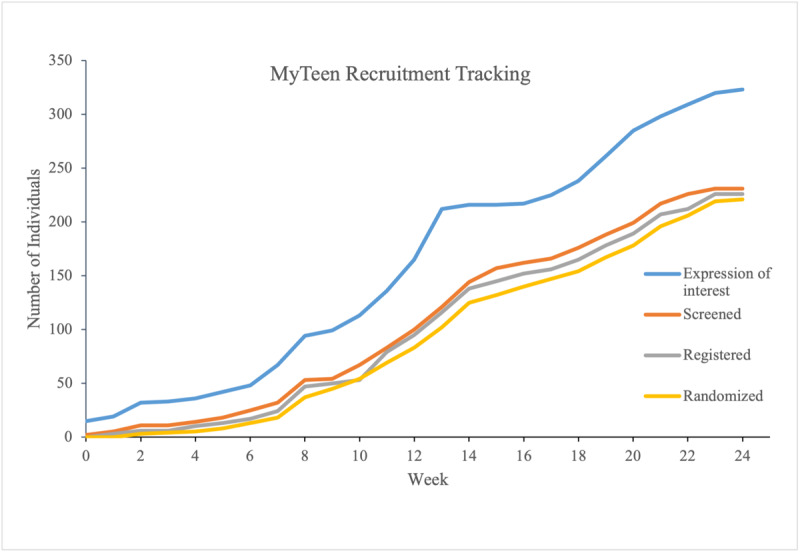
Over a 5-month period, 319 parents or caregivers expressed interest in our study, of which 221 agreed to participate in the study, exceeding our recruitment target of 214 participants. Attrition was low at the 1-month (4.5% overall; intervention group: n=5, 4.6%; control group: n=5, 4.5%) and 3-month follow-ups (9% overall; intervention group: n=10, 9.2%; control group: n=10, 8.9%).
The use of web-based recruitment strategies appeared to be most effective for recruiting and retaining parents in a text-messaging program trial. However, we encountered recruitment challenges (ie, underrepresentation of ethnic minority groups and fathers) similar to those reported in the literature. Therefore, efforts to engage ethnic minorities and fathers are needed.
Australian New Zealand Clinical Trials Registry ACTRN12618000117213; https://www.anzctr.org.au/Trial/Registration/TrialReview.aspx?id=374307.
育儿项目已被确认为提升育儿技能和儿童幸福感的有效策略。然而,临床和非临床环境中家庭项目的招募率仍然很低。
本研究旨在描述针对青少年(10 - 15岁)父母的短信项目(MyTeen)试验中所使用的招募和留存方法,并确定关键经验教训。我们旨在为寻求招募父母的研究人员提供见解和方向,并基于育儿项目试验招募和留存策略方面有限的文献进行拓展。
制定了一份招募计划,并在项目过程中根据需要进行监测和修改。确定了促进招募的策略(例如,项目内容和招募材料、工作人员特征以及研究程序)。使用了传统和基于网络的招募策略。
在5个月的时间里,319名父母或照顾者对我们的研究表示感兴趣,其中221人同意参与研究,超过了我们214名参与者的招募目标。在1个月随访时流失率较低(总体4.5%;干预组:n = 5,4.6%;对照组:n = 5,4.5%),3个月随访时也较低(总体9%;干预组:n = 10,9.2%;对照组:n = 10,8.9%)。
在短信项目试验中,基于网络的招募策略似乎最有效地招募和留存了父母。然而,我们遇到了与文献中报道类似的招募挑战(即少数民族群体和父亲的代表性不足)。因此,需要努力吸引少数民族和父亲参与。
澳大利亚新西兰临床试验注册中心ACTRN12618000117213;https://www.anzctr.org.au/Trial/Registration/TrialReview.aspx?id=374307