Center for Research in Indigenous Health, Wuqu' Kawoq, Tecpán, Chimaltenango, Guatemala.
Centre for Evidence-Based Development, Fundación Desarrolla Guatemala para la Educación y Salud (FUNDEGUA), Guatemala City, Guatemala.
Glob Health Sci Pract. 2021 Dec 21;9(4):752-764. doi: 10.9745/GHSP-D-20-00585. Print 2021 Dec 31.
Child stunting is a critical global health issue. Guatemala has one of the world's highest levels of stunting despite the sustained commitment to international nutrition policy best practices endorsed by the Scaling Up Nutrition (SUN) movement. Our objective was to use Guatemala as a case study to project the impact of a recently published national nutrition policy, the Great Crusade, that is consistent with SUN principles.
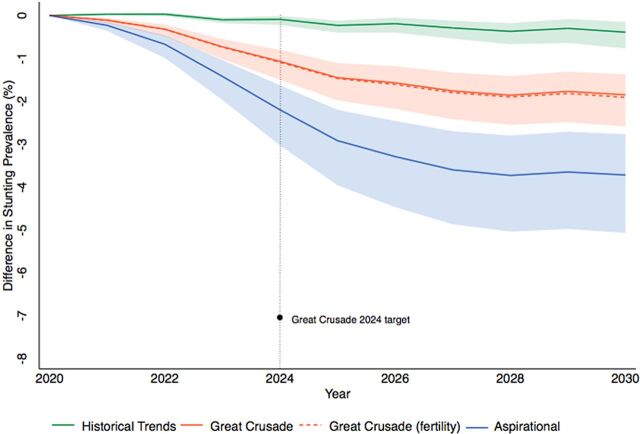
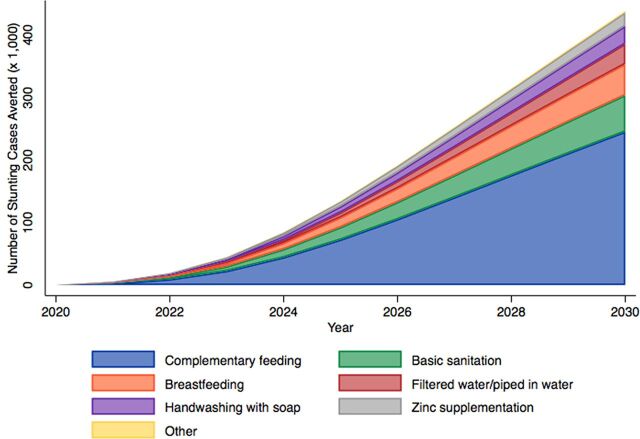
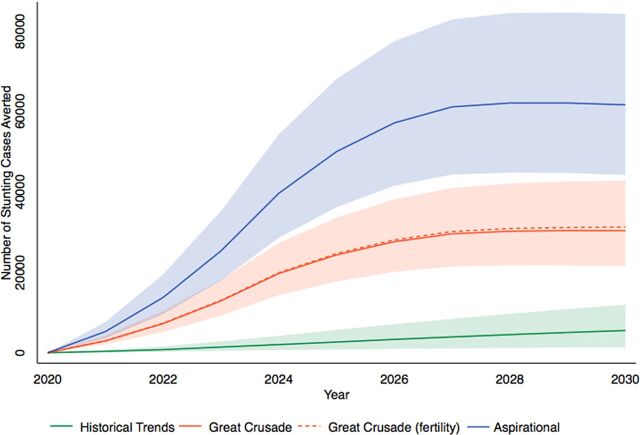
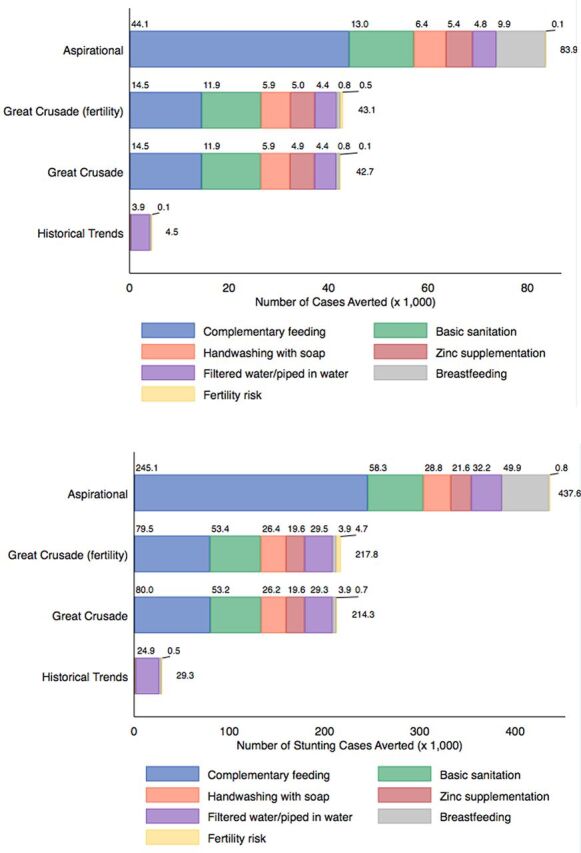
We used the Lives Saved Tool (LiST) to project the impact of scaling-up of nutrition interventions proposed in the Great Crusade and recommended by SUN. Our outcomes were changes in stunting prevalence, number of stunting cases averted, and number of cases averted by intervention in children under 5 years of age from 2020 to 2030. We considered 4 scenarios: (1) intervention coverage continues based on historical trends, (2) coverage targets in the Great Crusade are achieved, (3) coverage targets in the Great Crusade are achieved with reduced fertility risk, and (4) coverage reaches an aspirational level.
All scenarios led to modest reductions in stunting prevalence. In 2024, stunting prevalence was estimated to change by -0.1% (95% confidence interval [CI]= 0.0%,-0.2%) if historical trends continue, -1.1% (95% CI=-0.8%,-1.5%) in the Great Crusade scenario, and -2.2% (95% CI=-1.6%,-3.0%) in the aspirational scenario. In 2030, we projected a stunting prevalence of -0.4% (95% CI=-0.2%,-0.8%) and -3.7% (95% CI=-2.8%,-5.1%) in the historical trends and aspirational scenario, respectively. Complementary feeding, sanitation, and breastfeeding were the highest-impact interventions across models.
Targeted reductions in child stunting prevalence in Guatemala are unlikely to be achieved solely based on increases in intervention coverage. Our results show the limitations of current paradigms recommended by the international nutrition community. Policies and strategies are needed to address the broader structural drivers of stunting.
儿童发育迟缓是一个全球性的重大健康问题。危地马拉是世界上发育迟缓率最高的国家之一,尽管其一直致力于国际营养政策最佳实践,并得到了“营养促进可持续发展”运动的认可。我们的目标是以危地马拉为例,预测最近发布的符合“营养促进可持续发展”原则的国家营养政策“大进军”的影响。
我们使用生命挽救工具(LiST)来预测“大进军”中提出的营养干预措施的扩大规模以及“营养促进可持续发展”所建议的措施的影响。我们的结果是 2020 年至 2030 年期间,5 岁以下儿童发育迟缓流行率的变化、发育迟缓病例数的减少以及干预措施所避免的病例数。我们考虑了 4 种情况:(1)基于历史趋势,干预措施的覆盖范围继续扩大;(2)实现“大进军”中的覆盖目标;(3)实现“大进军”中的覆盖目标,同时降低生育风险;(4)实现有抱负的覆盖水平。
所有情景都导致发育迟缓流行率略有下降。如果按照历史趋势,2024 年估计发育迟缓流行率将变化-0.1%(95%置信区间[CI]=0.0%,-0.2%);“大进军”情景下为-1.1%(95% CI=-0.8%,-1.5%);在有抱负的情景下为-2.2%(95% CI=-1.6%,-3.0%)。到 2030 年,我们预计历史趋势和有抱负的情景下的发育迟缓流行率分别为-0.4%(95% CI=-0.2%,-0.8%)和-3.7%(95% CI=-2.8%,-5.1%)。补充喂养、卫生和母乳喂养是所有模型中影响最大的干预措施。
仅通过增加干预措施的覆盖范围,危地马拉儿童发育迟缓流行率的目标降低不太可能实现。我们的结果表明了国际营养界推荐的现有模式的局限性。需要政策和战略来解决造成发育迟缓的更广泛的结构性驱动因素。