Department of Clinical Sciences and Community Health, University of Milan, Milan, Italy.
Fondazione IRCCS Ca' Granda Ospedale Maggiore Policlinico, Milan, Italy.
Med Lav. 2021 Dec 23;112(6):477-485. doi: 10.23749/mdl.v112i6.12507.
In Italy, healthcare workers (HCWs) were among the first to receive COVID-19 vaccination. Aim of the present study is to evaluate frequency and severity of adverse events (AEs) following the second dose of BNT162b2 vaccine among HCWs of a large university hospital in Milan, Italy.
One month after having received the second dose of vaccine, HCWs filled-in a form about type, severity, and duration of post-vaccination local and systemic symptoms. We calculated the overall frequency of AEs and used multivariable Poisson regression models (adjusted for sex, age, BMI, smoking, allergy history, previous SARS-CoV-2 infection, anti-hypertensive therapy, and occupation) to calculate risk ratios (RR) and 95% confidence intervals (CI) of AEs according to selected variables.
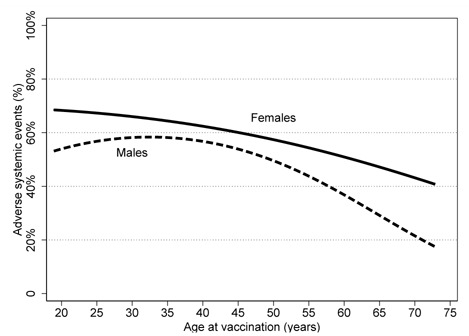
We included 3659 HCWs. Overall, 2801 (76.6%) experienced at least one local event, with pain at injection site being the most frequent (2788, 76.2%). Systemic events were reported by 2080 (56.8%) HCWs, with fatigue (52.3%), muscle pain (42.2%), headache (37.7%), joint pain (31.9%), and fever (26.2%) being the most frequent. Risks of systemic events were associated with female gender (RR=1.14, CI: 1.06-1.23), age (strong decrease with increasing age, p-trend<0.001), allergy history (RR=1.13, CI: 1.05-1.20), and current smoking (RR=0.90, CI: 0.84-0.97). HCWs with previous SARS-CoV-2 infection (even if symptomatic) were not at increased risk.
Both local and systemic acute effects after second dose of BNT162b2 vaccine were frequently reported. However, symptoms were mostly light/mild and of short duration. Thus, our findings support the safety of COVID-19 vaccination in adults in relatively good health.
在意大利,医护人员(HCWs)是首批接种 COVID-19 疫苗的人群之一。本研究旨在评估意大利米兰一家大型大学医院的 HCWs 接种 BNT162b2 疫苗第二剂后不良事件(AEs)的发生频率和严重程度。
在接种第二剂疫苗后一个月,HCWs 填写了一份关于接种后局部和全身症状的类型、严重程度和持续时间的表格。我们计算了 AEs 的总体发生率,并使用多变量泊松回归模型(根据性别、年龄、BMI、吸烟、过敏史、既往 SARS-CoV-2 感染、抗高血压治疗和职业进行调整),根据选定的变量计算 AEs 的风险比(RR)和 95%置信区间(CI)。
我们纳入了 3659 名 HCWs。总体而言,2801 名(76.6%)至少经历过一次局部事件,最常见的是注射部位疼痛(2788 名,76.2%)。2080 名(56.8%)HCWs 报告了全身事件,最常见的是疲劳(52.3%)、肌肉疼痛(42.2%)、头痛(37.7%)、关节痛(31.9%)和发热(26.2%)。全身事件的风险与女性性别(RR=1.14,CI:1.06-1.23)、年龄(随年龄增长而显著下降,p<0.001)、过敏史(RR=1.13,CI:1.05-1.20)和当前吸烟(RR=0.90,CI:0.84-0.97)有关。既往 SARS-CoV-2 感染(即使有症状)的 HCWs 并未增加风险。
接种 BNT162b2 疫苗第二剂后,局部和全身的急性效应均较常见。然而,症状大多为轻/中度,持续时间短。因此,我们的发现支持 COVID-19 疫苗在相对健康的成年人中的安全性。