Collivignarelli Maria Cristina, Abbà Alessandro, Caccamo Francesca Maria, Carnevale Miino Marco, Durante Angela, Bellazzi Stefano, Baldi Marco, Bertanza Giorgio
Department of Civil Engineering and Architecture, University of Pavia, Via Ferrata 3, 27100 Pavia, Italy.
Interdepartmental Centre for Water Research, University of Pavia, Via Ferrata 3, 27100 Pavia, Italy.
Membranes (Basel). 2021 Dec 12;11(12):977. doi: 10.3390/membranes11120977.
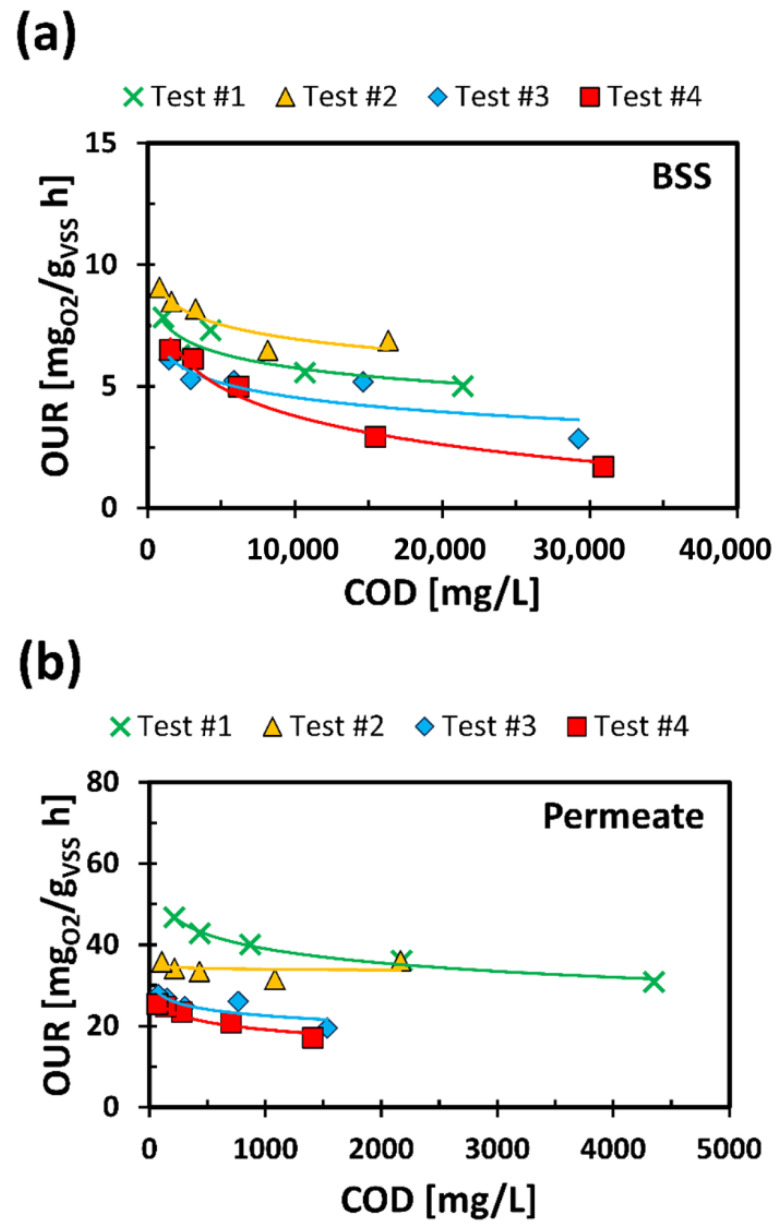
Minimizing the biological sewage sludge (BSS) produced by wastewater treatment plants (WWTPs) represents an increasingly difficult challenge. With this goal, tests on a semi-full scale Thermophilic Alternate Membrane Biological Reactor (ThAlMBR) were carried out for 12 months. ThAlMBR was applied both on thickened (TBSS) and digested biological sewage sludge (DBSS) with alternating aeration conditions, and emerged: (i) high COD removal yields (up to 90%), (ii) a low specific sludge production (0.02-0.05 kg/kg), (iii) the possibility of recovery the aqueous carbon residue (permeate) in denitrification processes, replacing purchased external carbon sources. Based on the respirometric tests, an excellent biological treatability of the permeate by the mesophilic biomass was observed and the denitrification kinetics reached with the diluted permeate ((4.0 mgN-NO/(g h)) were found comparable to those of methanol (4.4 mgN-NO/(g h)). Moreover, thanks to the similar results obtained on TBSS and DBSS, ThAlMBR proved to be compatible with diverse sludge line points, ensuring in both cases an important sludge minimization.
尽量减少污水处理厂(WWTPs)产生的生物污水污泥(BSS)是一项日益艰巨的挑战。为实现这一目标,对一个半规模的嗜热交替膜生物反应器(ThAlMBR)进行了为期12个月的测试。ThAlMBR在交替曝气条件下应用于浓缩生物污水污泥(TBSS)和消化生物污水污泥(DBSS),结果表明:(i)化学需氧量(COD)去除率高(高达90%);(ii)污泥产量低(0.02-0.05 kg/kg);(iii)在反硝化过程中有可能回收水相碳残余物(渗透液),从而替代购买的外部碳源。基于呼吸测定试验,观察到嗜温生物质对渗透液具有优异的生物可处理性,并且发现稀释后的渗透液达到的反硝化动力学(4.0 mgN-NO/(g h))与甲醇的反硝化动力学(4.4 mgN-NO/(g h))相当。此外,由于在TBSS和DBSS上获得了相似的结果,ThAlMBR被证明与不同的污泥处理点兼容,在两种情况下都确保了显著的污泥减量。