Wu Jingyi, Lin Yu, Li Pengfei, Hu Yonghua, Zhang Luxia, Kong Guilan
National Institute of Health Data Science, Peking University, Beijing 100191, China.
Advanced Institute of Information Technology, Peking University, Hangzhou 311215, China.
Diagnostics (Basel). 2021 Nov 30;11(12):2242. doi: 10.3390/diagnostics11122242.
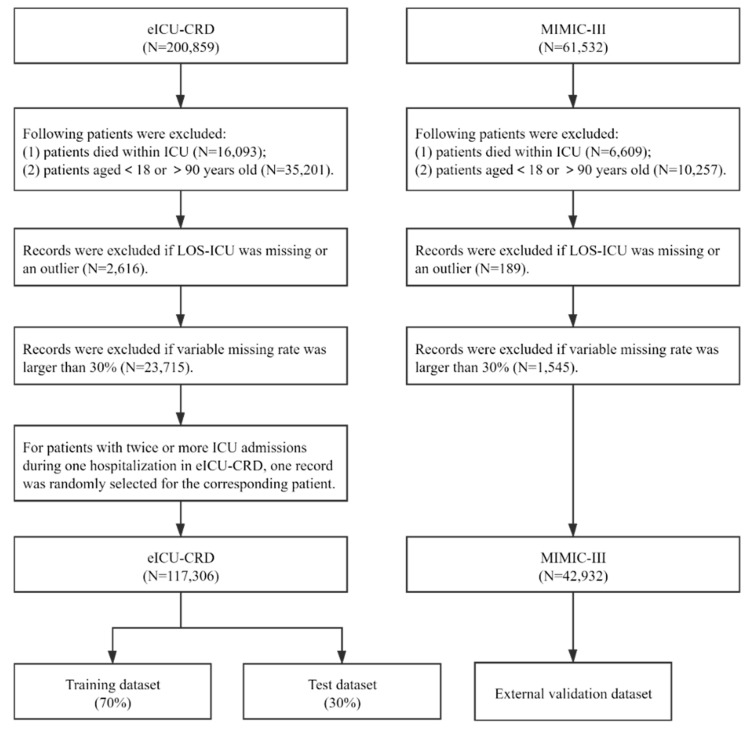
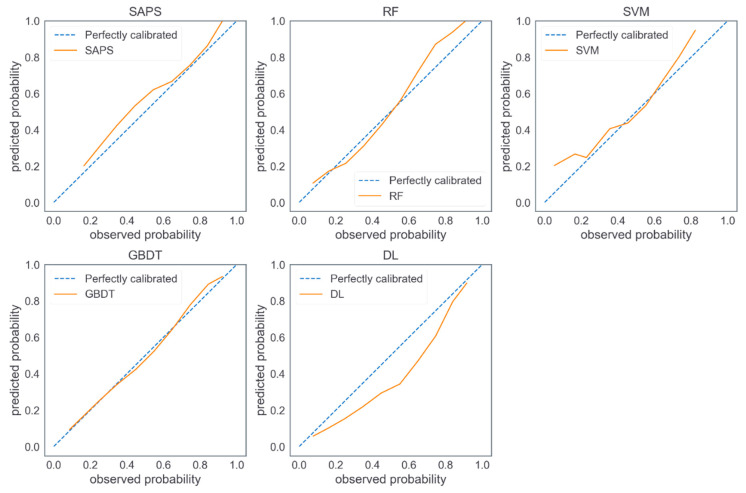
This study aimed to construct machine learning (ML) models for predicting prolonged length of stay (pLOS) in intensive care units (ICU) among general ICU patients. A multicenter database called eICU (Collaborative Research Database) was used for model derivation and internal validation, and the Medical Information Mart for Intensive Care (MIMIC) III database was used for external validation. We used four different ML methods (random forest, support vector machine, deep learning, and gradient boosting decision tree (GBDT)) to develop prediction models. The prediction performance of the four models were compared with the customized simplified acute physiology score (SAPS) II. The area under the receiver operation characteristic curve (AUROC), area under the precision-recall curve (AUPRC), estimated calibration index (ECI), and Brier score were used to measure performance. In internal validation, the GBDT model achieved the best overall performance (Brier score, 0.164), discrimination (AUROC, 0.742; AUPRC, 0.537), and calibration (ECI, 8.224). In external validation, the GBDT model also achieved the best overall performance (Brier score, 0.166), discrimination (AUROC, 0.747; AUPRC, 0.536), and calibration (ECI, 8.294). External validation showed that the calibration curve of the GBDT model was an optimal fit, and four ML models outperformed the customized SAPS II model. The GBDT-based pLOS-ICU prediction model had the best prediction performance among the five models on both internal and external datasets. Furthermore, it has the potential to assist ICU physicians to identify patients with pLOS-ICU risk and provide appropriate clinical interventions to improve patient outcomes.
本研究旨在构建机器学习(ML)模型,以预测普通重症监护病房(ICU)患者在重症监护病房的延长住院时间(pLOS)。一个名为eICU(协作研究数据库)的多中心数据库用于模型推导和内部验证,而重症监护医学信息集市(MIMIC)III数据库用于外部验证。我们使用四种不同的ML方法(随机森林、支持向量机、深度学习和梯度提升决策树(GBDT))来开发预测模型。将这四种模型的预测性能与定制的简化急性生理学评分(SAPS)II进行比较。采用受试者操作特征曲线下面积(AUROC)、精确召回率曲线下面积(AUPRC)、估计校准指数(ECI)和布里尔评分来衡量性能。在内部验证中,GBDT模型在总体性能(布里尔评分,0.164)、辨别力(AUROC,0.742;AUPRC,0.537)和校准(ECI,8.224)方面表现最佳。在外部验证中,GBDT模型同样在总体性能(布里尔评分,0.166)、辨别力(AUROC,0.747;AUPRC,0.536)和校准(ECI,8.294)方面表现最佳。外部验证表明,GBDT模型的校准曲线拟合最优,并且四种ML模型均优于定制的SAPS II模型。基于GBDT的pLOS-ICU预测模型在内部和外部数据集的五种模型中预测性能最佳。此外,它有潜力协助ICU医生识别有pLOS-ICU风险的患者,并提供适当的临床干预措施以改善患者预后。