Domingo Sandra, Solé Cristina, Moliné Teresa, Ferrer Berta, Cortés-Hernández Josefina
Lupus Unit, Rheumatology Departament, Hospital Universitari Vall d'Hebron, Institut de Recerca (VHIR), Universitat Autonoma de Barcelona, 08035 Barcelona, Spain.
Department of Pathology, Hospital Universitari Vall d'Hebron, Universitat Autònoma de Barcelona, 08035 Barcelona, Spain.
Biomedicines. 2021 Dec 7;9(12):1857. doi: 10.3390/biomedicines9121857.
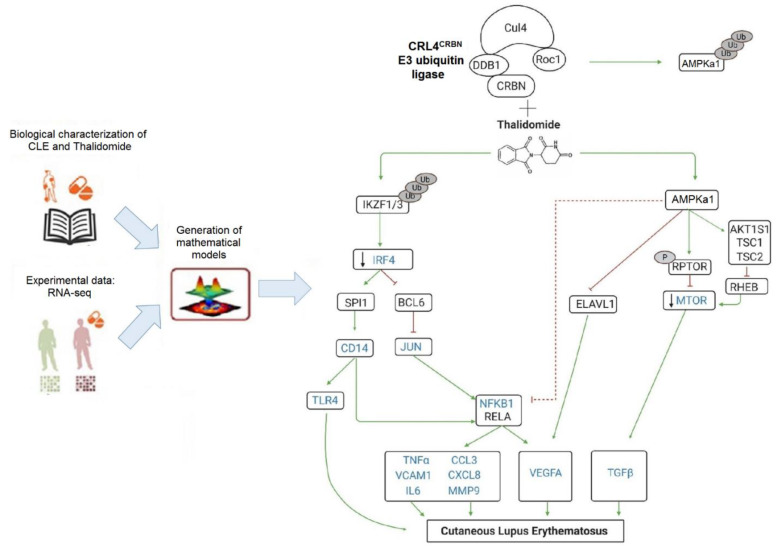
Thalidomide is effective in patients with refractory cutaneous lupus erythematosus (CLE). However, the mechanism of action is not completely understood, and its use is limited by its potential, severe side-effects. Immune cell subset analysis in thalidomide's CLE responder patients showed a reduction of circulating and tissue cytotoxic T-cells with an increase of iNKT cells and a shift towards a Th2 response. We conducted an RNA-sequencing study using CLE skin biopsies performing a Therapeutic Performance Mapping System (TMPS) analysis in order to generate a predictive model of its mechanism of action and to identify new potential therapeutic targets. Integrating RNA-seq data, public databases, and literature, TMPS analysis generated mathematical models which predicted that thalidomide acts via two CRBN-CRL4A- (CRL4) dependent pathways: IRF4/NF-ҡB and AMPK1/mTOR. Skin biopsies showed a significant reduction of IRF4 and mTOR in post-treatment samples by immunofluorescence. In vitro experiments confirmed the effect of thalidomide downregulating IRF4 in PBMCs and mTOR in keratinocytes, which converged in an NF-ҡB reduction that led to a resolution of the inflammatory lesion. These results emphasize the anti-inflammatory role of thalidomide in CLE treatment, providing novel molecular targets for the development of new therapies that could avoid thalidomide's side effects while maintaining its efficacy.
沙利度胺对难治性皮肤红斑狼疮(CLE)患者有效。然而,其作用机制尚未完全明确,且因其潜在的严重副作用,应用受限。对沙利度胺治疗有效的CLE患者进行免疫细胞亚群分析发现,循环及组织中的细胞毒性T细胞减少,不变自然杀伤T细胞(iNKT细胞)增加,且向Th2反应转变。我们使用CLE皮肤活检样本进行了一项RNA测序研究,并采用治疗性能映射系统(TMPS)分析,以生成其作用机制的预测模型,并确定新的潜在治疗靶点。通过整合RNA测序数据、公共数据库及文献,TMPS分析生成了数学模型,预测沙利度胺通过两条CRBN-CRL4A-(CRL4)依赖性途径发挥作用:IRF4/NF-ҡB和AMPK1/mTOR。皮肤活检样本的免疫荧光检测显示,治疗后样本中的IRF4和mTOR显著减少。体外实验证实,沙利度胺可下调外周血单核细胞(PBMC)中的IRF4及角质形成细胞中的mTOR,二者共同作用使NF-ҡB减少,从而使炎症性病变消退。这些结果强调了沙利度胺在CLE治疗中的抗炎作用,为开发新疗法提供了新的分子靶点,有望在维持疗效的同时避免沙利度胺的副作用。