Ohkuma Ryotaro, Ieguchi Katsuaki, Watanabe Makoto, Takayanagi Daisuke, Goshima Tsubasa, Onoue Rie, Hamada Kazuyuki, Kubota Yutaro, Horiike Atsushi, Ishiguro Tomoyuki, Hirasawa Yuya, Ariizumi Hirotsugu, Tsurutani Junji, Yoshimura Kiyoshi, Tsuji Mayumi, Kiuchi Yuji, Kobayashi Shinichi, Tsunoda Takuya, Wada Satoshi
Department of Clinical Diagnostic Oncology, Clinical Research Institute for Clinical Pharmacology & Therapeutics, Showa University, 6-11-11, Kitakarasuyama, Setagaya-ku, Tokyo 157-8577, Japan.
Department of Medicine, Division of Medical Oncology, School of Medicine, Showa University, 1-5-8, Hatanodai, Shinagawa-ku, Tokyo 142-8555, Japan.
Biomedicines. 2021 Dec 16;9(12):1929. doi: 10.3390/biomedicines9121929.
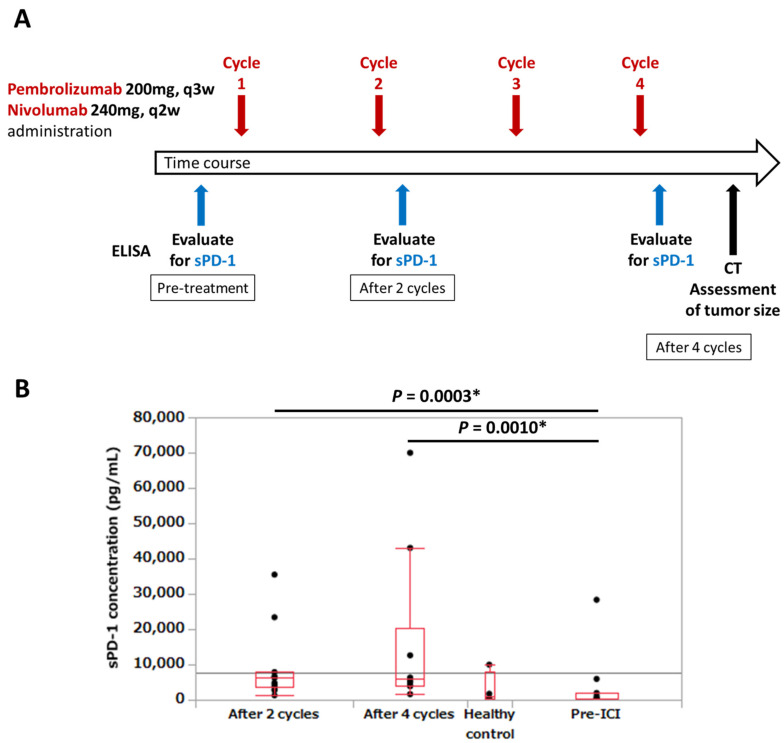
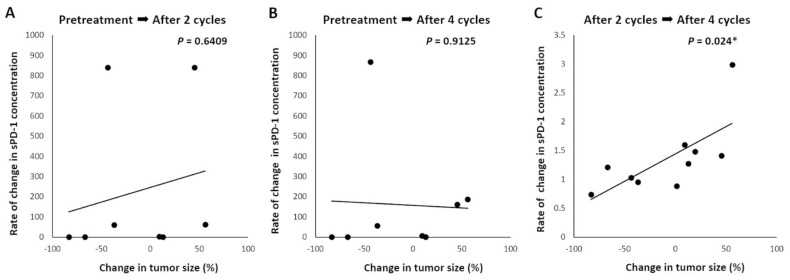
Immune checkpoint inhibitors (ICIs) confer remarkable therapeutic benefits to patients with various cancers. However, many patients are non-responders or develop resistance following an initial response to ICIs. There are no reliable biomarkers to predict the therapeutic effect of ICIs. Therefore, this study investigated the clinical implications of plasma levels of soluble anti-programmed death-1 (sPD-1) in patients with cancer treated with ICIs. In total, 22 patients (13 with non-small-cell lung carcinoma, 8 with gastric cancer, and 1 with bladder cancer) were evaluated for sPD-1 concentration using enzyme-linked immunosorbent assays for diagnostic and anti-PD-1 antibody analyses. sPD-1 levels were low before the administration of anti-PD-1 antibodies. After two and four cycles of anti-PD-1 antibody therapy, sPD-1 levels significantly increased compared with pretreatment levels ( = 0.0348 vs. 0.0232). We observed an increased rate of change in plasma sPD-1 concentrations after two and four cycles of anti-PD-1 antibody therapy that significantly correlated with tumor size progression ( = 0.024). sPD-1 may be involved in resistance to anti-PD-1 antibody therapy, suggesting that changes in sPD-1 levels can identify primary ICI non-responders early in treatment. Detailed analysis of each cancer type revealed the potential of sPD-1 as a predictive biomarker of response to ICI treatment in patients with cancer.
免疫检查点抑制剂(ICIs)为患有各种癌症的患者带来了显著的治疗益处。然而,许多患者对ICIs无反应或在初始反应后产生耐药性。目前尚无可靠的生物标志物来预测ICIs的治疗效果。因此,本研究调查了接受ICIs治疗的癌症患者血浆中可溶性抗程序性死亡-1(sPD-1)水平的临床意义。总共对22例患者(13例非小细胞肺癌、8例胃癌和1例膀胱癌)进行了评估,使用酶联免疫吸附测定法检测sPD-1浓度,用于诊断和抗PD-1抗体分析。在给予抗PD-1抗体之前,sPD-1水平较低。在进行两个和四个周期的抗PD-1抗体治疗后,sPD-1水平与治疗前水平相比显著升高(分别为0.0348对0.0232)。我们观察到在进行两个和四个周期的抗PD-1抗体治疗后,血浆sPD-1浓度的变化率增加,且与肿瘤大小进展显著相关( = 0.024)。sPD-1可能参与了对抗PD-1抗体治疗的耐药性,这表明sPD-1水平的变化可以在治疗早期识别出原发性ICIs无反应者。对每种癌症类型的详细分析揭示了sPD-1作为癌症患者ICI治疗反应预测生物标志物的潜力。