Célind Jimmy, Bygdell Maria, Martikainen Jari, Styrke Johan, Damber Jan-Erik, Kindblom Jenny M, Ohlsson Claes
Centre for Bone and Arthritis Research, Sahlgrenska Osteoporosis Centre, Institute of Medicine, Sahlgrenska Academy, University of Gothenburg, 405 30 Gothenburg, Sweden.
Department of Pediatrics, Institute of Clinical Sciences, The Sahlgrenska Academy, University of Gothenburg, 405 30 Gothenburg, Sweden.
Cancers (Basel). 2021 Dec 12;13(24):6238. doi: 10.3390/cancers13246238.
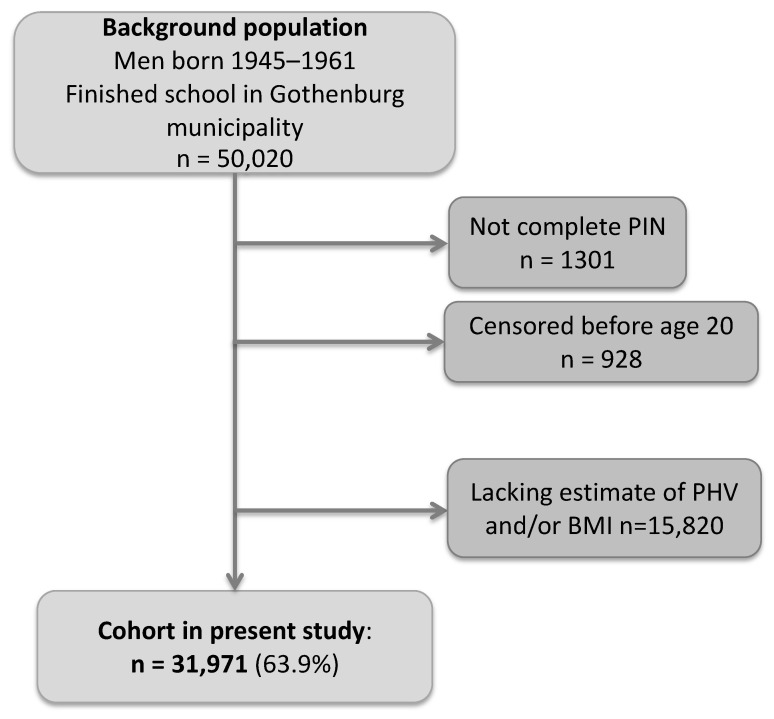
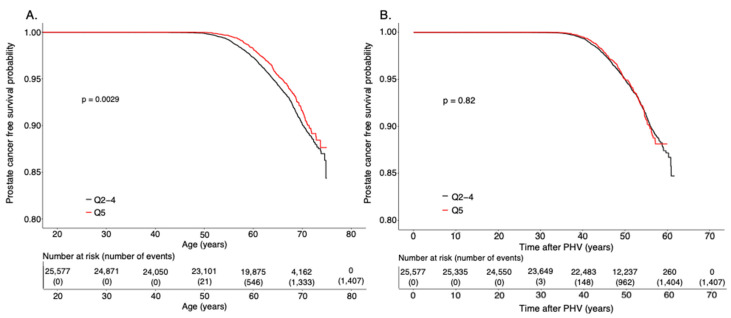
Previous studies of pubertal timing and the risk of prostate cancer have used self-reported markers of pubertal development, recalled in mid-life, and the results have been inconclusive. Our aim was to evaluate the age at the pubertal growth spurt, an objective marker of pubertal timing, and the risk of prostate cancer and high-risk prostate cancer. This population-based cohort study included 31,971 men with sufficient height measurements to calculate age at peak height velocity (PHV). Outcomes were accessed through national registers. Hazard ratios (HR) and 95% confidence intervals (CI) were estimated by Cox regressions with follow up starting at 20 years of age. In total, 1759 cases of prostate cancer including 449 high-risk were diagnosed during follow up. Mean follow up was 42 years (standard deviation 10.0). Compared to quintiles 2-4 (Q2-4), men in the highest age at PHV quintile (Q5) had lower risk of prostate cancer (HR 0.83, 95% CI 0.73-0.94), and of high-risk prostate cancer (0.73; 0.56-0.94). In an exploratory analysis with follow up starting at age at PHV, late pubertal timing was no longer associated with reduced risk of prostate cancer. Later pubertal timing was associated with reduced risk of prostate cancer and especially high-risk prostate cancer. We propose that the risk of prostate cancer might be influenced by the number of years with exposure to adult levels of sex steroids.
先前关于青春期发育时间与前列腺癌风险的研究使用了中年时回忆的青春期发育自我报告指标,结果尚无定论。我们的目的是评估青春期生长突增的年龄(青春期发育时间的一个客观指标)与前列腺癌及高危前列腺癌的风险。这项基于人群的队列研究纳入了31971名有足够身高测量数据以计算身高增长速度峰值(PHV)年龄的男性。通过国家登记处获取研究结果。采用Cox回归估计风险比(HR)和95%置信区间(CI),随访从20岁开始。在随访期间,共诊断出1759例前列腺癌病例,其中包括449例高危病例。平均随访时间为42年(标准差10.0)。与第2 - 4五分位数(Q2 - 4)相比,PHV年龄最高五分位数(Q5)的男性患前列腺癌的风险较低(HR 0.83,95% CI 0.73 - 0.94),患高危前列腺癌的风险也较低(0.73;0.56 - 0.94)。在一项从PHV年龄开始随访的探索性分析中,青春期发育时间较晚不再与前列腺癌风险降低相关。青春期发育时间较晚与前列腺癌尤其是高危前列腺癌风险降低相关。我们认为,前列腺癌的风险可能受暴露于成年水平性激素的年限影响。