Plioni Iris, Bekatorou Argyro, Terpou Antonia, Mallouchos Athanasios, Plessas Stavros, Koutinas Athanasios A, Katechaki Eleftheria
Department of Chemistry, University of Patras, 26504 Patras, Greece.
Department of Agricultural Development, Agri-Food, and Natural Resources Management, School of Agricultural Development, Nutrition & Sustainability, National and Kapodistrian University of Athens, 34400 Athens, Greece.
Foods. 2021 Dec 17;10(12):3133. doi: 10.3390/foods10123133.
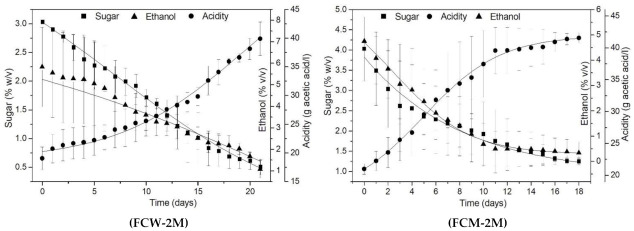
Fruit wastes and side-streams can be used for vinegar production to create added value for the agri-food sector and enhance farmer incomes and local economies. In this study, methods for vinegar production by wild and selected acetic acid bacteria (the quick starter and the acid-resistant ), free (FC) and immobilized (IC) on a natural cellulosic carrier, are proposed using sweet wine made from the industrial finishing side-stream (FSS) of Corinthian currants as raw material. The results showed all cultures can produce vinegar with 46.65 ± 5.43 g/L acidity, from sweet FSS wine containing 5.08 ± 1.19% alcohol. The effect of immobilization was more obvious in the case of the selected culture, presenting better acetification efficiency, both fresh and after cold storage for 2 months. The vinegars had an antioxidant capacity of 263.5 ± 8.4 and 277.1 ± 6.7 mg/L (as ascorbic acid) and phenolic content 333.1 ± 12.0 and 222.2 ± 2.9 mg/L (as gallic acid) (for FC and IC, respectively). They also had a rich volatilome (140 compounds identified by SPME GC-MS), with higher percentages of esters identified in vinegars made by IC. The results are encouraging for vinegar production with IC of a mixed and culture.
水果废料和副产品可用于生产醋,为农业食品部门创造附加值,提高农民收入和促进地方经济发展。在本研究中,提出了以科林斯葡萄工业加工副产品(FSS)制成的甜葡萄酒为原料,利用野生和选定的醋酸菌(快速启动菌和耐酸菌),游离(FC)和固定化(IC)在天然纤维素载体上生产醋的方法。结果表明,所有培养物都能以含5.08±1.19%酒精的甜FSS葡萄酒生产出酸度为46.65±5.43g/L的醋。在选定培养物的情况下,固定化的效果更明显,无论是新鲜的还是冷藏2个月后,其醋酸化效率都更高。这些醋的抗氧化能力分别为263.5±8.4和277.1±6.7mg/L(以抗坏血酸计)以及酚类含量分别为333.1±12.0和222.2±2.9mg/L(以没食子酸计)(分别针对FC和IC)。它们还具有丰富的挥发物组(通过SPME GC-MS鉴定出140种化合物),在IC制成的醋中鉴定出的酯类百分比更高。这些结果对于用混合菌和选定菌的IC生产醋来说是令人鼓舞的。