Castela Forte José, Folkertsma Pytrik, Gannamani Rahul, Kumaraswamy Sridhar, Mount Sarah, de Koning Tom J, van Dam Sipko, Wolffenbuttel Bruce H R
Department of Clinical Pharmacy and Pharmacology, University Medical Center Groningen, University of Groningen, Hanzeplein 1, 9713 GZ Groningen, The Netherlands.
Ancora Health B.V., Herestraat 106, 9711 LM Groningen, The Netherlands.
J Pers Med. 2021 Dec 7;11(12):1322. doi: 10.3390/jpm11121322.
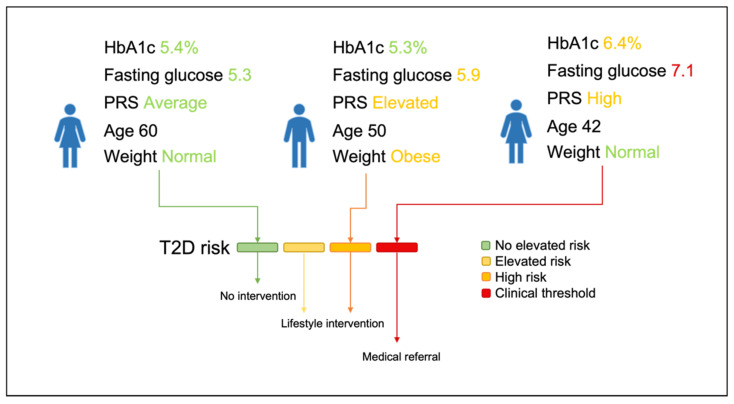
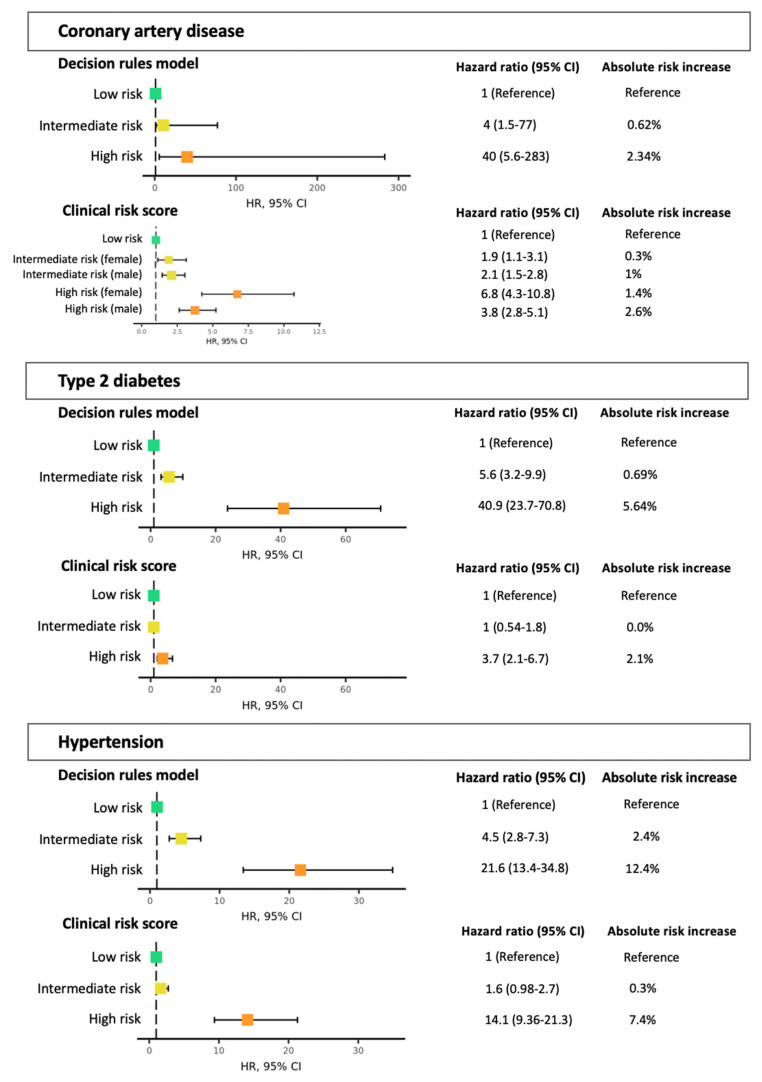
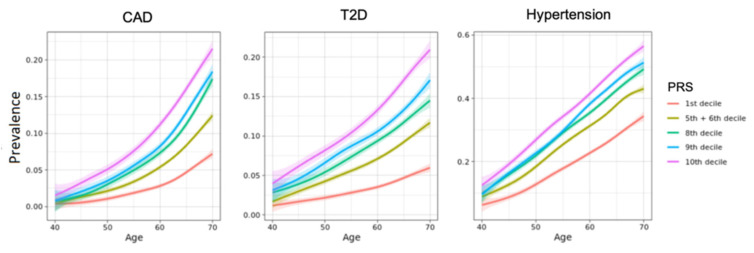
Many predictive models exist that predict risk of common cardiometabolic conditions. However, a vast majority of these models do not include genetic risk scores and do not distinguish between clinical risk requiring medical or pharmacological interventions and pre-clinical risk, where lifestyle interventions could be first-choice therapy. In this study, we developed, validated, and compared the performance of three decision rule algorithms including biomarkers, physical measurements, and genetic risk scores for incident coronary artery disease (CAD), diabetes (T2D), and hypertension against commonly used clinical risk scores in 60,782 UK Biobank participants. The rules models were tested for an association with incident CAD, T2D, and hypertension, and hazard ratios (with 95% confidence interval) were calculated from survival models. Model performance was assessed using the area under the receiver operating characteristic curve (AUROC), and Net Reclassification Index (NRI). The higher risk group in the decision rules model had a 40-, 40.9-, and 21.6-fold increased risk of CAD, T2D, and hypertension, respectively ( < 0.001 for all). Risk increased significantly between the three strata for all three conditions ( < 0.05). Based on genetic risk alone, we identified not only a high-risk group, but also a group at elevated risk for all health conditions. These decision rule models comprising blood biomarkers, physical measurements, and polygenic risk scores moderately improve commonly used clinical risk scores at identifying individuals likely to benefit from lifestyle intervention for three of the most common lifestyle-related chronic health conditions. Their utility as part of digital data or digital therapeutics platforms to support the implementation of lifestyle interventions in preventive and primary care should be further validated.
存在许多预测常见心脏代谢疾病风险的模型。然而,这些模型中的绝大多数都不包括遗传风险评分,也没有区分需要医学或药物干预的临床风险和临床前风险,而在临床前风险中,生活方式干预可能是首选治疗方法。在本研究中,我们针对60782名英国生物银行参与者,开发、验证并比较了三种决策规则算法(包括生物标志物、身体测量指标和遗传风险评分)对于冠心病(CAD)、糖尿病(T2D)和高血压发病情况的性能,并与常用的临床风险评分进行对比。对这些规则模型进行了与CAD、T2D和高血压发病情况的关联性测试,并从生存模型中计算出风险比(及其95%置信区间)。使用受试者工作特征曲线下面积(AUROC)和净重新分类指数(NRI)评估模型性能。决策规则模型中的高风险组患CAD、T2D和高血压的风险分别增加了40倍、40.9倍和21.6倍(所有P值均<0.001)。对于所有这三种疾病,在三个分层之间风险均显著增加(P<0.05)。仅基于遗传风险,我们不仅识别出了一个高风险组,还识别出了在所有健康状况下风险均升高的一个组。这些包含血液生物标志物、身体测量指标和多基因风险评分的决策规则模型,在识别可能从生活方式干预中获益的个体方面,适度地改进了常用的临床风险评分,这些个体患有三种最常见的与生活方式相关的慢性健康疾病。它们作为数字数据或数字治疗平台的一部分,以支持在预防和初级保健中实施生活方式干预的效用,应进一步得到验证。