• 文献检索
  • 文档翻译
  • 深度研究
  • 学术资讯
  • Suppr Zotero 插件Zotero 插件
  • 邀请有礼
  • 套餐&价格
  • 历史记录
应用&插件
Suppr Zotero 插件Zotero 插件浏览器插件Mac 客户端Windows 客户端微信小程序
定价
高级版会员购买积分包购买API积分包
服务
文献检索文档翻译深度研究API 文档MCP 服务
关于我们
关于 Suppr公司介绍联系我们用户协议隐私条款
关注我们

Suppr 超能文献

核心技术专利:CN118964589B侵权必究
粤ICP备2023148730 号-1Suppr @ 2026

文献检索

告别复杂PubMed语法,用中文像聊天一样搜索,搜遍4000万医学文献。AI智能推荐,让科研检索更轻松。

立即免费搜索

文件翻译

保留排版,准确专业,支持PDF/Word/PPT等文件格式,支持 12+语言互译。

免费翻译文档

深度研究

AI帮你快速写综述,25分钟生成高质量综述,智能提取关键信息,辅助科研写作。

立即免费体验

钛6铝4钒生物医学合金激光粉末床熔融中激光钻孔形成的匙孔:介观计算流体动力学模拟与基于经验验证的数学建模对比

Keyhole Formation by Laser Drilling in Laser Powder Bed Fusion of Ti6Al4V Biomedical Alloy: Mesoscopic Computational Fluid Dynamics Simulation versus Mathematical Modelling Using Empirical Validation.

作者信息

Ur Rehman Asif, Mahmood Muhammad Arif, Pitir Fatih, Salamci Metin Uymaz, Popescu Andrei C, Mihailescu Ion N

机构信息

ERMAKSAN, Bursa 16065, Turkey.

Department of Mechanical Engineering, Gazi University, Ankara 06570, Turkey.

出版信息

Nanomaterials (Basel). 2021 Dec 3;11(12):3284. doi: 10.3390/nano11123284.

DOI:10.3390/nano11123284
PMID:34947634
原文链接:https://pmc.ncbi.nlm.nih.gov/articles/PMC8707298/
Abstract

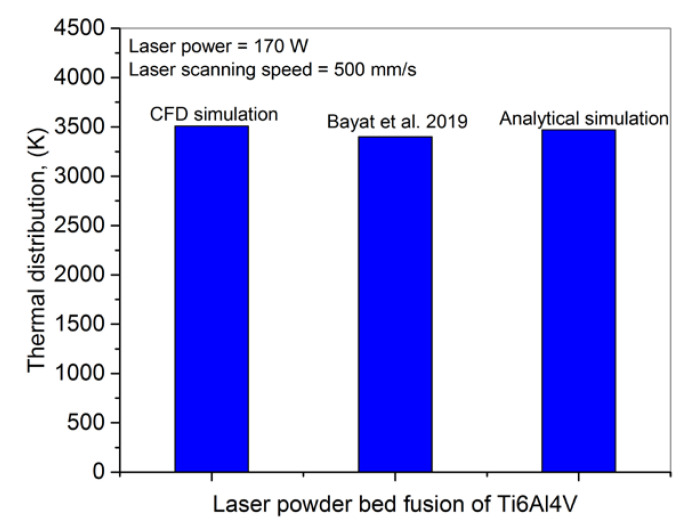
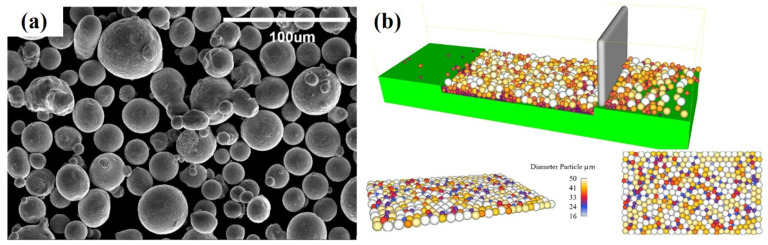
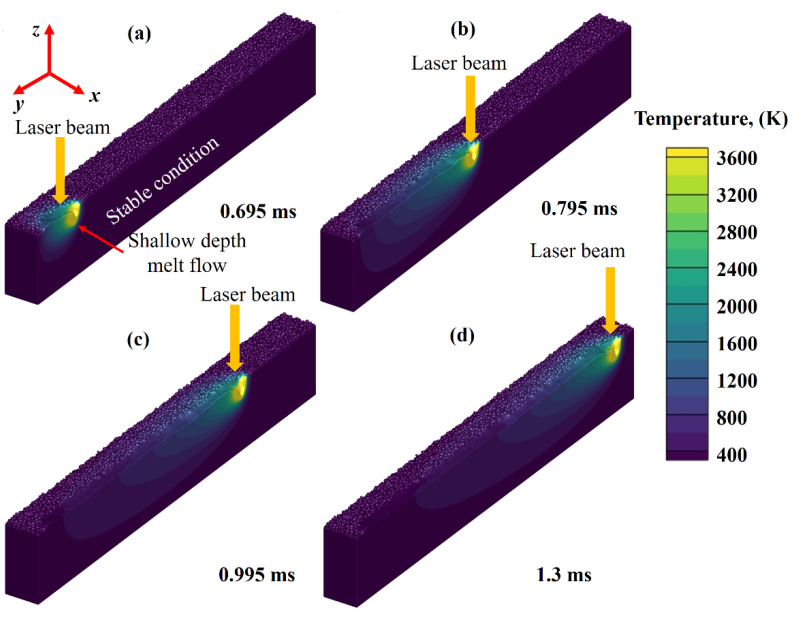
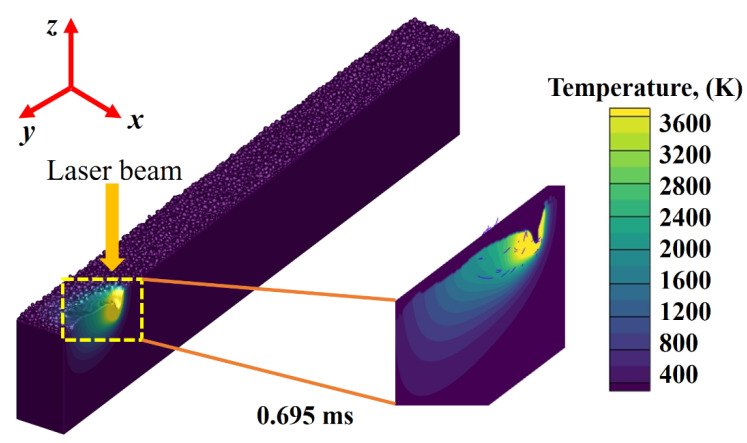
In the laser powder bed fusion (LPBF) process, the operating conditions are essential in determining laser-induced keyhole regimes based on the thermal distribution. These regimes, classified into shallow and deep keyholes, control the probability and defects formation intensity in the LPBF process. To study and control the keyhole in the LPBF process, mathematical and computational fluid dynamics (CFD) models are presented. For CFD, the volume of fluid method with the discrete element modeling technique was used, while a mathematical model was developed by including the laser beam absorption by the powder bed voids and surface. The dynamic melt pool behavior is explored in detail. Quantitative comparisons are made among experimental, CFD simulation and analytical computing results leading to a good correspondence. In LPBF, the temperature around the laser irradiation zone rises rapidly compared to the surroundings in the powder layer due to the high thermal resistance and the air between the powder particles, resulting in a slow travel of laser transverse heat waves. In LPBF, the keyhole can be classified into shallow and deep keyhole mode, controlled by the energy density. Increasing the energy density, the shallow keyhole mode transforms into the deep keyhole mode. The energy density in a deep keyhole is higher due to the multiple reflections and concentrations of secondary reflected beams within the keyhole, causing the material to vaporize quickly. Due to an elevated temperature distribution in deep keyhole mode, the probability of pores forming is much higher than in a shallow keyhole as the liquid material is close to the vaporization temperature. When the temperature increases rapidly, the material density drops quickly, thus, raising the fluid volume due to the specific heat and fusion latent heat. In return, this lowers the surface tension and affects the melt pool uniformity.

摘要

在激光粉末床熔融(LPBF)工艺中,操作条件对于基于热分布确定激光诱导的匙孔状态至关重要。这些状态分为浅匙孔和深匙孔,它们控制着LPBF工艺中缺陷形成的概率和强度。为了研究和控制LPBF工艺中的匙孔,提出了数学模型和计算流体动力学(CFD)模型。对于CFD,使用了带有离散元建模技术的流体体积法,同时通过考虑粉末床孔隙和表面对激光束的吸收来建立数学模型。详细探讨了动态熔池行为。对实验结果、CFD模拟结果和分析计算结果进行了定量比较,结果显示出良好的一致性。在LPBF中,由于粉末层中粉末颗粒之间的高热阻和空气,激光辐照区域周围的温度相对于周围环境迅速升高,导致激光横向热波传播缓慢。在LPBF中,匙孔可分为浅匙孔模式和深匙孔模式,由能量密度控制。增加能量密度时,浅匙孔模式会转变为深匙孔模式。深匙孔中的能量密度较高,这是由于匙孔内二次反射光束的多次反射和集中,导致材料迅速汽化。由于深匙孔模式下温度分布升高,当液态材料接近汽化温度时,形成气孔的概率比浅匙孔高得多。当温度迅速升高时,材料密度迅速下降,因此,由于比热容和熔化潜热,流体体积增加。反过来,这会降低表面张力并影响熔池均匀性。
https://cdn.ncbi.nlm.nih.gov/pmc/blobs/d1dd/8707298/8611df3b006b/nanomaterials-11-03284-g012.jpg
https://cdn.ncbi.nlm.nih.gov/pmc/blobs/d1dd/8707298/6220131aa4c7/nanomaterials-11-03284-g001.jpg
https://cdn.ncbi.nlm.nih.gov/pmc/blobs/d1dd/8707298/4b120be56080/nanomaterials-11-03284-g002.jpg
https://cdn.ncbi.nlm.nih.gov/pmc/blobs/d1dd/8707298/3c79967d75b6/nanomaterials-11-03284-g003.jpg
https://cdn.ncbi.nlm.nih.gov/pmc/blobs/d1dd/8707298/63a84411c120/nanomaterials-11-03284-g004.jpg
https://cdn.ncbi.nlm.nih.gov/pmc/blobs/d1dd/8707298/d56a607b3b93/nanomaterials-11-03284-g005.jpg
https://cdn.ncbi.nlm.nih.gov/pmc/blobs/d1dd/8707298/9e62c7a19dea/nanomaterials-11-03284-g006.jpg
https://cdn.ncbi.nlm.nih.gov/pmc/blobs/d1dd/8707298/c5d3eb49cc22/nanomaterials-11-03284-g007.jpg
https://cdn.ncbi.nlm.nih.gov/pmc/blobs/d1dd/8707298/61c18ca490be/nanomaterials-11-03284-g008.jpg
https://cdn.ncbi.nlm.nih.gov/pmc/blobs/d1dd/8707298/8d53aaed6847/nanomaterials-11-03284-g009.jpg
https://cdn.ncbi.nlm.nih.gov/pmc/blobs/d1dd/8707298/2f996004926c/nanomaterials-11-03284-g010.jpg
https://cdn.ncbi.nlm.nih.gov/pmc/blobs/d1dd/8707298/576142098234/nanomaterials-11-03284-g011.jpg
https://cdn.ncbi.nlm.nih.gov/pmc/blobs/d1dd/8707298/8611df3b006b/nanomaterials-11-03284-g012.jpg
https://cdn.ncbi.nlm.nih.gov/pmc/blobs/d1dd/8707298/6220131aa4c7/nanomaterials-11-03284-g001.jpg
https://cdn.ncbi.nlm.nih.gov/pmc/blobs/d1dd/8707298/4b120be56080/nanomaterials-11-03284-g002.jpg
https://cdn.ncbi.nlm.nih.gov/pmc/blobs/d1dd/8707298/3c79967d75b6/nanomaterials-11-03284-g003.jpg
https://cdn.ncbi.nlm.nih.gov/pmc/blobs/d1dd/8707298/63a84411c120/nanomaterials-11-03284-g004.jpg
https://cdn.ncbi.nlm.nih.gov/pmc/blobs/d1dd/8707298/d56a607b3b93/nanomaterials-11-03284-g005.jpg
https://cdn.ncbi.nlm.nih.gov/pmc/blobs/d1dd/8707298/9e62c7a19dea/nanomaterials-11-03284-g006.jpg
https://cdn.ncbi.nlm.nih.gov/pmc/blobs/d1dd/8707298/c5d3eb49cc22/nanomaterials-11-03284-g007.jpg
https://cdn.ncbi.nlm.nih.gov/pmc/blobs/d1dd/8707298/61c18ca490be/nanomaterials-11-03284-g008.jpg
https://cdn.ncbi.nlm.nih.gov/pmc/blobs/d1dd/8707298/8d53aaed6847/nanomaterials-11-03284-g009.jpg
https://cdn.ncbi.nlm.nih.gov/pmc/blobs/d1dd/8707298/2f996004926c/nanomaterials-11-03284-g010.jpg
https://cdn.ncbi.nlm.nih.gov/pmc/blobs/d1dd/8707298/576142098234/nanomaterials-11-03284-g011.jpg
https://cdn.ncbi.nlm.nih.gov/pmc/blobs/d1dd/8707298/8611df3b006b/nanomaterials-11-03284-g012.jpg

相似文献

1
Keyhole Formation by Laser Drilling in Laser Powder Bed Fusion of Ti6Al4V Biomedical Alloy: Mesoscopic Computational Fluid Dynamics Simulation versus Mathematical Modelling Using Empirical Validation.钛6铝4钒生物医学合金激光粉末床熔融中激光钻孔形成的匙孔:介观计算流体动力学模拟与基于经验验证的数学建模对比
Nanomaterials (Basel). 2021 Dec 3;11(12):3284. doi: 10.3390/nano11123284.
2
Laser Melting Deposition Additive Manufacturing of Ti6Al4V Biomedical Alloy: Mesoscopic In-Situ Flow Field Mapping via Computational Fluid Dynamics and Analytical Modelling with Empirical Testing.Ti6Al4V生物医学合金的激光熔化沉积增材制造:通过计算流体动力学进行介观原位流场映射以及结合经验测试的分析建模
Materials (Basel). 2021 Dec 15;14(24):7749. doi: 10.3390/ma14247749.
3
A Combined Experimental-Numerical Method to Evaluate Powder Thermal Properties in Laser Powder Bed Fusion.一种用于评估激光粉末床熔融中粉末热性能的实验与数值相结合的方法。
J Manuf Sci Eng. 2018;140. doi: 10.1115/1.4040877.
4
Numerical Simulation in the Melt Pool Evolution of Laser Powder Bed Fusion Process for Ti6Al4V.Ti6Al4V激光粉末床熔融过程熔池演变的数值模拟
Materials (Basel). 2022 Oct 28;15(21):7585. doi: 10.3390/ma15217585.
5
High Reflectivity and Thermal Conductivity Ag-Cu Multi-Material Structures Fabricated via Laser Powder Bed Fusion: Formation Mechanisms, Interfacial Characteristics, and Molten Pool Behavior.通过激光粉末床熔融制备的高反射率和高导热率银铜多材料结构:形成机制、界面特性和熔池行为
Micromachines (Basel). 2023 Jan 31;14(2):362. doi: 10.3390/mi14020362.
6
Transient Laser Energy Absorption, Co-axial Melt Pool Monitoring, and Relationship to Melt Pool Morphology.瞬态激光能量吸收、同轴熔池监测及其与熔池形态的关系。
Addit Manuf. 2020 Dec;36. doi: 10.1016/j.addma.2020.101504.
7
Effect of Laser Scanning Speed on the Microstructure and Mechanical Properties of Laser-Powder-Bed-Fused K418 Nickel-Based Alloy.激光扫描速度对激光粉末床熔融K418镍基合金微观结构和力学性能的影响
Materials (Basel). 2022 Apr 22;15(9):3045. doi: 10.3390/ma15093045.
8
On thermal properties of metallic powder in laser powder bed fusion additive manufacturing.关于激光粉末床熔融增材制造中金属粉末的热性能
J Manuf Process. 2019;47. doi: https://doi.org/10.1016/j.jmapro.2019.09.012.
9
Laser Powder Bed Fusion (LPBF) of In718 and the Impact of Pre-Heating at 500 and 1000 °C: Operando Study.In718的激光粉末床熔融(LPBF)以及500和1000°C预热的影响:原位研究
Materials (Basel). 2021 Nov 5;14(21):6683. doi: 10.3390/ma14216683.
10
A Micro-Computed Tomography Comparison of the Porosity in Additively Fabricated CuCr1 Alloy Parts Using Virgin and Surface-Modified Powders.使用原始粉末和表面改性粉末通过增材制造法制备的CuCr1合金零件孔隙率的微计算机断层扫描比较
Materials (Basel). 2021 Apr 16;14(8):1995. doi: 10.3390/ma14081995.

引用本文的文献

1
Simulation Study on the Impact of Melt Track Overlap Rate on the Forming Result During the Selective Laser Melting of Ti-6Al-4V Alloy.Ti-6Al-4V合金选择性激光熔化过程中熔道重叠率对成形结果影响的模拟研究
Materials (Basel). 2025 May 15;18(10):2314. doi: 10.3390/ma18102314.
2
Review on Multiscale Transport Phenomena in the Metal-Based Additive Manufacturing Process.金属基增材制造过程中的多尺度传输现象综述
3D Print Addit Manuf. 2024 Aug 20;11(4):1471-1494. doi: 10.1089/3dp.2023.0051. eCollection 2024 Aug.
3
Investigation and Optimization of Effects of 3D Printer Process Parameters on Performance Parameters.

本文引用的文献

1
Laser Powder Bed Fusion (LPBF) of In718 and the Impact of Pre-Heating at 500 and 1000 °C: Operando Study.In718的激光粉末床熔融(LPBF)以及500和1000°C预热的影响:原位研究
Materials (Basel). 2021 Nov 5;14(21):6683. doi: 10.3390/ma14216683.
2
Full-Field Mapping and Flow Quantification of Melt Pool Dynamics in Laser Powder Bed Fusion of SS316L.SS316L激光粉末床熔融中熔池动力学的全场映射与流动量化
Materials (Basel). 2021 Oct 21;14(21):6264. doi: 10.3390/ma14216264.
3
Prediction of Epitaxial Grain Growth in Single-Track Laser Melting of IN718 Using Integrated Finite Element and Cellular Automaton Approach.
3D打印机工艺参数对性能参数影响的研究与优化
Materials (Basel). 2023 Apr 26;16(9):3392. doi: 10.3390/ma16093392.
4
Thermophysical Properties of Nanofluid in Two-Phase Fluid Flow through a Porous Rectangular Medium for Enhanced Oil Recovery.用于提高采收率的通过多孔矩形介质的两相流体流动中纳米流体的热物理性质
Nanomaterials (Basel). 2022 Mar 18;12(6):1011. doi: 10.3390/nano12061011.
5
Advances in Laser Additive Manufacturing of Cobalt-Chromium Alloy Multi-Layer Mesoscopic Analytical Modelling with Experimental Correlations: From Micro-Dendrite Grains to Bulk Objects.钴铬合金激光增材制造多层介观分析建模进展及与实验的相关性:从微观枝晶晶粒到块状物体
Nanomaterials (Basel). 2022 Feb 26;12(5):802. doi: 10.3390/nano12050802.
6
Influence of Silicon Carbide on Direct Powder Bed Selective Laser Process (Sintering/Melting) of Alumina.碳化硅对氧化铝直接粉末床选择性激光工艺(烧结/熔化)的影响。
Materials (Basel). 2022 Jan 15;15(2):637. doi: 10.3390/ma15020637.
7
Laser Melting Deposition Additive Manufacturing of Ti6Al4V Biomedical Alloy: Mesoscopic In-Situ Flow Field Mapping via Computational Fluid Dynamics and Analytical Modelling with Empirical Testing.Ti6Al4V生物医学合金的激光熔化沉积增材制造:通过计算流体动力学进行介观原位流场映射以及结合经验测试的分析建模
Materials (Basel). 2021 Dec 15;14(24):7749. doi: 10.3390/ma14247749.
基于集成有限元和元胞自动机方法预测IN718单道激光熔覆中的外延晶粒生长
Materials (Basel). 2021 Sep 10;14(18):5202. doi: 10.3390/ma14185202.
4
Keyhole threshold and morphology in laser melting revealed by ultrahigh-speed x-ray imaging.通过超高速X射线成像揭示激光熔化中的匙孔阈值和形态。
Science. 2019 Feb 22;363(6429):849-852. doi: 10.1126/science.aav4687.
5
Revealing internal flow behaviour in arc welding and additive manufacturing of metals.揭示金属弧焊和增材制造中的内部流动行为。
Nat Commun. 2018 Dec 21;9(1):5414. doi: 10.1038/s41467-018-07900-9.
6
Laser and electron-beam powder-bed additive manufacturing of metallic implants: A review on processes, materials and designs.金属植入物的激光和电子束粉末床增材制造:工艺、材料与设计综述
J Orthop Res. 2016 Mar;34(3):369-85. doi: 10.1002/jor.23075. Epub 2015 Oct 29.