College of Health and Biomedicine, Victoria University, Melbourne, VIC 8001, Australia.
School of Psychology & Public Health, La Trobe University, Melbourne, VIC 3086, Australia.
Int J Environ Res Public Health. 2021 Dec 15;18(24):13222. doi: 10.3390/ijerph182413222.
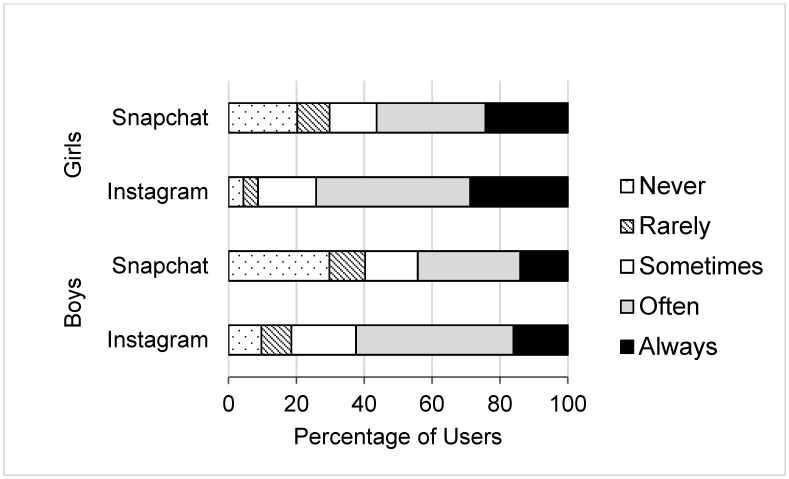
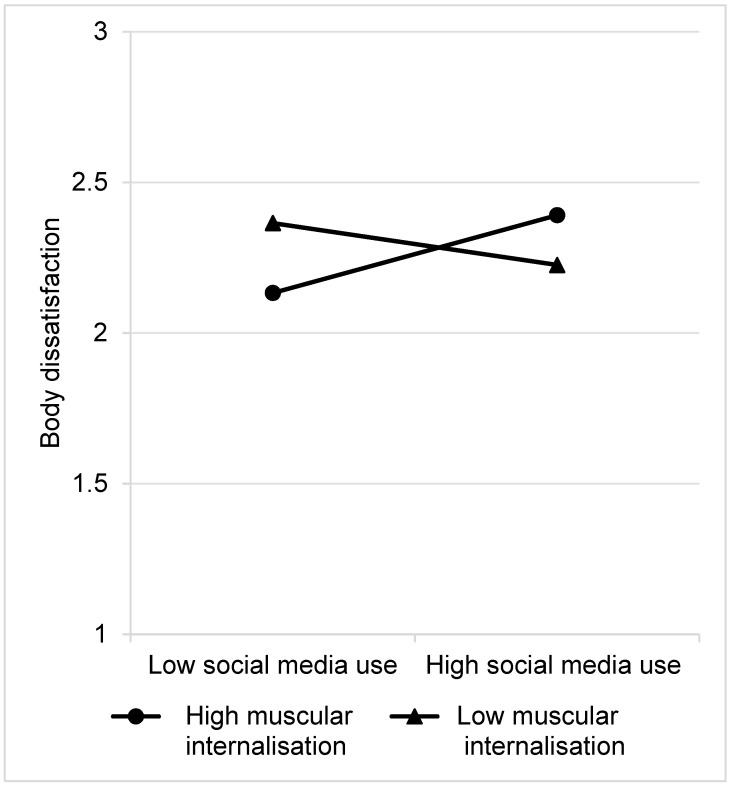
Internalisation of appearance ideals moderates the relationship between exposure to media images and body dissatisfaction. To date, the role of thin- and muscular-ideal internalisation in the context of social media remains under explored, particularly for boys. As such, we aimed to explore how social media use (Instagram and Snapchat) was related to body dissatisfaction, and whether thin- and muscular-ideal internalisation would moderate this relationship in a sample of 1153 adolescent boys and girls (55.42% males; = 13.71, = 1.14). As hypothesised, social media use, and thin- and muscular ideal internalisation were positively correlated with body dissatisfaction in both genders. In moderation analyses, thin-ideal internalisation emerged as the only variable that had a significant effect on body dissatisfaction in both genders. Additionally, the influence of social media use on body dissatisfaction was moderated by muscular-ideal internalisation in boys, whereby for boys with high muscular-ideal internalisation, greater social media use was associated with greater body dissatisfaction. The two-way (muscular x thin-ideal internalisation) and three-way interaction (social media use x thin-ideal internalisation x muscular-ideal internalisation) effects on body dissatisfaction were non-significant. These findings emphasise the importance of considering the sociocultural environment (i.e., new media influences) as frameworks for understanding body dissatisfaction and suggest targeting of internalisation of appearance ideals in body dissatisfaction prevention programs.
内化外貌理想缓和了接触媒体形象与身体不满之间的关系。迄今为止,社交媒体背景下的瘦体型和肌肉体型理想内化的作用仍未得到充分探索,尤其是对于男孩。因此,我们旨在探讨社交媒体使用(Instagram 和 Snapchat)与身体不满之间的关系,以及在 1153 名青少年男孩和女孩(55.42%为男性; = 13.71, = 1.14)样本中,瘦体型和肌肉体型理想内化是否会缓和这种关系。如假设的那样,社交媒体使用和瘦体型和肌肉体型理想内化与两性的身体不满呈正相关。在适度分析中,瘦体型理想内化是唯一在两性中对身体不满有显著影响的变量。此外,在男孩中,社交媒体使用对身体不满的影响受到肌肉体型理想内化的调节,对于肌肉体型理想内化较高的男孩,更多的社交媒体使用与更大的身体不满相关。身体不满的双向(肌肉 x 瘦体型理想内化)和三向交互(社交媒体使用 x 瘦体型理想内化 x 肌肉体型理想内化)效应不显著。这些发现强调了将社会文化环境(即新媒体影响)作为理解身体不满的框架的重要性,并表明在身体不满预防计划中应针对外貌理想内化进行目标定位。