Exercise and Immunometabolism Research Group, Postgraduation Program in Movement Sciences, Department of Physical Education, Universidade Estadual Paulista (UNESP), Presidente Prudente 19060-900, SP, Brazil.
Department of Clinical Physiology, Polytechnic Institute of Coimbra, Coimbra Health School, Rua 5 de Outubro-SM Bispo, Apartado 7006, 3046-854 Coimbra, Portugal.
Int J Environ Res Public Health. 2021 Dec 16;18(24):13249. doi: 10.3390/ijerph182413249.
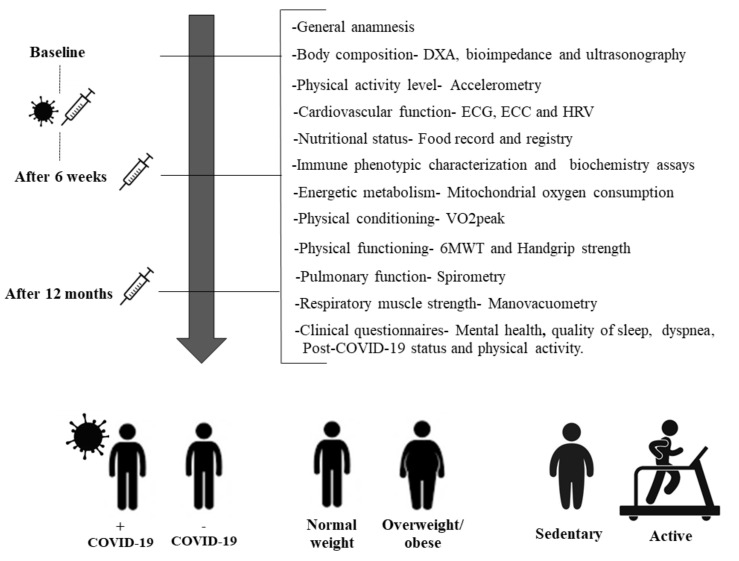
This proposal aims to explain some of the gaps in scientific knowledge on the natural history of coronavirus disease (COVID-19), with a specific focus on immune, inflammatory, and metabolic markers, in parallel with temporal assessment of clinical and mental health in patients with COVID-19. The study will explore the temporal modulatory effects of physical activity and body composition on individual trajectories. This approach will provide a better understanding of the survival mechanisms provided by the immunomodulatory role of physical fitness. We will conduct a prospective observational cohort study including adult patients previously infected with the SARS-CoV-2 virus who have expressed a mild to moderate COVID-19 infection. Procedures will be conducted for all participants at baseline, six weeks after vaccination, and again at 12 months. At each visit, a venous blood sample will be collected for immune phenotypic characterization and biochemistry assays (inflammatory and metabolic parameters). Also, body composition, physical activity level, cardiovascular and pulmonary function, peripheral and respiratory muscle strength, functional exercise capacity, and mental health will be evaluated. Using the baseline information, participants will be grouped based on physical activity levels (sedentary versus active), body composition (normal weight versus overweight or obese), and SARS-CoV-2 status (positive versus negative). A sub-study will provide mechanistic evidence using an in-vitro assay based on well-trained individuals and age-matched sedentary controls who are negative for SARS-CoV-2 infection. Whole blood will be stimulated using recombinant human coronavirus to determine the cytokine profile. Peripheral blood mononuclear cells (PBMCs) from healthy well-trained participants will be collected and treated with homologous serum (from the main study; samples collected before and after the vaccine) and recombinant coronavirus (inactive virus). The metabolism of PBMCs will be analyzed using Respirometry (Seahorse). Data will be analyzed using multilevel repeated-measures ANOVA. The data generated will help us answer three main questions: (1) Does the innate immune system of physically active individuals respond better to viral infections compared with that of sedentary people? (2) which functional and metabolic mechanisms explain the differences in responses in participants with different physical fitness levels? and (3) do these mechanisms have long-term positive modulatory effects on mental and cardiovascular health? Trial registration number: Brazilian Registry of Clinical Trials: RBR-5dqvkv3. Registered on 21 September 2021.
本研究旨在阐述冠状病毒病(COVID-19)自然史相关科学知识的一些空白,特别关注 COVID-19 患者的免疫、炎症和代谢标志物,并对其临床和心理健康进行时间评估。该研究将探索身体活动和身体成分对个体轨迹的时间调节作用。这种方法将更好地了解身体健康的免疫调节作用所提供的生存机制。
我们将进行一项前瞻性观察队列研究,纳入先前感染 SARS-CoV-2 病毒且表达轻度至中度 COVID-19 感染的成年患者。所有参与者将在基线、接种疫苗后 6 周和 12 个月时进行检测。每次就诊时,将采集静脉血样进行免疫表型特征分析和生物化学检测(炎症和代谢参数)。此外,还将评估身体成分、身体活动水平、心血管和肺功能、周围和呼吸肌肉力量、功能运动能力和心理健康。根据基线信息,将参与者按身体活动水平(久坐与活跃)、身体成分(正常体重与超重或肥胖)和 SARS-CoV-2 状态(阳性与阴性)进行分组。一项子研究将提供基于训练有素的个体和年龄匹配的 SARS-CoV-2 感染阴性的久坐对照的体外检测的机制证据。将使用重组人冠状病毒刺激全血以确定细胞因子谱。从健康的训练有素的参与者中收集外周血单核细胞(PBMC),并用同源血清(来自主要研究;接种疫苗前后采集的样本)和重组冠状病毒(失活病毒)处理。使用呼吸仪( Seahorse )分析 PBMC 的代谢。使用多级重复测量 ANOVA 分析数据。
(1)与久坐的人相比,身体活跃的人的固有免疫系统对病毒感染的反应是否更好?(2)不同身体适应能力的参与者的反应差异的功能和代谢机制是什么?(3)这些机制对心理和心血管健康是否具有长期的积极调节作用?
巴西临床试验注册处:RBR-5dqvkv3。于 2021 年 9 月 21 日注册。