Exercise and Immunometabolism Research Group, Postgraduation Program in Movement Sciences, Department of Physical Education, Universidade Estadual Paulista (UNESP), Presidente Prudente, Brazil.
Polytechnic Institute of Coimbra, Coimbra Health School, Coimbra, Portugal.
Front Immunol. 2023 Sep 11;14:1212745. doi: 10.3389/fimmu.2023.1212745. eCollection 2023.
This study aimed to evaluate if physical activity is associated with systemic and cellular immunometabolic responses, in young adults after mild-to-moderate COVID-19 infection.
Mild- to- moderate post-COVID-19 patients (70.50 ± 43.10 days of diagnosis; age: 29.4 (21.9- 34.9) years; BMI: 25.5 ± 4.3 kg m n = 20) and healthy age-matched controls (age: 29.3 (21.2 - 32.6) years; BMI: 25.4 ± 4.7 kg m; n = 20) were evaluated. Physical activity levels (PAL), body composition, dietary habits, muscular and pulmonary function, mental health, sleep quality, metabolic parameters, immune phenotypic characterization, stimulated whole blood and PBMC culture (cytokine production), mRNA, and mitochondrial respiration in PBMCs were evaluated.
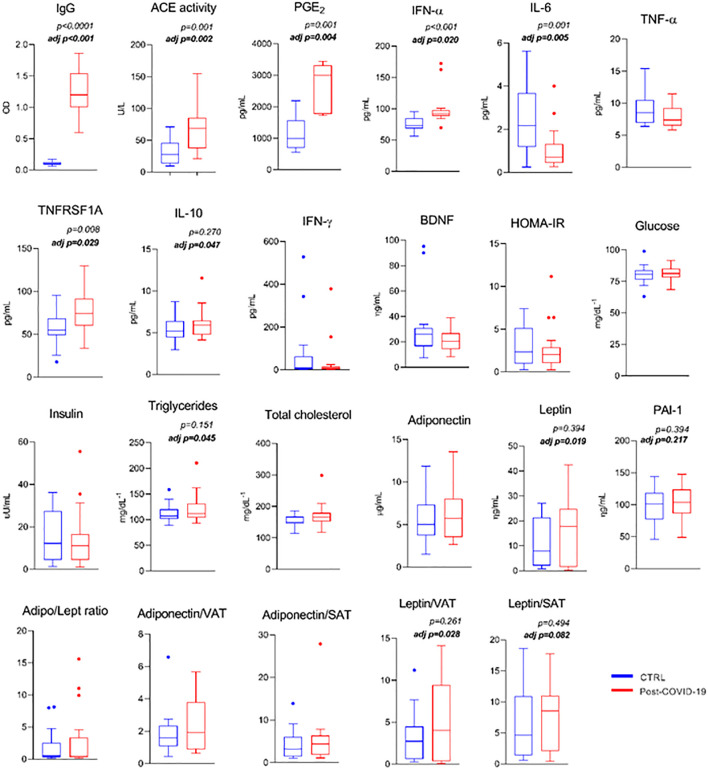
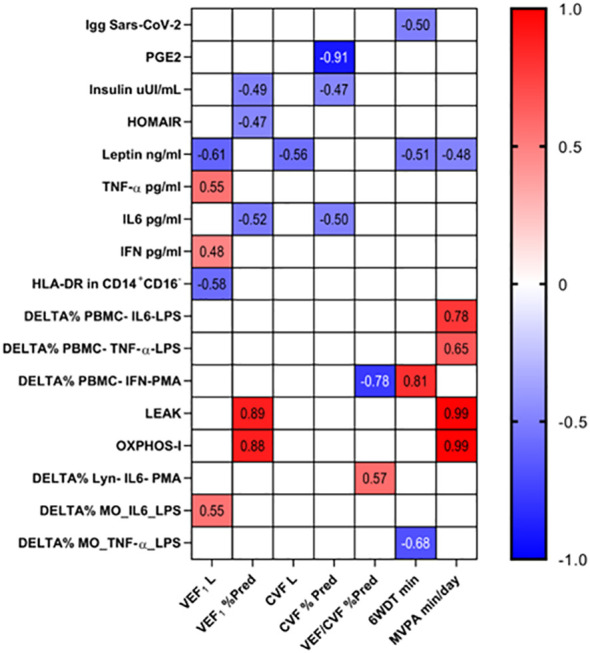
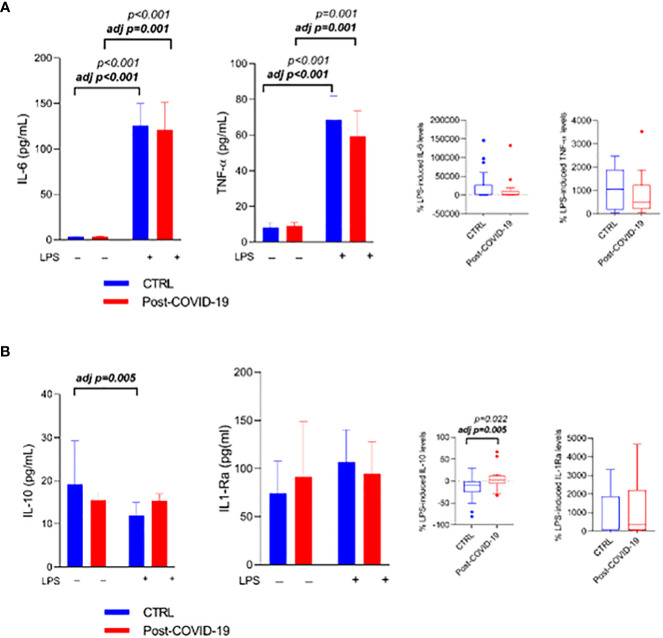
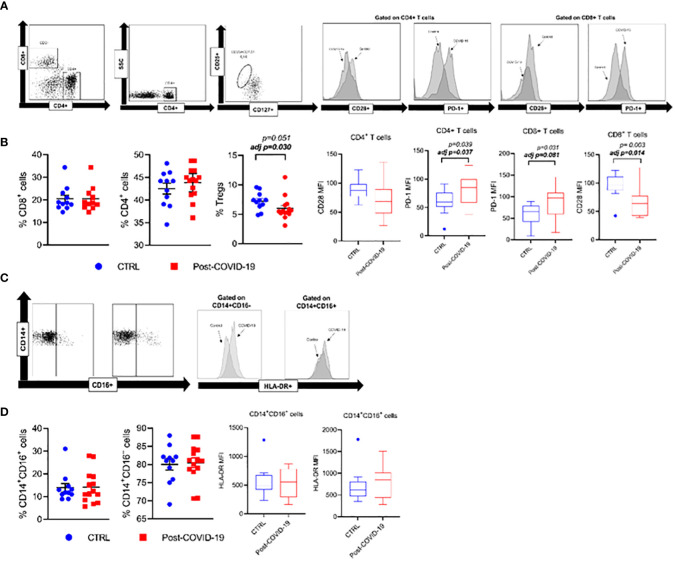
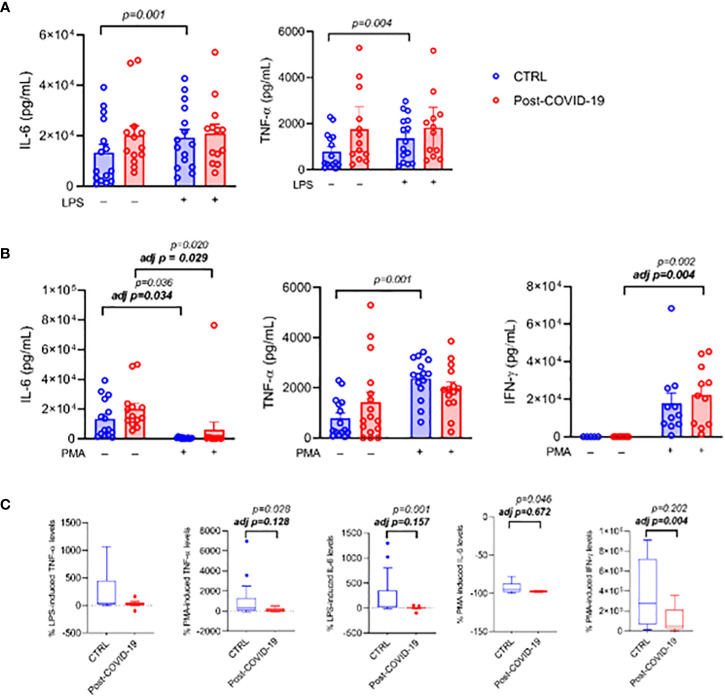
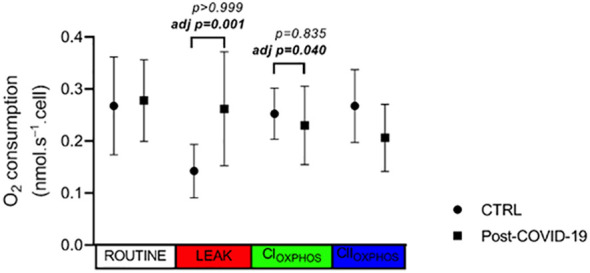
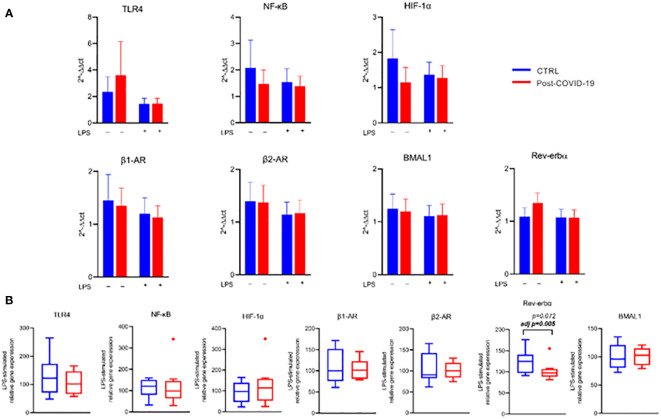
The post-COVID-19 group exhibited lower levels of moderate to vigorous physical activity (MVPA) (p = 0.038); therefore, all study comparisons were performed with adjustment for MVPA. Post-COVID-19 impacted the pulmonary function (FEV1, FEV1%pred, FVC, and FVC %pred) compared with the control (p adjusted by MVPA (p adj) <0.05). Post-COVID-19 exhibited lower levels of serum IL-6 (p adj <0.01), whereas it showed higher serum IL-10, triglyceride, leptin, IgG, ACE activity, TNFRSF1A, and PGE (p adj <0.05) levels compared with controls. Post-COVID-19 presented a lower percentage of Treg cells (p adj = 0.03) and altered markers of lymphocyte activation and exhaustion (lower CD28 expression in CD8 T cells (p adj = 0.014), whereas CD4T cells showed higher PD1 expression (p adj = 0.037)) compared with the control group. Finally, post- COVID-19 presented an increased LPS-stimulated whole- blood IL-10 concentration (p adj <0.01). When exploring mitochondrial respiration and gene expression in PBMCs, we observed a higher LEAK state value (p adj <0.01), lower OXPHOS activity (complex I) (p adj = 0.04), and expression of the Rev-Erb-α clock mRNA after LPS stimulation in the post-COVID-19 patients than in the control (p adj <0.01). Mainly, PAL was associated with changes in IL-10, triglyceride, and leptin levels in the plasma of post-COVID-19 patients. PAL was also associated with modulation of the peripheral frequency of Treg cells and the expression of PD-1 in CD8+ T cells, although it abrogated the statistical effect in the analysis of TNF-α and IL-6 production by LPS- and PMA-stimulated PBMC of post-COVID-19 patients.
Young adults after mild-to-moderate SARS-CoV-2 infection appeared to have lower physical activity levels, which can be associated with clinical and immunometabolic responses in a complex manner.
本研究旨在评估轻度至中度 COVID-19 后年轻成年人的身体活动是否与全身和细胞免疫代谢反应相关。
轻度至中度 COVID-19 后患者(诊断后 70.50±43.10 天;年龄:29.4(21.9-34.9)岁;BMI:25.5±4.3kg/m ² ,n=20)和健康年龄匹配的对照组(年龄:29.3(21.2-32.6)岁;BMI:25.4±4.7kg/m ² ,n=20)进行了评估。评估了身体活动水平(PAL)、身体成分、饮食习惯、肌肉和肺功能、心理健康、睡眠质量、代谢参数、免疫表型特征、刺激全血和 PBMC 培养(细胞因子产生)、PBMC 中的 mRNA 和线粒体呼吸。
COVID-19 组表现出较低水平的中等到剧烈体力活动(MVPA)(p=0.038);因此,所有研究比较均进行了 MVPA 调整。与对照组相比,COVID-19 对肺功能(FEV1、FEV1%pred、FVC 和 FVC%pred)产生了影响(p 调整后由 MVPA (p adj )<0.05)。与对照组相比,COVID-19 组血清 IL-6 水平较低(p adj <0.01),而血清 IL-10、三酰甘油、瘦素、IgG、ACE 活性、TNFRSF1A 和 PGE 水平较高(p adj <0.05)。与对照组相比,COVID-19 组 Treg 细胞的百分比较低(p adj =0.03),淋巴细胞激活和衰竭的标志物发生改变(CD8 T 细胞中 CD28 表达降低(p adj =0.014),而 CD4 T 细胞中 PD1 表达升高(p adj =0.037))。最后,COVID-19 患者的 LPS 刺激全血 IL-10 浓度升高(p adj <0.01)。当探索 PBMC 中的线粒体呼吸和基因表达时,我们观察到 COVID-19 患者在 LPS 刺激后 LEAK 状态值较高(p adj <0.01),氧化磷酸化(复合物 I)活性较低(p adj =0.04),时钟 mRNA Rev-Erb-α 的表达增加,而对照组则没有(p adj <0.01)。主要是,PAL 与 COVID-19 患者血浆中 IL-10、三酰甘油和瘦素水平的变化相关。PAL 还与外周 Treg 细胞频率和 CD8+T 细胞中 PD-1 表达的调节有关,尽管它在分析 COVID-19 患者 LPS 和 PMA 刺激的 PBMC 产生 TNF-α和 IL-6 时削弱了统计学效应。
轻度至中度 SARS-CoV-2 感染后的年轻成年人似乎身体活动水平较低,这可能与复杂的临床和免疫代谢反应有关。