Epidemiology Unit and Girona Cancer Registry, Institut de Recerca Contra la Leucèmia Josep Carreras, 17004 Girona, Spain.
Epidemiology Unit and Girona Cancer Registry, Institut Català d'Oncologia, Pla Director d'Oncologia, 17004 Girona, Spain.
Int J Environ Res Public Health. 2021 Dec 16;18(24):13269. doi: 10.3390/ijerph182413269.
The recent COVID-19 pandemic has compromised socio-health care, with consequences for the diagnosis and follow-up of other pathologies. The aim of this study was to evaluate the impact of COVID-19 on cancer diagnosis in Girona, Spain.
Observational study of samples received in two pathology laboratories during 2019-2020 (tertiary hospital in Girona and county hospital in Figueres). Date, sample type, and location and morphology were available. Samples were recoded to determine malignancy and grouped by location. Comparisons were made by calendar year and period of exposure to COVID-19.
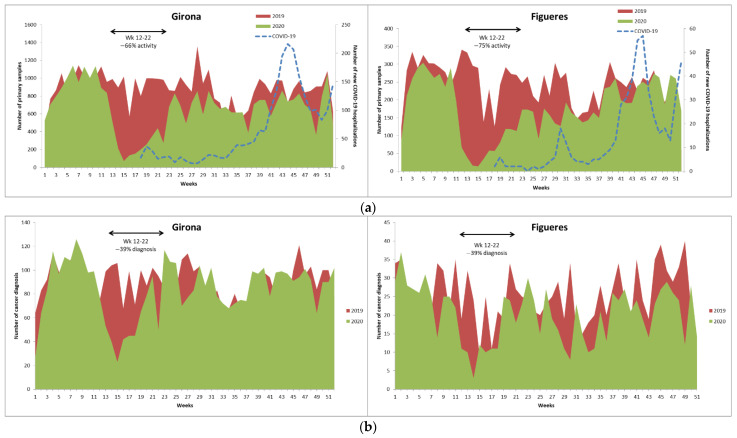
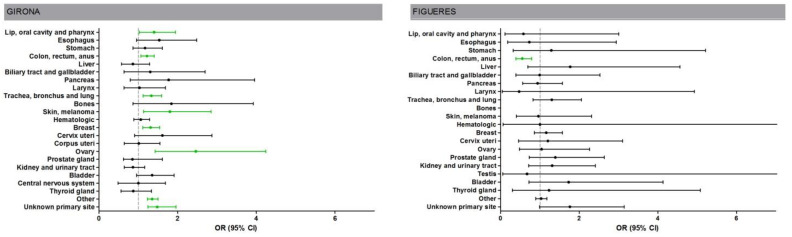
102,360 samples were included: 80,517 from Girona and 21,843 from Figueres. The reduction in activity in the pathology laboratories in 2020 compared to the previous year was 25.4% in Girona and 27.5% in Figueres. The reduction in cancer diagnoses in 2020 compared to 2019 was 6.8% in Girona and 21% in Figueres. In both laboratories, a decrease was observed in the diagnoses of neoplasms of the lip, oral cavity and pharynx, larynx, colon, rectum and anus, kidney and urinary system, melanoma, and central nervous system. A statistically significant higher probability of a sample received in the pathology laboratory displaying malignancy during COVID-19 was found (Girona: OR = 1.28, 95% CI: 1.23-1.34; Figueres: OR = 1.10, 95% CI: 1.01-1.20) with respect to the COVID-19-free period.
The COVID-19 pandemic has resulted in a reduction in cancer diagnoses by pathology departments that varies according to tumor location and type of hospital. Despite this, the optimization of care resources and the recovery effort have partially reduced the impact of the pandemic in certain neoplasms.
最近的 COVID-19 大流行影响了社会健康护理,对其他疾病的诊断和随访产生了影响。本研究旨在评估 COVID-19 对西班牙赫罗纳癌症诊断的影响。
对 2019-2020 年期间两家病理实验室接收的样本进行观察性研究(赫罗纳的一家三级医院和菲格雷斯的一家县医院)。可用的样本包括日期、样本类型、位置和形态。对样本进行重新编码以确定恶性程度,并按位置分组。通过日历年度和接触 COVID-19 的时间段进行比较。
共纳入 102360 例样本:来自赫罗纳的 80517 例和来自菲格雷斯的 21843 例。与前一年相比,2020 年两家病理实验室的活动减少了 25.4%,在赫罗纳和菲格雷斯分别为 27.5%。与 2019 年相比,2020 年癌症诊断减少了 6.8%,在赫罗纳和菲格雷斯分别为 21%。在两家实验室中,都观察到唇、口腔和咽、喉、结肠、直肠和肛门、肾脏和泌尿系统、黑色素瘤和中枢神经系统的肿瘤诊断减少。在 COVID-19 期间,病理实验室收到的显示恶性肿瘤的样本的可能性显著增加(赫罗纳:OR = 1.28,95%CI:1.23-1.34;菲格雷斯:OR = 1.10,95%CI:1.01-1.20)。
COVID-19 大流行导致病理科癌症诊断减少,其变化与肿瘤位置和医院类型有关。尽管如此,对护理资源的优化和恢复努力部分减轻了大流行对某些肿瘤的影响。