UOC Psichiatria, Azienda Ospedaliera Universitaria Integrata (AOUI) di Verona, Policlinico 'G.B. Rossi', P.le Scuro 10, 37134 Verona, Italy.
Section of Psychiatry, Department of Neuroscience, Biomedicine and Movement Sciences, University of Verona, 37129 Verona, Italy.
Int J Environ Res Public Health. 2021 Dec 19;18(24):13374. doi: 10.3390/ijerph182413374.
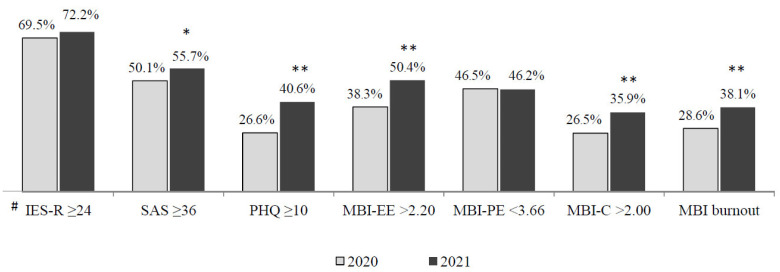
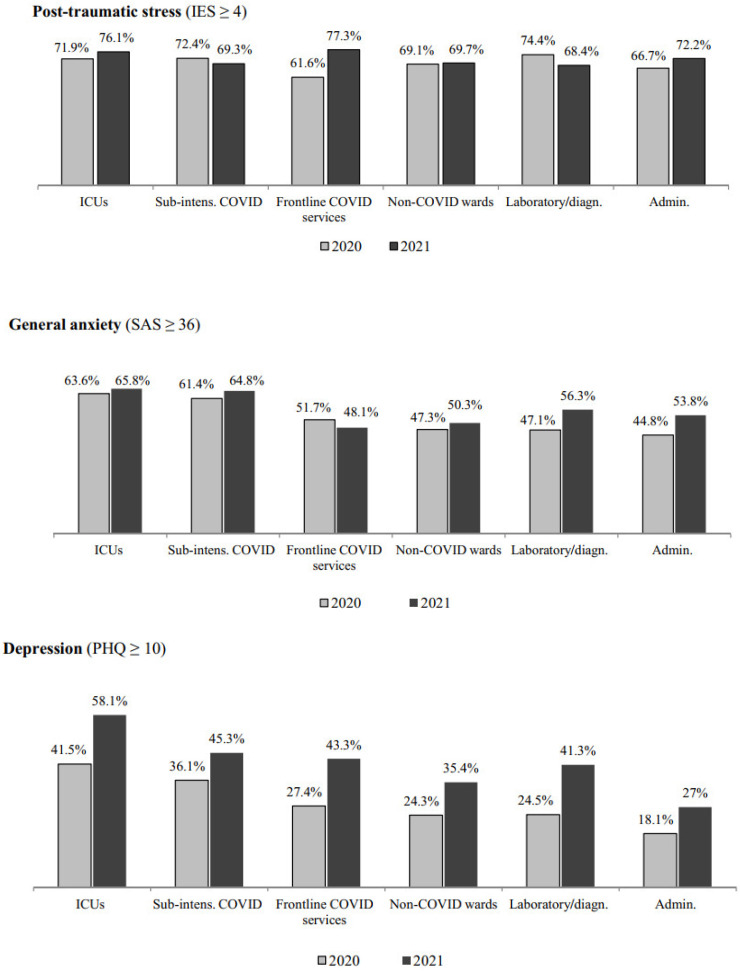
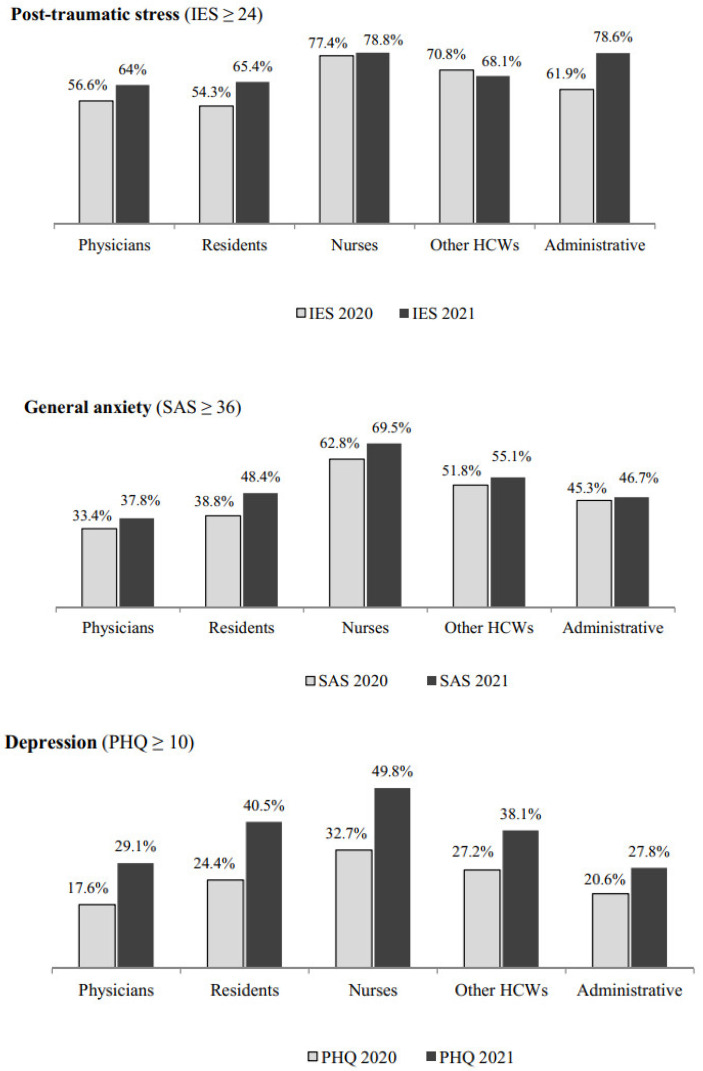
This study aimed to evaluate the mental health outcomes of health care workers (HCWs) of the Verona academic hospital trust (Italy) one year after the outbreak of COVID-19 and to identify predicted risk factors. A web-based survey was conducted from mid-April to mid-May 2021 on hospital workers one year after the first evaluation performed during the lock-down phase of the COVID-19 pandemic. Post-traumatic stress, general anxiety, depression, and burnout were assessed by using, respectively, the impact of event scale (IES-R), the self-rating anxiety scale (SAS), the patient health questionnaire (PHQ-9) and the Maslach burnout inventory-general survey (MBI-GS). Multivariate logistic regression analysis was performed to identify factors associated with each of the four mental health outcomes one year after the COVID-19 outbreak. A total of 1033 HCWs participated. The percentage of HCWs scoring above the cut-off increased from 2020 to 2021 in all of the outcome domains (anxiety, 50.1% vs. 55.7, < 0.05; depression, 26.6% vs. 40.6%, < 0.001; burnout, 28.6% vs. 40.6%, < 0.001; chi-square test), with the exception of post-traumatic distress. There was also an increase when stratifying by occupation and workplace, with a greater increase for depression and burnout. Multivariate analysis revealed that, one year after the COVID-19 outbreak, nurses were at the greatest risk of anxiety and depression, whereas residents were at the greatest risk of burnout (in terms of low professional efficacy). Working in intensive care units was associated with an increased risk of developing severe emotional exhaustion and a cynical attitude towards work.
本研究旨在评估意大利维罗纳学术医院信托基金(Verona Academic Hospital Trust)的医护人员(HCWs)在 COVID-19 爆发一年后的心理健康状况,并确定预测风险因素。2021 年 4 月中旬至 5 月中旬,在 COVID-19 大流行封锁阶段首次评估一年后,对医院工作人员进行了一项基于网络的调查。使用创伤后应激障碍影响量表(IES-R)、自我评定焦虑量表(SAS)、患者健康问卷(PHQ-9)和马斯拉赫职业倦怠量表(MBI-GS)分别评估创伤后应激、一般焦虑、抑郁和职业倦怠。采用多变量逻辑回归分析确定 COVID-19 爆发一年后与四种心理健康结果相关的因素。共有 1033 名 HCWs 参与了调查。在所有结果领域(焦虑症:50.1%比 55.7%, < 0.05;抑郁症:26.6%比 40.6%, < 0.001;职业倦怠:28.6%比 40.6%, < 0.001),除创伤后应激障碍外,2020 年至 2021 年,得分高于临界值的 HCWs 比例均有所增加(卡方检验)。按职业和工作场所分层时,这种情况也有所增加,抑郁和职业倦怠的增加幅度更大。多变量分析显示,COVID-19 爆发一年后,护士患焦虑症和抑郁症的风险最大,而住院医师患职业倦怠(表现为专业效能低下)的风险最大。在重症监护病房工作与发生严重情绪疲惫和对工作持愤世嫉俗态度的风险增加有关。